Prayagraj (Allahabad) Travel Guide: Sacred Sangam, Kumbh Mela & Complete City Exploration
Last Updated on
14/01/2026
This Prayagraj Travel Guide takes you deep into one of India’s most ancient and spiritually powerful cities. Nestled in the heart of Uttar Pradesh, Prayagraj—formerly known as Allahabad—is not merely a destination, but a living archive of Indian civilisation.
At the sacred Triveni Sangam, where the rivers Ganga and Yamuna meet the invisible Saraswati, faith, history, and culture flow together uninterrupted for thousands of years. From timeless Vedic rituals and Puranic legends to Mughal architecture, colonial heritage, and modern pilgrimage tourism, this travel guide to Prayagraj explores every layer of the city’s soul in a clear, practical, and immersive way. before exploring prayagraj visit my india travel guide for first-time travellers-visas & 20 day itinerary ithelps you understand India
- Prayagraj Travel Guide: History, Mythology & Civilisational Roots
- 🏰 Mughal Influence: From Courts to Architecture
- British Influence: The Colonial Legacy(1801–1947)
- Prayagraj Travel Guide: Modern Prayagraj and Urban Transformation
- 🕉️ Ganga Ghat Rituals: The Flow of Faith
- 🌊 Triveni Sangam Rituals: The Quest for Liberation
- Boat Journey to Sangam
- Optimal Times for Sangam Bathing
- 🎪 Major Festivals and Gatherings
- Extraordinary Spectacles
- 🔱 Procession of the Naga Sadhus
- 🕉️ The First Sacred Dip at the Sangam
- 🧘 Sant Sammelans – Assemblies of Wisdom
- 🎶 Cultural Performances and Sacred Arts
- 🌍 Global Pilgrimage and Curiosity
- ✨ Narrative Essence (One Line)
- 🏕️ The Tent City Rising from the Plains
- 🏥 Medical Camps of Compassion
- 🔎 Lost and Found Centres of Hope
- 🍲 Langar – Kitchens Without Boundaries
- 🌉 Bridges That Appear and Disappear
- ✨ Narrative Essence
- Next Ardh Kumbh Mela: 2031(Every 6 Years)
- 🕯️ Kalpawas – A Month of Sacred Commitment
- 🌅 Dawn Bath in Winter Waters
- 🍚 The Discipline of a Single Satvik Meal
- 🧘 Hours of Puja, Meditation, and Mantra
- 📖 Pravachans – Learning at the Feet of Wisdom
- 🌤️ Afternoons of Rest and Reflection
- 🪔 Evening Sandhya Aarti at the Ghats
- 🕰️ Early Sleep, Complete Renunciation
- 🏕️ Organised Living in a Temporary City
- 🏥 Care, Food, and Essential Services
- ✨ Narrative Essence
- Additional Festivals:
- 🛕Prayagraj Travel Guide: Top Attractions & Must-Visit Places
- 🧠 One-Line Conceptual Meaning
- Where to Stay: Civil Lines vs. Old City
- Excursions: Best Day Trips
- 🌤️ Best Time to Visit Allahabad (Prayagraj)
- 🚆 How to Reach Allahabad (Prayagraj)
- ⏳ How Much Time Is Required
- 🗓️ Two-Day Itinerary for Prayagraj
- 🛡️ Safety Checklist for Sacred Destinations
- 🎒 Safety Tips for Solo Travellers
- 🔁 The Sacred Triveni Circuit: Ayodhya – Prayagraj – Varanasi
- 🌺 Conclusion: Prayagraj as the Living Core of Indian Civilisation
- Official References
- Related Posts
- FAQs About Allahabad Travel Guide 2026
- ❓ What is Prayagraj famous for?
- ❓ Is Prayagraj worth visiting for tourists?
- ❓ What is the best time to visit Prayagraj?
- ❓ How many days are enough to explore Prayagraj?
- ❓ What is included in a Prayagraj Travel Guide for first-time visitors?
- ❓ Is Prayagraj safe for solo travellers and foreign tourists?
- ❓ Why is Prayagraj important in Hindu pilgrimage?
- Start Planning your trip now
Prayagraj Travel Guide: History, Mythology & Civilisational Roots
Mythological Narratives:
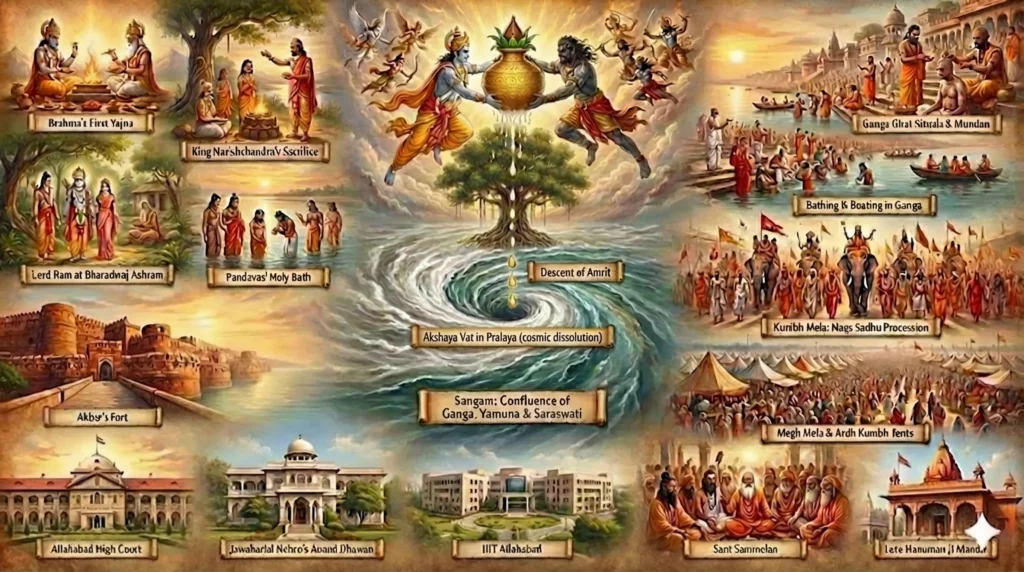
Ancient Puranic texts proclaim Prayagraj as “Tirth-Raj” – the king of all pilgrimage sites. The Matsya Purana, Padma Purana, and Vayu Purana contain extensive references to this sacred location, establishing its unparalleled spiritual importance in Hindu cosmology.
The city’s spiritual essence flows from celestial events chronicled in sacred texts. According to Puranic accounts, Lord Brahma performed the first cosmic ritual here following the creation of the universe. The very name “Prayag” derives from “Pra” (excellent) and “Yaag” (sacrifice), signifying the site of the ultimate sacred offering.
The Dashashwamedh Ghat carries the legacy of King Harishchandra, who performed the legendary ten horse sacrifices at this very location. Near the Sangam stands the Akshayavat, an immortal banyan tree mentioned in both the Ramayana and Mahabharata, believed to be indestructible even during cosmic dissolution.
Ramayana and Mahabharata Connections
Ramayana Period: During their forest exile, Lord Rama, Sita, and Lakshmana rested at Sage Bharadwaj’s ashram, which still exists today as a revered pilgrimage site. The sage guided them towards Chitrakoot, making this a crucial waypoint in their spiritual journey.
Mahabharata Era: The Pandavas visited this sacred confluence during their period of anonymity. Ancient scriptures proclaim that bathing in these holy waters absolves all sins and purifies the soul, a belief that has endured for thousands of years.
Triveni Sangam: The Divine Confluence of Three Rivers

The Triveni Sangam represents the meeting point of three mighty rivers, each symbolising distinct spiritual qualities. The Ganga flows with its characteristic white-grey hue, representing purity and moksha. The Yamuna brings its distinctive blue-green colour, embodying maternal compassion. The Saraswati, though invisible to the physical eye, represents knowledge and wisdom flowing beneath the visible waters.
Puranic traditions assert that bathing at this sacred confluence during auspicious times grants moksha (liberation from the cycle of rebirth) and cleanses all karmic debts accumulated across lifetimes.
🏰 Mughal Influence: From Courts to Architecture
In 1575 CE, Emperor Akbar established Mughal administration in Prayag, recognising its spiritual importance and strategic location.
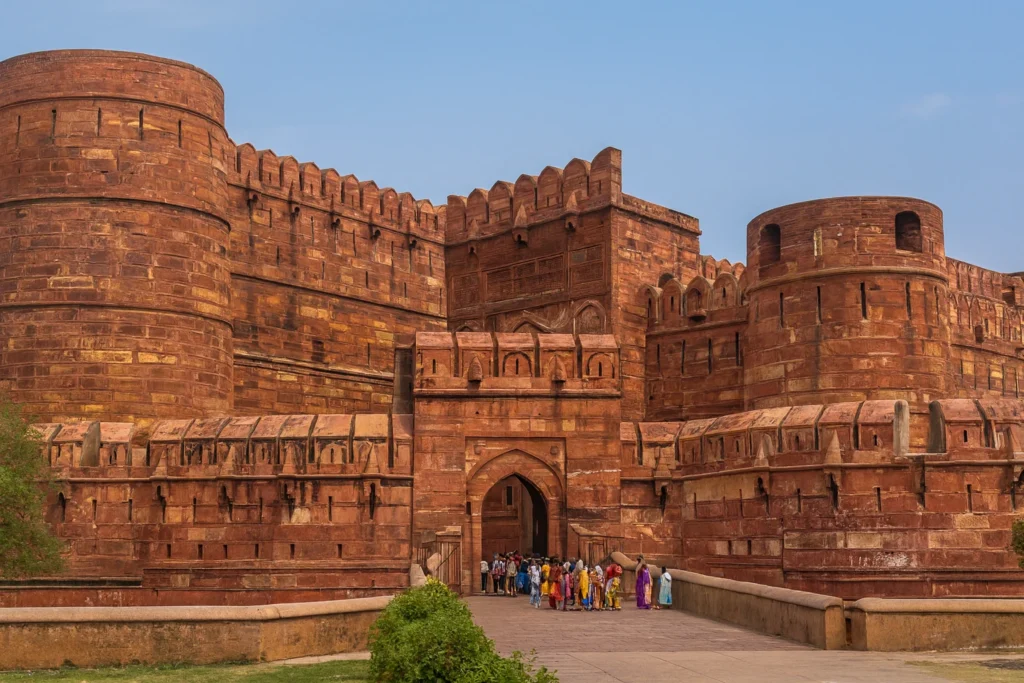
The Allahabad Fort (1583) symbolised Mughal authority while enclosing sacred sites like the Ashoka Pillar, Akshayavat, and Saraswati Koop.
Khusro Bagh (1622) reflected refined Mughal aesthetics through symmetry, gardens, and sandstone mausoleums.
Akbar renamed the city Ilahabas and strengthened revenue systems and trade routes, integrating it into the Mughal empire.
Under Shah Jahan, Persian artistic elements blended with indigenous craftsmanship, enriching local architecture.
Even during Aurangzeb’s rule, mosque construction continued, preserving the layered Mughal legacy of Prayag.
British Influence: The Colonial Legacy(1801–1947)
From 1801, a treaty with the Nawab of Awadh brought Allahabad under British rule, reshaping its political, legal, and urban character. The city played a key role in the 1857 uprising under Maulvi Liaquat Ali, later marked by colonial symbols such as All Saints Cathedral and the neo-classical Allahabad High Court. The establishment of Muir Central College in 1887, along with Anand Bhawan, transformed Allahabad into a centre of education, nationalism, and freedom leadership. Colonial infrastructure, Hindi journalism, Congress sessions, and Gandhian movements collectively embedded the city at the heart of India’s independence struggle.
Prayagraj Travel Guide: Modern Prayagraj and Urban Transformation
In October 2018, the restoration of the name Prayagraj reaffirmed the city’s ancient spiritual identity while reflecting its modern evolution. Under the Smart City Mission, Wi-Fi zones around the Sangam and smart surveillance have improved safety and digital connectivity. Allahabad University, along with IIT Prayagraj, IIIT Allahabad, and MNNIT, has strengthened the city’s role as a major academic hub. As the seat of the Allahabad High Court, Prayagraj continues as Uttar Pradesh’s judicial capital. Upgraded ghats, hotels, river cruises, improved transport links, airport expansion, new bridges, proposed metro lines, and ring roads together highlight balanced urban growth.
🕉️ Ganga Ghat Rituals: The Flow of Faith
Principal Ghats and Their Associated Rituals:
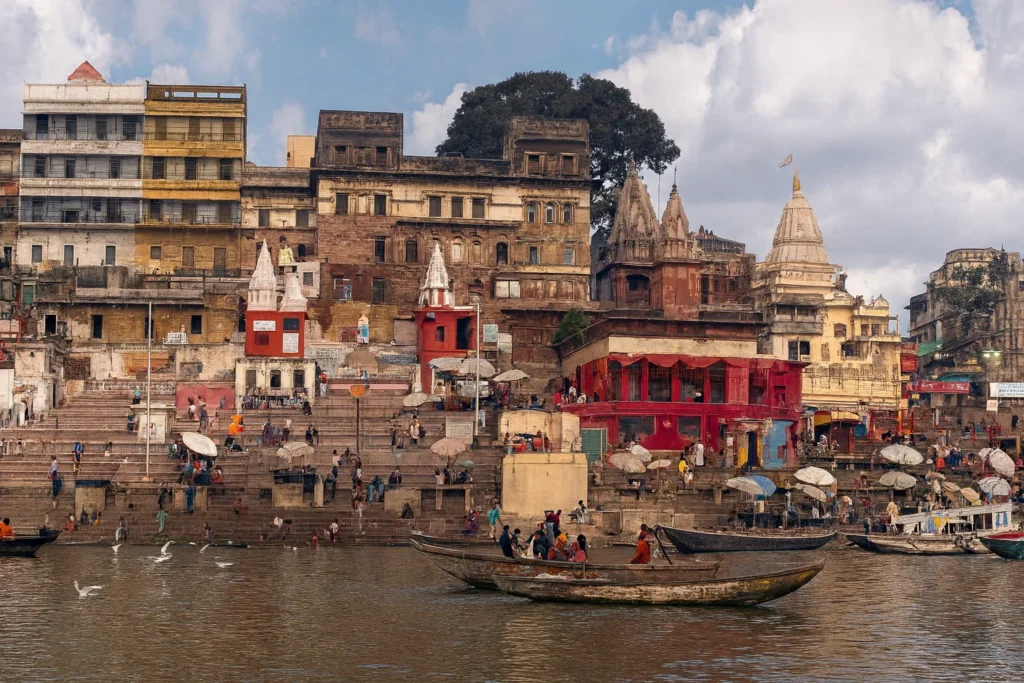
Dashashwamedh Ghat Dawn breaks around 4 AM when devotees begin their sacred ablutions during Brahma Muhurat, the most auspicious period before sunrise. Practitioners perform Surya Namaskar sequences and yoga whilst pandits conduct elaborate yajnas, with offerings made to the sacred fire accompanied by Vedic chants that echo across the water.
Saraswati Ghat This ghat holds particular significance for students and scholars. During Basant Panchami, a grand celebration honours Saraswati, the goddess of learning. Devotees donate books and perform special pujas seeking blessings for academic success and artistic excellence.
Nagvasuki Ghat On Nag Panchami, devotees gather to worship serpent deities with offerings of milk and flowers. The ancient reverence for nagas (serpent beings) as protectors and symbols of cosmic energy finds expression in these time-honoured rituals.
Gau Ghat The tradition of go-daan (cow donation) and feeding cows continues at this ghat, reflecting the sacred status of cattle in Hindu cosmology. Acts of compassion towards these gentle creatures are believed to generate spiritual merit.
Daily Ritual Practices:
Morning Hours (4–7 AM)
Before sunrise, devotees bathe in the icy waters of the Ganga, believing it cleanses body and soul. Standing in the river, they offer arghya to the rising sun while chanting ancient mantras. Quiet meditation and small aartis create an atmosphere of deep spiritual stillness.
Evening Hours (5–7 PM)
As dusk approaches, the Ganga Aarti illuminates the ghats with rhythmic flames and devotional chants. Priests perform synchronised rituals with brass lamps while devotees release floating diyas carrying prayers downstream. The sound of bells and sacred fires fills the air with reverence.
Special Observances
Mondays are marked by Shiv Abhishek using Ganga water, while full moon nights host Satyanarayan Katha. Amavasya is dedicated to Pitru Tarpan for ancestors, and Ekadashi involves fasting and intensified spiritual discipline.
“Practical Information”
Cultural Note: The Pandas of Prayag At the Sangam, you will meet priests known as ‘Pandas’. They maintain massive genealogical records (Bahi Khata) of families going back centuries. While this is fascinating, some can be aggressive in asking for donations (Dakshina).
- Tip: It is okay to politely say “No” and keep walking. If you wish to donate, a small amount (₹100-₹200) is respectful and sufficient. Do not feel pressured into paying large sums.
Traditional Practices Preserved Through Generations:
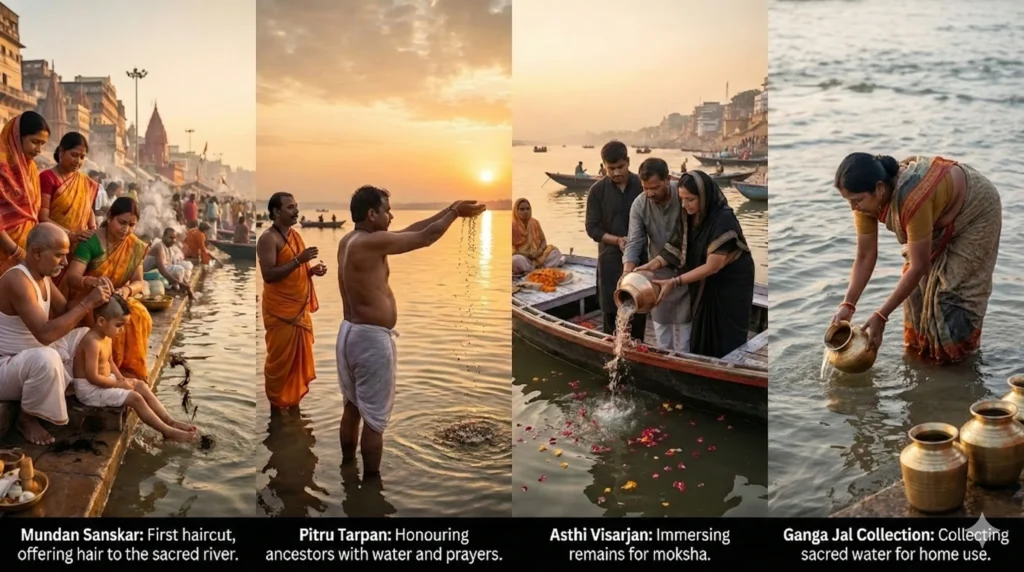
Mundan Sanskar Families bring young children for their first haircut, a significant rite of passage. The shaved hair is offered to the sacred river, symbolising the removal of past life karma and a fresh spiritual beginning.
Pitru Tarpan Descendants honour their ancestors by offering water mixed with sesame seeds and prayers, ensuring the peaceful journey of departed souls and maintaining the sacred bond between generations.
Asthi Visarjan Cremated remains are immersed in the Ganga, completing the final rites. Families believe this ensures their loved ones achieve moksha, liberation from the cycle of rebirth.
Ganga Jal Collection Pilgrims carefully collect sacred Ganga water in sealed containers, transporting it to distant homes where it is preserved for years, used in religious ceremonies, given to the dying, and treasured as a tangible connection to the divine.
🌊 Triveni Sangam Rituals: The Quest for Liberation
The Sacred Bathing Protocol:
Pilgrims prepare with clean, preferably new clothes, packing extra garments and towels in waterproof bags. A small amount of money is kept aside for dakshina to priests. Mental purity and readiness are considered as important as physical preparation.
The Bathing Sequence
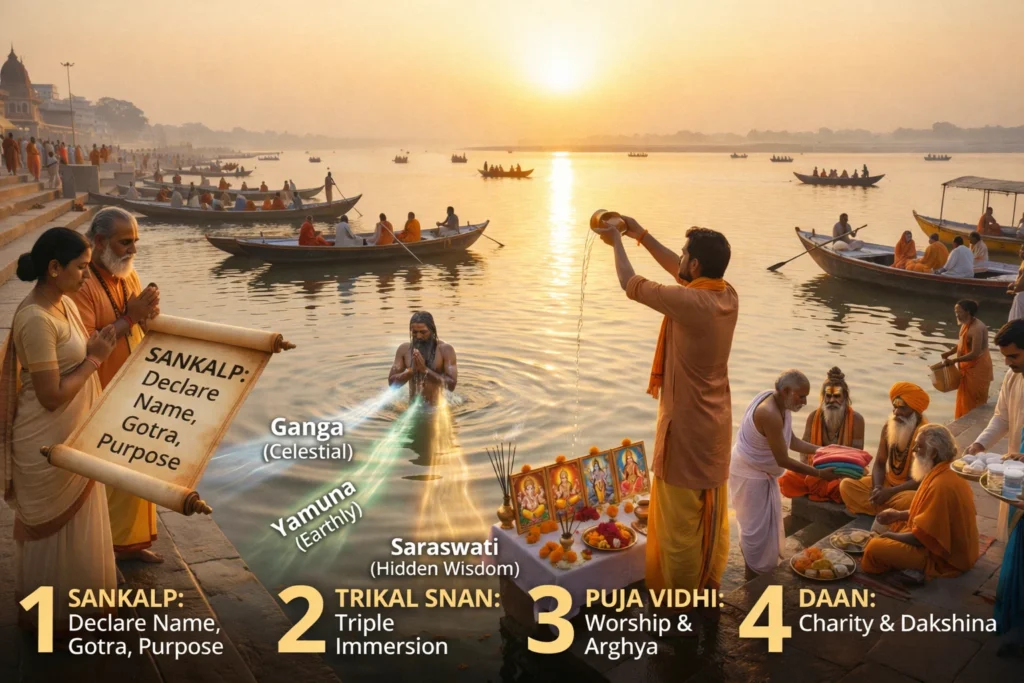
Step One – Sankalp (Sacred Intention)
Before entering the river, a pandit guides devotees through sankalp, where they declare their name, gotra, and rashi. The spiritual purpose—health, prosperity, spiritual growth, or liberation—is clearly stated with focused intent.
Step Two – Trikal Snan (Triple Immersion)
The ritual involves three complete immersions: first in the Ganga, honouring the celestial descent; second in the Yamuna, symbolising earthly devotion; and finally at the Sangam, where the invisible Saraswati represents hidden wisdom. Each immersion is performed with prescribed mantras.
Step Three – Puja Vidhi (Worship Procedure)
After bathing, devotees worship Ganga Maiya with flowers and incense and offer arghya to Surya Deva. Panch Dev Puja follows, honouring Ganesha, Surya, Vishnu, Shiva, and Devi as embodiments of cosmic balance.
Step Four – Daan (Charitable Giving)
The ritual concludes with charity through clothing donations, food offerings, and dakshina to priests. These acts are believed to amplify the spiritual merit earned through the sacred bath.
Step Five – Prasad Distribution
Pilgrims collect Ganga water in sealed containers and distribute prasad among family and friends. This act symbolically extends the blessings to those unable to undertake the pilgrimage.
Boat Journey to Sangam
Operating Hours and Logistics
Boats operate from 5 AM to 6 PM, weather permitting. Government boats charge nominal fees, private boats cater to groups, and luxury boats offer enhanced comfort at higher rates.
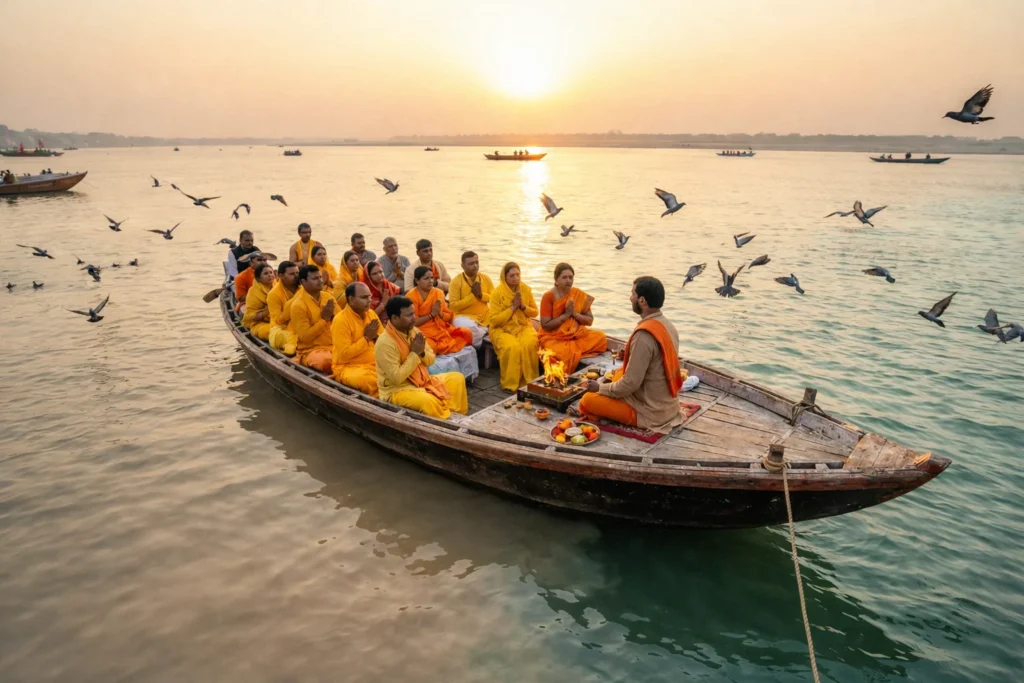
The Journey Experience
The forty-five-minute journey from Saraswati Ghat reveals the confluence of three differently coloured rivers. Boatmen narrate sacred legends, while onboard pandits conduct brief pujas. Feeding grains to pigeons is considered a gesture of peace and harmony.
Optimal Times for Sangam Bathing
Dawn Immersion (5–7 AM)
Sunrise is regarded as highly auspicious, as the first solar rays are believed to intensify the spiritual potency of the waters. This time is favoured by dedicated spiritual practitioners.
Amrit Bela (3–6 AM)
On sacred days, the pre-dawn Amrit Bela attracts large crowds. The stillness and darkness before sunrise are believed to concentrate spiritual energy, enhancing ritual effectiveness.
Sacred Bathing Festivals
Makar Sankranti marks the sun’s northward journey, Mauni Amavasya emphasises silence and inner transformation, and Basant Panchami celebrates spring and the worship of Saraswati.
Kumbh and Ardh Kumbh
During these grand events, Shahi Snan days draw millions of pilgrims. Processions led by ash-smeared Naga sadhus reflect the continuity of ancient ascetic traditions.
Safety Precautions
Life jackets are mandatory on boats, and children must be closely supervised. Strong currents and deep waters at the Sangam require caution, especially for non-swimmers. Valuables should be secured in waterproof covers, and group travel is advised for safety.
🎪 Major Festivals and Gatherings
Next Maha Kumbh: 2037 (January-February) (Every 12 Years)
Historical and Spiritual Foundations According to Hindu mythology, during the churning of the cosmic ocean (Samudra Manthan), drops of the nectar of immortality (amrit) fell at four locations on earth, including Prayagraj. This celestial event established the city as one of four sites for the Kumbh Mela, the others being Haridwar, Ujjain, and Nashik. UNESCO has recognised the Kumbh Mela as Intangible Cultural Heritage of Humanity, acknowledging its significance as the world’s largest peaceful gathering and most ancient continuous religious festival.
🕉️ Prayagraj Kumbh 2037 – Shahi Snan & Parv Snan Dates (Combined Table)
| S. No. | Tithi / Parv | 🔱 Shahi Snan Date (2037) | 🌊 Parv Snan Date (2037) | Remarks (English) |
| 1 | Paush Purnima | — | 30 Dec 2036 | Auspicious opening of the Kumbh period |
| 2 | Makar Sankranti | 14 Jan 2037 | 14 Jan 2037 | Both Shahi and Parv Snan observed |
| 3 | Paush Amavasya | — | 28 Jan 2037 | Dedicated to ancestral rites and purification |
| 4 | Mauni Amavasya | 9 Feb 2037 | 9 Feb 2037 | Most spiritually significant bathing day |
| 5 | Basant Panchami | 14 Feb 2037 | 14 Feb 2037 | Associated with Saraswati worship and learning |
| 6 | Maghi Purnima | 24 Feb 2037 (Amrit Snan) | 24 Feb 2037 | Full-moon spiritual culmination |
| 7 | Mahashivratri | 11 Mar 2037 | 11 Mar 2037 | Final sacred bath of the Kumbh |
Extraordinary Spectacles
UNESCO has recognized it as an “Intangible Cultural Heritage of Humanity.”
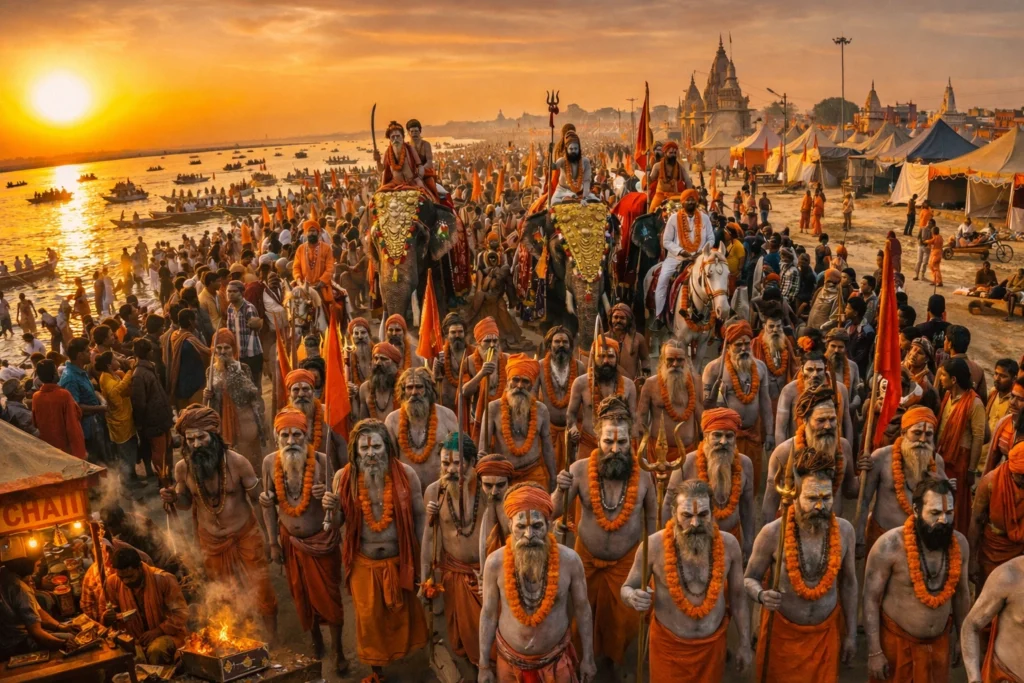
🔱 Procession of the Naga Sadhus
Ash-smeared ascetics from ancient akharas march towards the Sangam, claiming the sacred waters before all others. Their thunderous chants of “Har Har Mahadev”, tridents raised high, create a living bridge between the modern world and timeless renunciation.
🕉️ The First Sacred Dip at the Sangam
As dawn breaks, thousands of renunciates enter the confluence in perfect ritual order. This moment, heavy with symbolism, marks the spiritual opening of the Kumbh and sets the sacred rhythm for all who follow.
🧘 Sant Sammelans – Assemblies of Wisdom
Spiritual leaders gather beneath vast tents, sharing insights drawn from scripture, experience, and contemplation. Seekers from across the world sit side by side, listening as ancient philosophies are translated into living guidance.
🎶 Cultural Performances and Sacred Arts
Classical music, traditional dance, and devotional storytelling unfold across the mela grounds. These performances transform faith into rhythm and movement, allowing spirituality to be felt as much as understood.
🌍 Global Pilgrimage and Curiosity
Visitors from distant nations arrive, drawn by the sheer scale and mystery of the Kumbh. What begins as curiosity often deepens into quiet awe, as they witness a tradition not preserved in museums, but lived in full flow.
✨ Narrative Essence (One Line)
The Kumbh is not merely observed—it is experienced, where devotion becomes spectacle and history breathes in the present.
Infrastructure and Facilities
🏕️ The Tent City Rising from the Plains
From empty riverbanks, a vast temporary city takes shape almost overnight. From modest shelters to air-conditioned luxury tents, it offers every pilgrim a place to rest within this fleeting urban miracle.
🏥 Medical Camps of Compassion
White tents staffed by doctors and nurses stand ready day and night. Free treatment flows quietly here, ensuring that devotion is supported by care and human concern.
🔎 Lost and Found Centres of Hope
Amid the crowds, these centres become islands of reassurance. Separated families are reunited through patient coordination and the quiet determination of volunteers.
🍲 Langar – Kitchens Without Boundaries
Community kitchens serve millions of free meals each day, asking nothing in return. The simple act of sharing food becomes a powerful expression of seva, or selfless service.
🌉 Bridges That Appear and Disappear
Temporary bridges stretch across the rivers, carrying endless streams of pilgrims. Engineered to endure the festival’s weight, they vanish once the gathering ends, leaving no trace behind.
✨ Narrative Essence
At the Kumbh, infrastructure does more than function—it participates, serving faith, humanity, and impermanence in equal measure.
Next Ardh Kumbh Mela: 2031(Every 6 Years)
The Ardh Kumbh (Half Kumbh) functions as a smaller yet substantial version of the Maha Kumbh. Spanning forty-five to fifty-five days, it maintains similar rituals and organisational structures whilst operating at a slightly reduced scale. The 2019 Ardh Kumbh demonstrated India’s capacity for mega-event management, with seamless coordination between government agencies, religious authorities, and civil society organisations.
Magh Mela (Annual)
Duration: Makar Sankranti to Maha Shivratri – 3 January to 15 February 2026 (44 days)
Month-Long Bathing Festival
The Magh Mela transforms the confluence area annually, creating a temporary spiritual city that functions with its own rhythms and rules. Unlike the Kumbh’s infrequent occurrence, the Magh Mela provides an annual opportunity for prolonged spiritual immersion.
Principal Bathing Dates
📅 Magh Mela 2026 – Major Holy Bathing Dates at Prayagraj
| S. No. | Festival / Tithi | Date (2026) | Significance |
| 1 | Paush Purnima | 3 January 2026 | Opening of Magh Mela and Kalpvas; first sacred dip |
| 2 | Makar Sankranti | 14 January 2026 | Harvest festival with auspicious sun transit; major bathing day |
| 3 | Mauni Amavasya | 18 January 2026 | Day of silence and deep spiritual purification |
| 4 | Basant Panchami | 23 January 2026 | Festival of Saraswati and beginnings; devotional bath |
| 5 | Maghi Purnima | 1 February 2026 | Full moon day, key bathing ritual for kalpvasis |
| 6 | Mahashivratri | 15 February 2026 | Concluding sacred bathing day of the Magh Mela |
🕯️ Kalpawas – A Month of Sacred Commitment
Kalpawas calls devotees to pause ordinary life and settle beside the Sangam for an entire month. Living in simple tents, Kalpawaasis embrace discipline, devotion, and quiet endurance as a path to profound spiritual transformation.
🌅 Dawn Bath in Winter Waters
Before sunrise, Kalpawaasis step into the icy river, surrendering comfort to faith. Each cold immersion becomes an act of resilience, believed to cleanse both body and consciousness.
🍚 The Discipline of a Single Satvik Meal
Daily nourishment is reduced to one modest, vegetarian meal. This simplicity trains the mind to detach from excess and remain focused on spiritual purpose.
🧘 Hours of Puja, Meditation, and Mantra
Morning hours unfold in silence, prayer, and repetition of sacred sounds. Within their tents, Kalpawaasis turn inward, cultivating stillness amidst the vast gathering.
📖 Pravachans – Learning at the Feet of Wisdom
Late mornings draw devotees to discourses by saints and scholars. Ancient scriptures are interpreted in living words, offering guidance shaped by experience rather than theory.
🌤️ Afternoons of Rest and Reflection
As the sun rises higher, activity slows. These quiet hours allow the body to recover and the mind to reflect, maintaining balance within the demanding routine.
🪔 Evening Sandhya Aarti at the Ghats
As daylight fades, Kalpawaasis return to the river for the evening aarti. Lamps, chants, and flowing water merge, closing the day in collective reverence.
🕰️ Early Sleep, Complete Renunciation
By nightfall, the tents fall silent. Early sleep completes the cycle of austerity, preparing the body and mind for another day of disciplined living.
🏕️ Organised Living in a Temporary City
Government-allocated tents and private camps transform the riverbanks into a planned settlement. From basic shelters to comfortable amenities, every pilgrim finds a place within this transient city.
🏥 Care, Food, and Essential Services
Free medical camps, community kitchens, and public services operate tirelessly. Post offices, banks, police posts, and help centres ensure that devotion unfolds within a secure and supportive environment.
✨ Narrative Essence
Kalpawas is not merely lived—it is endured, embraced, and finally absorbed, turning one month into a lifetime of inner change.
Additional Festivals:
Ganga Dussehra Mela Celebrated in May-June on Jyeshtha Shukla Dashami, this festival honours the descent of Ganga from heaven to earth. Devotees light thousands of lamps along the ghats, creating a luminous spectacle. Cultural events and special pujas mark the occasion.
Dev Deepawali Following Varanasi’s famous celebration, Prayagraj’s Dev Deepawali occurs on Kartik Purnima in November. Lakhs of earthen lamps illuminate the ghats, creating a breathtaking vista. Special night aartis draw large congregations of devotees.
Shravan Mela Throughout the holy month of Shravan (July-August), Shiva devotees flock to the city. Kanwar yatris (pilgrims carrying holy water) make their way to local Shiva temples. Monday observances during this month attract particularly large crowds.
🛕Prayagraj Travel Guide: Top Attractions & Must-Visit Places
Sacred Sites:
Triveni Sangam ⭐⭐⭐⭐⭐ The confluence represents the city’s spiritual epicenter and primary pilgrimage destination. Optimal visiting time is dawn at 5 AM when the morning light reveals the meeting of different-coloured waters. Entry to the ghat area is free, though boat charges apply separately. Plan two to three hours for the complete experience including bathing rituals and boat journey.
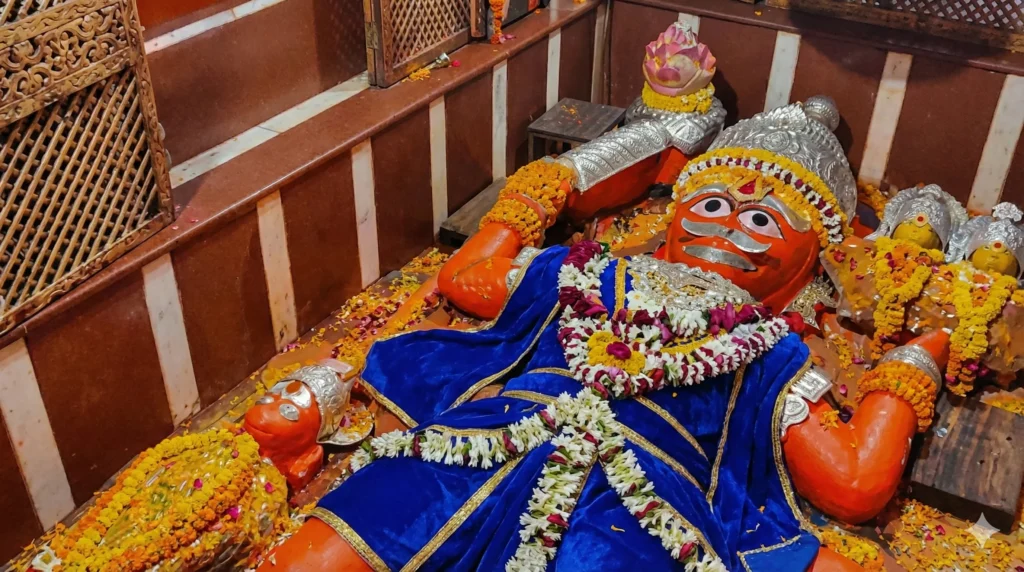
Hanuman Mandir (Bade Hanuman Ji) ⭐⭐⭐⭐⭐ This temple houses a unique reclining Hanuman idol located immediately adjacent to the Sangam. Local belief holds that the deity protects the city during floods, with the murti remaining miraculously safe even when waters rise above danger levels. Morning aarti commences at 5 AM, whilst evening prayers begin at 7 PM.
Mankameshwar Temple Among the city’s most ancient Shiva temples, Mankameshwar contains a self-manifested (swayambhu) Shivling. Located in Civil Lines, the temple experiences particularly heavy attendance during the Shravan month when Shiva devotees flock to offer prayers and perform abhishek.
Alopi Devi Mandir ⭐⭐⭐⭐ Distinctive for having no idol, this temple houses only a wooden yantra (mystical diagram). Recognised as one of the Shakti Peeths (sites where parts of Goddess Sati’s body fell), it attracts devotees seeking blessings from the Divine Mother. Operating hours extend from 5 AM to 10 PM.
Someshwar Mahadev Temple Situated along the Yamuna riverbank, this Shiva temple offers a peaceful environment for worship and meditation, attracting devotees seeking tranquillity away from more crowded sites.
Nagvasuki Temple Dedicated to serpent deities, this temple becomes a focal point during Nag Panchami celebrations when devotees worship with special fervour, offering milk and flowers to the naga Devtas.
Akshayavat (Within Allahabad Fort) The immortal banyan tree stands within the fort’s restricted area, accessible only with special permission during limited periods. The same compound houses the Ashoka Pillar, transported from Pataliputra, bearing inscriptions from Emperor Ashoka’s reign in the 3rd century BCE.
🌳 Pauranic Beliefs Associated with Akshaya Vat, Prayagraj
- The Eternal Tree
Akshaya means imperishable—this banyan tree is believed to survive every Pralaya (cosmic dissolution), standing as a symbol of eternity. - Witness of Repeated Creation Cycles
Puranas describe Akshaya Vat as the silent witness of multiple Kalpas, observing the universe being destroyed and reborn again and again. - Seat of Lord Vishnu
It is believed that Lord Vishnu rested beneath this tree during Pralaya, floating on cosmic waters in his Yog Nidra. - Connection with Narayana Form
Some texts associate the tree with Adi Narayana, representing preservation and balance in the cosmic cycle. - Linked to the Triveni Sangam
Akshaya Vat is considered spiritually connected to the Sangam of Ganga, Yamuna, and Saraswati, amplifying its sacred energy. - Association with Moksha (Liberation)
Ancient belief holds that prayers offered here lead to liberation, especially when combined with Sangam snan. - Referenced in Padma and Matsya Puranas
These Puranas explicitly mention Akshaya Vat as a centre of divine stability during cosmic chaos. - Role in Ancestor Worship
Performing Pind Daan and Pitru Tarpan near Akshaya Vat is believed to grant peace to ancestral souls. - Symbol of Dharma
The banyan’s spreading roots and branches represent Dharma sustaining the world, much like the tree sustains life beneath it. - Protected by Divine Forces
Tradition says that no natural or cosmic force can destroy Akshaya Vat, as it is divinely protected.
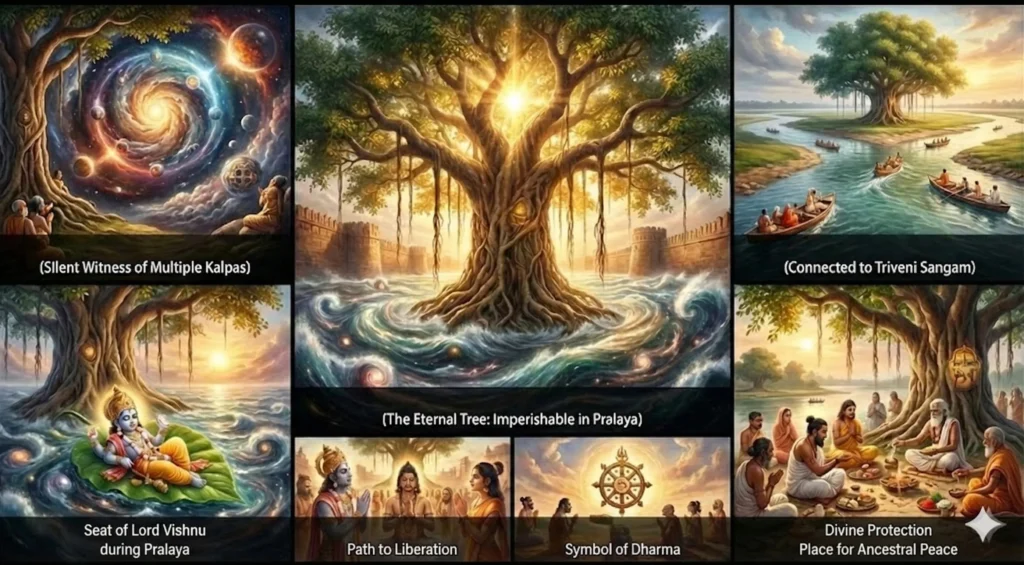
🧠 One-Line Conceptual Meaning
Akshaya Vat represents cosmic continuity—when everything ends, it alone remains.
Historical Monuments:
Allahabad Fort ⭐⭐⭐⭐ Constructed by Emperor Akbar in 1583, this imposing structure showcases Indo-Islamic architectural excellence. Key attractions include the Ashoka Pillar dating to 232 BCE, the mysterious Saraswati Koop (well), Patalpuri Temple, and Akbar’s baoli (stepwell). Portions of the fort remain under military control, but accessible areas operate from 8 AM to 6 PM.
Khusro Bagh ⭐⭐⭐⭐ This walled garden complex contains three magnificent Mughal mausoleums. The intricate sandstone architecture, geometric garden layout, and historical significance make it a photographer’s paradise. Morning and evening light provide optimal conditions for capturing the structures’ beauty. Entry fees range from ten to twenty rupees.
Anand Bhawan ⭐⭐⭐⭐⭐ The ancestral home of the Nehru family now functions as a museum preserving India’s independence struggle. Original furniture, personal belongings, letters, and photographs document the lives of Motilal Nehru, Jawaharlal Nehru, and Indira Gandhi. Adults pay ten rupees entry, students five rupees. Operating hours are 9:30 AM to 5 PM; the museum closes Mondays. Adjacent Swaraj Bhawan served as the Congress party’s office during the freedom movement.
Allahabad Museum ⭐⭐⭐ Established in 1931, this museum houses significant collections including terracotta figures from ancient sites, paintings by Nicholas Roerich and Raja Ravi Varma, sculptures, and manuscripts. Entry costs twenty rupees. Opening hours are 10 AM to 5 PM; closed Mondays.
All Saints Cathedral ⭐⭐⭐ Built in 1887, this Gothic architectural masterpiece represents the British colonial period. The cathedral’s soaring spires and stained glass windows create an atmosphere of contemplative beauty. Visitors are welcome free of charge; respectful behaviour and appropriate dress are expected.
Modern Attractions:
Company Bagh (Alfred Park) ⭐⭐⭐ This 133-acre park holds profound historical significance as the site where freedom fighter Chandrashekhar Azad martyred himself in a gunfight with British police in 1931. A statue commemorates his sacrifice. The park offers pleasant walking paths and picnic areas, making it popular for morning exercise and family outings.
Allahabad University ⭐⭐⭐ Established in 1887 as Asia’s fourth-oldest university, the campus features impressive Gothic architecture and heritage buildings. The Senate Hall exemplifies the period’s architectural grandeur. Visitors interested in educational history and colonial architecture find the campus worth exploring.
Khuldabad (Jhunsi) Located across the Yamuna, this area is associated with King Janak, father of Sita in the Ramayana. The region hosts a famous Holi fair and provides insights into rural life and ancient legends.
Bharadwaj Ashram This serene location along the Yamuna riverbank marks the site of Sage Bharadwaj’s hermitage mentioned in the Ramayana. The peaceful environment attracts those seeking meditation and spiritual retreat.
Parks and Recreation:
Chandrashekhar Azad Park Beyond its historical importance, the park provides jogging tracks, children’s play areas, and open spaces for recreation and relaxation.
Minto Park This site marks where the East India Company formally took control in 1857, making it historically significant though modest in size.
Photography Locations: 📸
Sunrise at the Sangam provides the most spectacular photographic opportunity, with golden light illuminating the confluence of three rivers. The view of Allahabad Fort from Yamuna Bridge during evening hours captures the monument’s imposing grandeur against a colourful sky. Khusro Bagh’s sandstone mausoleums offer endless architectural photography possibilities. Chowk’s narrow lanes teem with street life ideal for documentary photography. Alfred Park provides natural settings for landscape and portrait work.
Getting Around: Transport & Costs
Navigating Prayagraj is easy if you know which vehicle to choose.
Prayagraj Travel Guide: Famous Food of Prayagraj
Prayagraj is famous for breakfast. Locals believe in a heavy morning meal.
- Dahi-Jalebi (The Breakfast of Champions): Unlike other cities where Jalebi is a dessert, here it is eaten with fresh curd (Dahi) in the morning. The sourness of the curd cuts the sweetness of the Jalebi.
- Where to try: Hira Halwai in Civil Lines.
- Dehati Rasgulla: A little away from the main city, these are brown, spongy cheese balls that are less sweet than the Bengali version but richer in milky flavour.
- Masala Samosa (No Potato!): In the Loknath Lane (Old City), you get a unique ‘Masala Samosa’ filled with spices and dal, not potatoes. It is tiny, crunchy, and very spicy.
- Lassi: End your meal with a clay cup of thick Lassi (sweetened yoghurt drink) topped with Malai (clotted cream).
- Where to try: Raja Ram Lassi Waala (Since 1890).
- Allahabadi Guava has GI Tag , special taste green out side & red inside must try if it is in season .
Where to Stay: Civil Lines vs. Old City
The city is divided into two distinct zones. Choose based on your comfort level.
- Option A: Civil Lines (Recommended for Foreigners) This is the modern, British-built part of the city. It is clean, has wide roads, and is safe at night.
- Vibe: Quiet, upscale, and full of cafes.
- Hotels: You will find 4-star brands like The Legend, Kanha Shyam, or Grand Continental here.
- Price: ₹4,000 – ₹8,000 ($50 – $100) per night.
- Option B: Near Sangam / Old City Stay here only if you want to be walking distance from the river and don’t mind noise, crowds, and traffic.
- Vibe: Chaotic and intense.
- Hotels: Mostly budget guesthouses and Dharamshalas.
- Price: ₹1,000 – ₹2,500 ($12 – $30) per night.
Excursions: Best Day Trips
If you have an extra day, take a taxi to these nearby gems:
- Sitamarhi (85 km): A stunning temple by the river Ganges, believed to be the spot where Goddess Sita entered the Earth. It is incredibly peaceful and scenic compared to the city.
- Kaushambi (60 km): A must-visit for history buffs. It was one of the greatest cities of ancient India (6th Century BC). You can see the ruins of the Ghoshitarama Monastery where Lord Buddha stayed and preached.
- Vindhyachal (80 km): A powerful Shaktipeeth (Goddess Temple) located on a hill. The drive offers beautiful views of the Gangetic plains.
🌤️ Best Time to Visit Allahabad (Prayagraj)
The most pleasant period to visit is between October and March, when temperatures remain comfortable for sightseeing and river activities. Winter months are especially significant due to the Magh Mela, offering a unique opportunity to witness the city’s spiritual life at its peak.
NAPKIN AI SE BANE
🚆 How to Reach Allahabad (Prayagraj)
Prayagraj is well connected by air, rail, and road. The city’s airport operates regular flights from major Indian hubs, while Prayagraj Junction serves as a key railway node with trains from all parts of the country. National highways and frequent bus services also make road travel convenient.
⏳ How Much Time Is Required
A minimum of two days is ideal to explore the city’s major spiritual and historical landmarks. For a deeper experience—including the Sangam, temples, museums, and cultural sites—three to four days allow a relaxed and more immersive visit.
🗓️ Two-Day Itinerary for Prayagraj
Day 1: Spiritual Core and Ancient Heritage
Morning (6:00–9:00 AM)
Begin the day with a sunrise visit to the Triveni Sangam, where the Ganga, Yamuna, and Saraswati converge. A quiet boat ride followed by a ritual dip sets a serene and reflective tone for the journey.
Late Morning (9:30–12:30 PM)
Proceed to Bade Hanuman Ji Temple, known for its reclining idol, and then visit Akshaya Vat inside the Allahabad Fort complex, a site deeply rooted in Pauranic tradition.
Afternoon (1:00–3:00 PM)
Enjoy a relaxed lunch and rest, allowing time to absorb the morning’s spiritual intensity. This pause is ideal for reflection or journalling.
Evening (4:00–7:00 PM)
Visit Anand Bhawan, the historic residence of the Nehru family, followed by a stroll through Chandrashekhar Azad Park. Conclude the day by witnessing the Ganga Aarti at Arail or Saraswati Ghat.
Day 2: Culture, Learning, and Colonial Legacy
Morning (8:00–10:30 AM)
Explore the Allahabad Museum, which offers insight into art, archaeology, and the freedom movement. Continue to the Allahabad High Court area to observe its grand colonial architecture from outside.
Late Morning (11:00 AM–1:00 PM)
Visit Khusro Bagh, a Mughal-era garden complex, where quiet pathways and tombs narrate stories of imperial history.
Afternoon (2:00–4:00 PM)
After lunch, explore local markets for handicrafts, books, and regional sweets, capturing the everyday rhythm of the city.
Evening (4:30–7:00 PM)
End your journey with a peaceful walk along the riverfront or a short boat ride at dusk, watching the city soften into evening light.
✨ Travel Tip
Prayagraj is best experienced slowly—allowing the river, history, and people to guide your pace.
🛡️ Safety Checklist for Sacred Destinations
✔ Stay alert in crowded ghats, temples, and aarti areas
✔ Follow police, volunteers, and local administration instructions
✔ Avoid deep water and strong river currents; bathe only at safe points
✔ Carry minimal cash; keep valuables in secure, waterproof pouches
✔ Dress modestly and wear comfortable walking footwear
✔ Drink safe water and eat from clean, trusted food stalls
✔ Travel in groups whenever possible, especially early morning or late evening
✔ Keep emergency contacts and location details accessible
🎒 Safety Tips for Solo Travellers
✔ Share your daily plan and live location with a trusted contact
✔ Avoid isolated ghats and lanes, especially after sunset
✔ Keep emergency numbers and accommodation details saved offline
✔ Use registered transport and avoid accepting unsolicited help
✔ Carry minimal luggage and keep valuables close at all times
✔ Choose well-lit, centrally located accommodation
✔ Be cautious near rivers; do not bathe alone in unfamiliar areas
✔ Trust your instincts—step away if a situation feels uncomfortable

🔁 The Sacred Triveni Circuit: Ayodhya – Prayagraj – Varanasi
These three ancient cities lie within easy reach of one another, forming a natural spiritual circuit across eastern Uttar Pradesh. Travelling through them in sequence allows visitors to experience devotion, history, and living tradition without long or exhausting journeys.
Suggested Travel Flow
- Ayodhya → Prayagraj: ~170 km | 4–5 hours by road
- Prayagraj → Varanasi: ~120 km | 3–4 hours by road
Ideal Duration
5 to 6 days offer a balanced pace—two days in Ayodhya, two in Prayagraj, and one to two days in Varanasi.
Why This Circuit Works
Ayodhya introduces the spiritual foundations of devotion, Prayagraj represents ritual and convergence, and Varanasi completes the journey with timeless continuity. Together, they form a seamless pilgrimage and cultural experience rooted in India’s oldest civilisational landscape.
One route, three cities, and thousands of years of living heritage.
🌺 Conclusion: Prayagraj as the Living Core of Indian Civilisation
Prayagraj stands not as a chapter of history, but as its living continuum. From the silent depths of the Triveni Sangam to the thunderous energy of the Kumbh Mela, the city embodies India’s enduring relationship with faith, time, and collective memory. Rituals performed at its ghats are not symbolic recreations—they are the same acts repeated across millennia, linking present generations with those long past.
This Prayagraj Travel Guide reveals how the city functions as a civilisational junction, where Vedic philosophy, Puranic cosmology, Mughal administration, colonial institutions, and modern urban life coexist without rupture. Whether experienced through dawn bathing, temple worship, literary heritage, or everyday street life, Prayagraj offers insight into how India preserves continuity while absorbing change.
Viewed within the broader geography of the subcontinent, Prayagraj forms a crucial axis of India’s sacred and cultural landscape—connecting Ayodhya’s devotion, Varanasi’s timelessness, and the wider pilgrimage networks that span the country. Travellers seeking a deeper understanding of these interconnected traditions can explore this larger framework through The Full Travel Guide to India, which documents India’s spiritual circuits, cultural regions, and living heritage as one integrated journey:
In Prayagraj, the traveller does not simply move through space but through layers of time, belief, and civilisation—where rivers become memory, rituals become history, and history continues to flow.
Official References
1️⃣ Prayagraj District Official Website
All rituals sangam everything about Praygraj
🔗 https://prayagraj.nic.in/tourism/
2️⃣Incredible India
Also for tourism places of prayagraj (Allahbad )
🔗 https://www.incredibleindia.gov.in/en
Related Posts
1️⃣ The Ultimate Indian Festival Calendar 2026: Dates, Rituals, and Itineraries for 24 Major Celebrations
This is ultimate blog here you can search all festivals of India every ritual related to that festival
🔗 https://travelwiseguide.com/indian-festivals-calendar-2026/
2️⃣ Ayodhya Ram Janmabhoomi Darshan:Timings,Significance and Travel Guide
About Ramjanmbhum every keypoint you will get here
🔗 https://travelwiseguide.com/ayodhya-ram-janmabhoomi-darshan-guide/
3️⃣ Varanasi Travel Guide 2025: Famous Ghats, Ganga Aarti & Sacred Vibes
Know the land of Kashi you will be fully aware about Ganga Arti, Darshan timings , food , boating
🔗https://travelwiseguide.com/varanasi-travel-guide-2025/
FAQs About Allahabad Travel Guide 2026
❓ What is Prayagraj famous for?
Prayagraj is famous for the Triveni Sangam, where the rivers Ganga, Yamuna, and the mythical Saraswati meet, making it one of the most sacred pilgrimage cities in India and the primary site of the Kumbh Mela.
❓ Is Prayagraj worth visiting for tourists?
Yes, Prayagraj is worth visiting for tourists interested in spiritual heritage, ancient history, Mughal and colonial architecture, major festivals like Kumbh and Magh Mela, and authentic North Indian culture.
❓ What is the best time to visit Prayagraj?
The best time to visit Prayagraj is from October to March, when the weather is pleasant and major spiritual events such as Magh Mela take place, offering a deeper cultural experience.
❓ How many days are enough to explore Prayagraj?
Two days are sufficient to cover major attractions like the Triveni Sangam, temples, and historical monuments, while three to four days allow a more relaxed and immersive visit.
❓ What is included in a Prayagraj Travel Guide for first-time visitors?
A Prayagraj Travel Guide for first-time visitors typically includes Sangam rituals, temple visits, Kumbh and Magh Mela information, historical sites, food recommendations, accommodation options, and local transport tips.
❓ Is Prayagraj safe for solo travellers and foreign tourists?
Yes, Prayagraj is generally safe for solo travellers and foreign tourists, especially in well-visited areas like Civil Lines and the Sangam, provided basic precautions are followed during crowded festivals.
❓ Why is Prayagraj important in Hindu pilgrimage?
Prayagraj is considered Tirth-Raj (King of Pilgrimages) in Hindu tradition, as bathing at the Triveni Sangam is believed to cleanse sins and grant spiritual liberation (moksha).