Travel Terms Meaning: 20 Expert Secrets to Save Your Money
Last Updated on
12 March 2026

- Phase 1: Planning Your Itinerary and Understanding Travel Terms Meaning
- Decoding Flight Connections: Layovers, Stopovers, and Open-Jaw Tickets Explained
- Phase 2: Accommodation Mastery—Travel Terms Meaning for Hotels and Stays
- Decoding Hotel Meal Plans: The Real Difference Between CP, MAP, AP, and EP
- Phase 3: On-Ground Navigation and Essential Tourism Terminology
- Phase 4:How to Master Hotel Timing & Avoid Costly Booking Mistakes
- The Smart Traveller Challenge
- Official References
- Related Posts
- Conclusion: Master Travel Terms Meaning and Book Like a Professional
- FAQs About Travel Terms Meaning
Imagine this: You’re standing at a luxury resort reception in Goa, heart racing as the manager explains your booking. “Sir, you’ve selected EP, but most guests prefer MAP for the full experience.” The words float around you like foreign currency—confusing and expensive. That sinking feeling when you realise you’ve potentially missed out on something brilliant (or worse, overpaid) simply because travel terms meaning felt like decoding ancient Sanskrit.
I’ve been there.This tourism terminologyguide is born out of my own embarrassing moment in Scottish Highlands . During my first solo trip to there I confidently booked what I thought was a “complete package,” only to discover I’d secured merely a room whilst my fellow travellers enjoyed hearty breakfasts and three-course dinners included in their rates. That embarrassing moment taught me the golden rule: understanding this travel vocabulary for beginners isn’t just helpful- it’s financially as somone with hotel management experience, I’ve decoded the jargon for you .
As someone with hotel management experience and countless miles under my belt, I’ve decoded the travel industry’s secret language. This comprehensive guide will transform you from a confused tourist into a savvy explorer who speaks the industry’s dialect fluently.
💡 Quick Guide: 20 Expert Secrets You’ll Master Today
In this blog, I have shared 20 hidden secrets gleaned from my professional hotel management experience and personal travel disasters—all designed to save you both time and money:
📅 Phase 1: Planning & Timing Secrets
- 1. Buffer Time Strategy: Making proper use of buffer time within your itinerary.
- 2. Shoulder Season Hack: Choosing a cheaper and better time to travel instead of peak season.
- 3. Weather Pattern Research: Planning according to the destination’s specific weather patterns.
- 4. Festival Advance Planning: Preparing early for major events, such as Holi in Mathura.
- 5. Open-Jaw Ticket Advantage: Arriving in one city and departing from another to save time and money.
✈️ Phase 2: Flights & Transit Secrets
- 6. Layover vs Stopover Knowledge: Understanding the crucial 24-hour rule.
- 7. The 90-Minute Connection Rule: Maintaining a safety margin for international flight connections.
- 8. Conquering Jet Lag Strategy: Science-based light exposure and hydration techniques.
- 9. Strategic Connecting Flights: Arranging your connecting flights smartly to avoid delays.
🏨 Phase 3: Accommodation Mastery
- 10. Room Category Awareness: Understanding the real difference between Standard and Deluxe rooms.
- 11. Twin vs Double Bed Distinction: Essential information for couples to avoid awkward check-ins.
- 12. Meal Plan Mastery: Making the right choice between CP, MAP, AP, and EP plans.
- 13. Boutique Hotels vs Homestays: Selecting the accommodation with the right ‘personality’ for your trip.
- 14. Inventory Psychology: The truth behind “Only 2 rooms left” booking alerts.
- 15. Subject to Availability Rule: The reality of requesting early check-ins and late check-outs.
🗺️ Phase 4: On-Ground & Documentation
- 16. FIT Style Independence: The freedom of planning your trip without a travel agent.
- 17. Local Guide Advantage: Utilising local knowledge that outperforms standard GPS.
- 18. Sustainable Footprints: Effective ways to support the local community while travelling.
- 19. Voucher vs Invoice: Avoiding common documentation errors that lead to bureaucratic nightmares.
- 20. No-Show Prevention: The vital importance of communication when facing travel delays.
Phase 1: Planning Your Itinerary and Understanding Travel Terms Meaning

The foundation of every memorable journey begins long before you pack your bags—it starts with understanding the language of travel and crafting a roadmap that works. This is where most travellers either set themselves up for seamless adventures or costly confusion.
Understanding Your Itinerary: More Than Just a Schedule
An itinerary isn’t merely a list of places—it’s your trip’s DNA. During my recent expedition through Rajasthan, I witnessed fellow travellers with loose plans scrambling for last-minute bookings whilst I glided seamlessly from Jodhpur’s blue streets to Udaipur’s golden palaces.
Your itinerary should include:
- Buffer time between locations
- Local festival dates (trust me, Holi in Mathura requires advance planning)
- Weather patterns for each destination
The Shoulder Season Secret: How Timing Impacts Your Tourism Terminology and Budget

Picture this: Kerala’s backwaters in September, just as monsoons retreat. The emerald landscape glistens with fresh rain, tourist crowds have vanished, and accommodation rates drop by 40%. This magical window is called shoulder season when you understand this part of travel terms meaning ,you unlock the sweet spot between peak tourism chaos and complete off-season closures.
Pro insight: I’ve saved hundreds of pounds by timing trips during shoulder seasons. The experience remains authentic, locals are friendlier, and your Instagram photos capture destinations without human barriers.
Decoding Flight Connections: Layovers, Stopovers, and Open-Jaw Tickets Explained

Mastering flight-related hotel booking jargon and transit terms can save you a fortune. Standing in Singapore’s Changi Airport at 3 AM, I finally grasped the travel terms meaning behind layovers and stopovers.”
Mastering flight-related travel terminology can save you a fortune and transform how you navigate the world. Standing in Singapore’s Changi Airport at 3 AM, I finally grasped the travel terms meaning behind layovers and stopovers—a distinction that completely changed my booking strategy.
Understanding Layovers vs Stopovers: The 24-Hour Rule
A layover is any flight connection under 24 hours—perfect for stretching legs, grabbing decent coffee, and making your next connection. Think of those 2-hour waits in Dubai or the 6-hour stretch in Istanbul where you explore the airport’s amenities but can’t officially “visit” the city.
A stopover, however, exceeds 24 hours and opens up entirely new possibilities. This extended break allows you to leave the airport, explore another destination, and essentially add a bonus city to your itinerary without purchasing separate flights.
Pro insight: I’ve turned necessary stopovers into mini-adventures—spending 36 hours exploring Istanbul’s bazaars during a London-Bangkok journey, effectively getting three destinations for the price of two flights.
Connecting Flights: Timing Is Everything
My Amsterdam connecting flight disaster taught me valuable lessons. Missing connections due to tight scheduling isn’t just inconvenient—it’s expensive. Always allow minimum 90 minutes for international connections, especially in busy hubs like Heathrow or Frankfurt.
Essential strategy: Book connecting flights with the same airline alliance when possible. If delays cause missed connections, they’re responsible for rebooking you at no extra cost.
Open-Jaw Tickets: The Clever Traveller’s Hack
Here’s a revelation that transformed my European adventures: open-jaw tickets allow you to fly into one city and depart from another. Instead of backtracking to your original arrival point, you create a linear journey that saves both time and money.
Real example: My planned London-Rome-Athens-London journey became London-Rome, Athens-London, saving £180 and three precious travel days. Combined with strategic connecting flights, this approach maximises exploration time whilst minimising costs.
Perfect for: Multi-city European tours, cross-country American road trips, or any journey where returning to your starting point wastes valuable travel time.
Phase 2: Accommodation Mastery—Travel Terms Meaning for Hotels and Stays

Once your itinerary is locked and transport sorted, the next crucial decision determines where you’ll rest your head each night. Hotel bookings can be a minefield of confusing terminology, and one wrong choice can either drain your budget or leave you cramped in unsuitable spaces. I’ve learned this the hard way, and now I’ll share the insider knowledge that transforms accommodation confusion into confident bookings.
Understanding Room Categories: From Standard Rooms to Deluxe Suites
My Barcelona hotel booking nightmare began with assuming all “double rooms” were identical. Arriving exhausted after a delayed flight, I discovered my “Standard Double” resembled a generous cupboard compared to the “Deluxe Suite” my friends enjoyed next door.
Standard Rooms: Basic accommodation with essential amenities—perfect for budget-conscious explorers who spend minimal time indoors.
Deluxe Rooms: Enhanced space, superior views, and upgraded amenities. During my Swiss Alps retreat, the deluxe room’s mountain vista transformed morning coffee into a meditation experience.
Suites: Separate living areas creating home-like comfort. Essential for longer stays or special occasions where space equals sanity.
TheTwin Room vs Double Room Confusion

This distinction nearly ruined my romantic Santorini getaway. Booking a twin room expecting intimacy, we arrived to find two separate single beds positioned like awkward strangers. Double rooms feature one larger bed, whilst twin rooms offer two individual beds—crucial knowledge for couples seeking romance over practicality. This is a vital part of travel vocabulary for beginners to avoid awkward check-in- surprises

Decoding Hotel Meal Plans: The Real Difference Between CP, MAP, AP, and EP
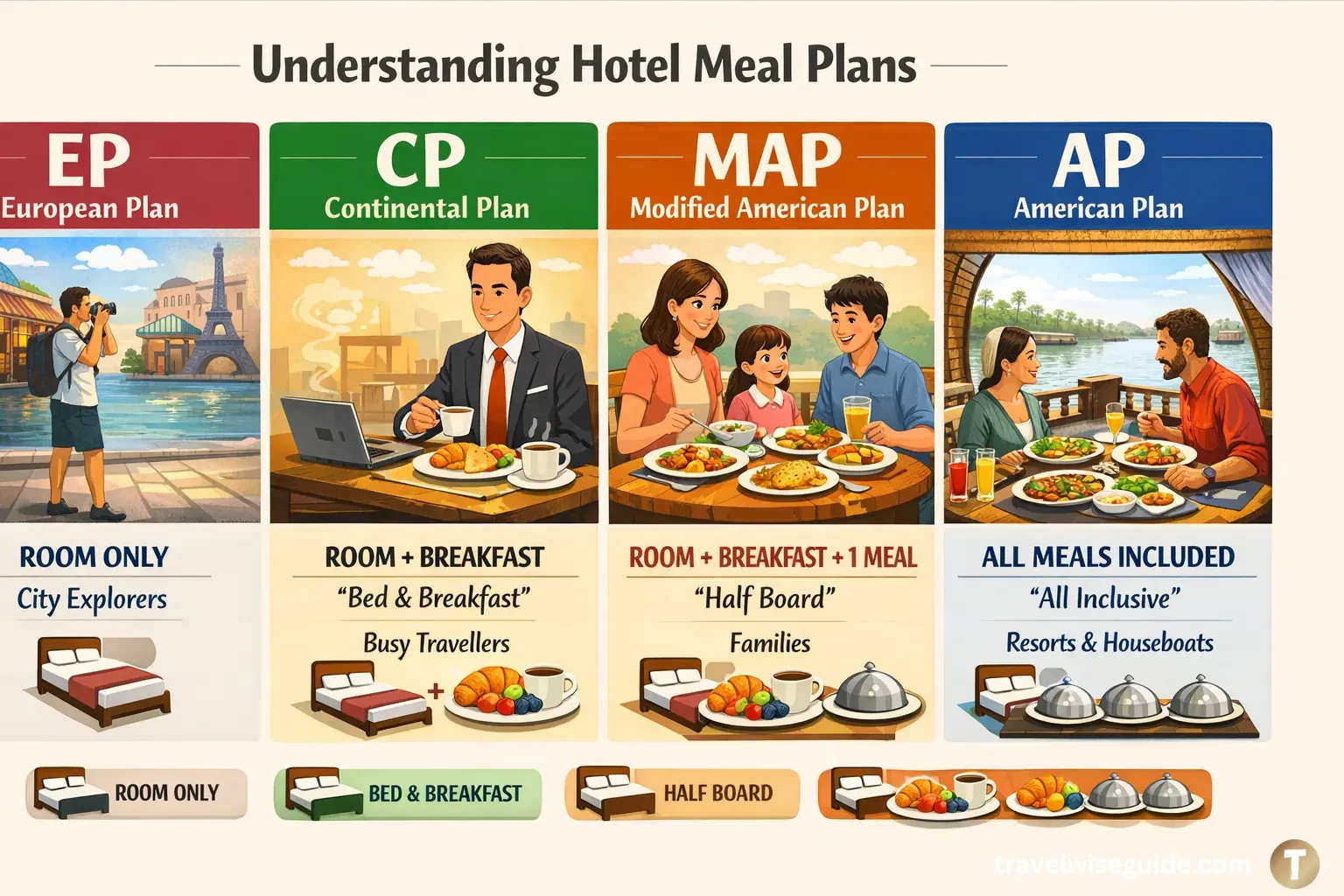
Standing in a Kerala houseboat’s tiny galley, surrounded by endless backwaters, I finally understood why the captain insisted on the American Plan (AP). No restaurants, no food delivery—just us, the water, and three magnificent meals prepared onboard.. If you’ve ever wondered about the difference between CP, MAP, AP, and EP plans, you’re not alone. This is the most searched travel terms meaning in the hospitality industry
| Plan Code | Full Term | What’s Included | Perfect For |
| EP | European Plan | Room only | City explorers wanting local cuisine freedom |
| CP | Continental Plan | Room + breakfast | Business travellers with packed schedules |
| MAP | Modified American Plan | Room + breakfast + one meal | Families wanting flexibility with some convenience |
| AP | American Plan | All meals included | Remote locations or all-inclusive experiences |
This tourism terminology guide helps you pick the right plan so you don’t pay for meals you won’t eat
Boutique Hotels vs Homestays: Understanding Accommodation Personalities

During my Shimla expedition, I experienced both worlds. The boutique hotel offered Instagram-worthy aesthetics and professional service, whilst the nearby homestay provided authentic conversations with Mrs. Sharma over morning tea, sharing local legends about the surrounding mountains.
Boutique hotels deliver:
- Unique design aesthetics
- Personalised luxury service
- Higher prices for curated experiences
Homestays offer:
- Genuine cultural immersion
- Home-cooked regional cuisine
- Budget-friendly authentic experiences
Phase 3: On-Ground Navigation and Essential Tourism Terminology
Every year, millions of travellers unknowingly overpay for hotels, flights, and experiences simply because they don’t understand the industry’s secret language. These costly mistakes are entirely preventable once you decode the terminology that separates savvy explorers from confused tourists.
Travel Styles Decoded: Are You an FIT or a GIT Traveller?

Understanding travel terms meaning also extends to your travel style. My philosophy shifted dramatically after experiencing both Free Independent Travel (FIT) and Group Inclusive Tours (GIT) across Southeast Asia. This travel vocabulary for beginners helps you decide how you want to see the world. As an FIT traveller, I discovered hidden temples in Bagan through serendipitous conversations with locals. However, during my GIT experience in Vietnam, the structured approach unveiled historical contexts I’d have missed independently.
FIT (Free Independent Traveller) suits:
- Adventurous spirits seeking authentic discoveries
- Flexible schedules accommodating spontaneous detours
- Budget-conscious explorers comfortable with uncertainty
GIT (Group Inclusive Tour) benefits:
- First-time visitors to challenging destinations
- Travellers preferring structured itineraries
- Those seeking comprehensive cultural education
Sustainable Tourism: Beyond Trending Hashtags
In this tourism terminology guide, we must address ‘Sustainable Tourism’ as more than just a buzzword. Walking through Leh’s ancient monasteries, I met a monk who spoke about tourism’s impact on their fragile ecosystem. That conversation shifted my entire travel philosophy from ‘taking memories’ to ‘leaving positive footprints’. It means choosing locally-owned accommodations and respecting cultural traditions.”
Sustainable tourism means:
- Choosing locally-owned accommodations
- Respecting cultural traditions and dress codes
- Minimising environmental impact through conscious choices
Why Local Guides Outperform Technology in Off-beat Destinations
My most memorable experiences happened in places absent from mainstream guidebooks. A tiny village near Spiti Valley where electricity arrives for three hours daily, yet locals shared stories under starlit skies that Hollywood couldn’t replicate.
Off-beat destinations provide:
- Authentic cultural exchanges
- Lower costs than tourist hotspots
- Unique stories worth sharing
Why Local Guides Trump Google Maps
Technology fails when you need it most. During my Ladakh adventure, GPS showed blank screens whilst Tenzin, my local guide, navigated by reading mountain shadows and wind patterns. His knowledge transformed a simple trek into an educational journey through Buddhism, geology, and survival wisdom.
Phase 4:How to Master Hotel Timing & Avoid Costly Booking Mistakes
Your journey’s final phase involves mastering the checkout process and understanding hotel policies that can either save you money or create unexpected expenses. These seemingly small details often determine whether your trip ends on a high note or with frustrating surprises.
Check-in/Check-out Realities
Navigating the final leg of your journey requires understanding certain check-in and check-out realities that can make or break your experience, especially when dealing with international flights and tight schedules.
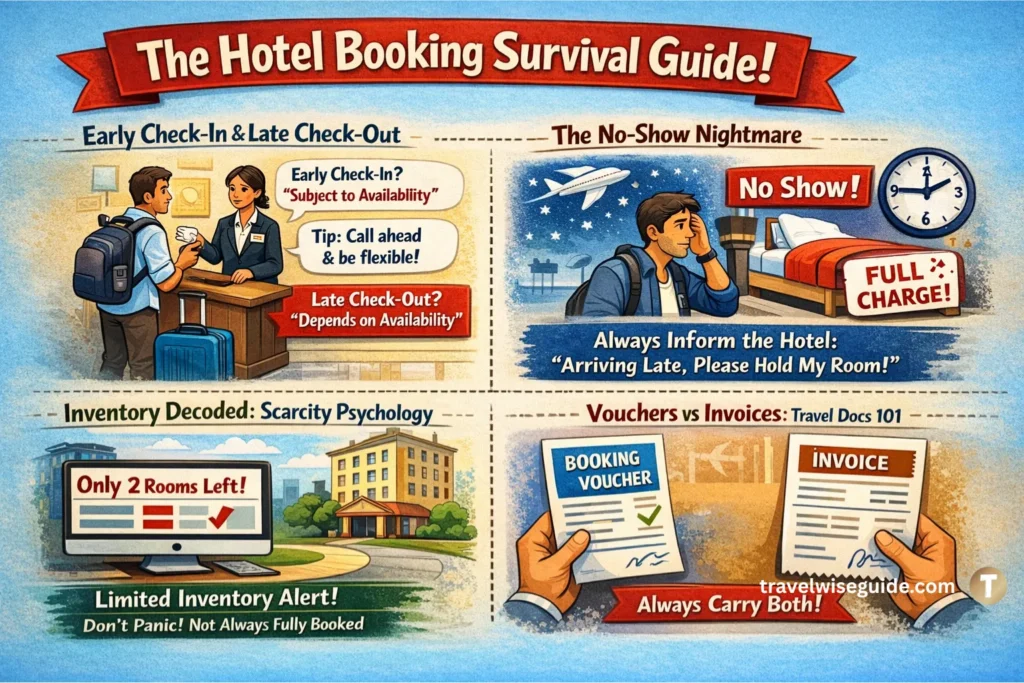
Early Check-in and Late Check-out: The Availability Game
Rushing from Heathrow to my London hotel at 8 AM after a red-eye flight, I learned that early check-in isn’t guaranteed—it’s “subject to availability.” This phrase haunts exhausted travellers worldwide. Hotels can’t promise your room before standard check-in times (typically 3 PM) because previous guests might extend their stays.
Pro strategy: Call ahead, explain your situation politely, and offer flexibility. Many hotels accommodate early arrivals if rooms are ready, especially during off-peak periods.
Late check-out operates similarly. That extra few hours can transform your departure day from frantic packing to leisurely breakfast, but availability determines everything.
The No-Show Nightmare
My friend’s Goa adventure nearly became a financial disaster when flight delays created a no-show situation. Hotels typically hold reservations until midnight on your arrival date. Failing to appear or notify them can result in full charges without accommodation—a expensive lesson in communication.
Essential action: Always inform hotels about delays, even if arriving at 2 AM. Most establishments appreciate notification and will hold your reservation accordingly.
Inventory Decoded: The Scarcity Psychology
When booking platforms display “Only 2 rooms left!” they’re referencing hotel inventory—available room stock at specific rates. This hotel management terminology creates urgency, but understanding it prevents panic bookings. Limited inventory might mean discounted rooms are nearly sold out, not that the hotel is fully booked.Don’t let hotel booking jargon like ‘Limited Inventory’ panic you into a bad deal. Understanding the travel terms meaning behind these alerts keeps you in control.
Vouchers vs Invoices: Documentation That Matters
Standing at Bangkok’s airport, I watched travellers fumble through papers during hotel transfers. The difference between vouchers (booking confirmations) and invoices (payment receipts) can determine smooth check-ins versus bureaucratic nightmares.
Always carry:
- Booking vouchers for accommodation confirmations
- Payment invoices for expense tracking
- Digital backups accessible offline
Conquering Jet Lag: Science Meets Strategy

After numerous transcontinental flights, I’ve mastered jet lag management. The secret isn’t just about sleep schedules—it’s about light exposure, meal timing, and gradual adjustment.
Jet lag occurs when your internal body clock conflicts with your destination’s time zone. Combat it by:
- Adjusting sleep patterns three days before departure
- Hydrating extensively during flights
- Seeking natural sunlight immediately upon arrival
The Smart Traveller Challenge
Test your newfound tourism terminology knowledge:
- Question: If you want hotel accommodation with breakfast but prefer exploring local restaurants for other meals, which plan suits you best?
- Question: What’s the ideal season for visiting hill stations to avoid crowds while enjoying pleasant weather?
- Question: When booking flights for a multi-city European tour, which ticket type saves money and time?
Answers: 1. CP (Continental Plan), 2. Shoulder Season, 3. Open-Jaw Tickets
Official References
1.Ministry of Tourism (Incredible India)
- For Hotel classification (Star ratings) and sustainable tourism .
- Link: incredibleindia.org
2. Bureau of Civil Aviation Security (BCAS):
- For Airport terminology and security protocols
- Link: bcasindia.gov.in
3. National Portal of India (Tourism Section)
- For the data of Indian travel policies and tourism industry
- india.gov.in
Related Posts
- India e-Visa Rejection? Make It Stress-Free – 2025 complete Guide
- .why Indian e visa rejected, can you reapply it , how to avoid indian e visa rejections
- https://travelwiseguide.com/india-e-visa-rejection-guide-2025/
2. India Airport Survival Guide 2025: Navigating Customs & Immigration at Delhi (DEL) & Mumbai (BOM)
- Immigration, Customs , Duty free allowance, Critical Legal & Security Restrictions
- https://travelwiseguide.com/india-airport-guide-delhi-mumbai-customs
. 3. India Travel Budget Guide (Avoid These 2026 Mistakes)
- Food price , travel cost ,accommodation cost , intercity travel cost, how much cash should you have ?
- https://travelwiseguide.com/india-travel-budget-guide-daily-costs/
Conclusion: Master Travel Terms Meaning and Book Like a Professional
Understanding travel terms’ meaning transforms confusion into confidence. This tourism terminology guide is your passport to smarter travel Whether you’re decoding hotel meal plans, distinguishing between twin and double rooms, timing your travels during shoulder seasons, or navigating the complexities of layovers versus stopovers, this knowledge becomes your passport to smarter, more economical adventures.
The tourism industry’s jargon no longer holds mysterious power over your wallet. You’ve unlocked the secret language that separates seasoned travellers from bewildered tourists, understanding everything from FIT versus GIT travel styles to the reality behind hotel inventory limitations.
Your turn: Which travel term surprised you most? Share your own travel terminology confusion stories in the comments below—let’s build a community of informed explorers who help each other navigate this beautiful, complex world of travel.
Remember, every expert traveller started with their first confused moment at a hotel reception desk. The difference lies in learning from those experiences and sharing wisdom with fellow adventurers. having read it . you are confident so enough visit whole india , every thing is there in my blog Don’t Visit India Without Reading This: The Ultimate India Travel Guide (2026)