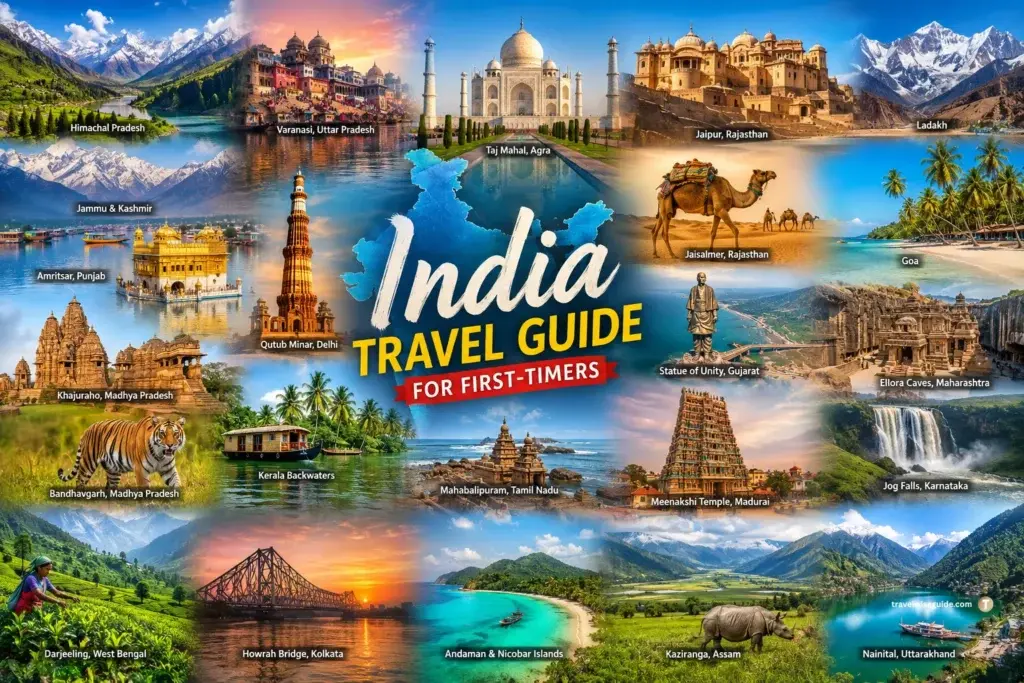
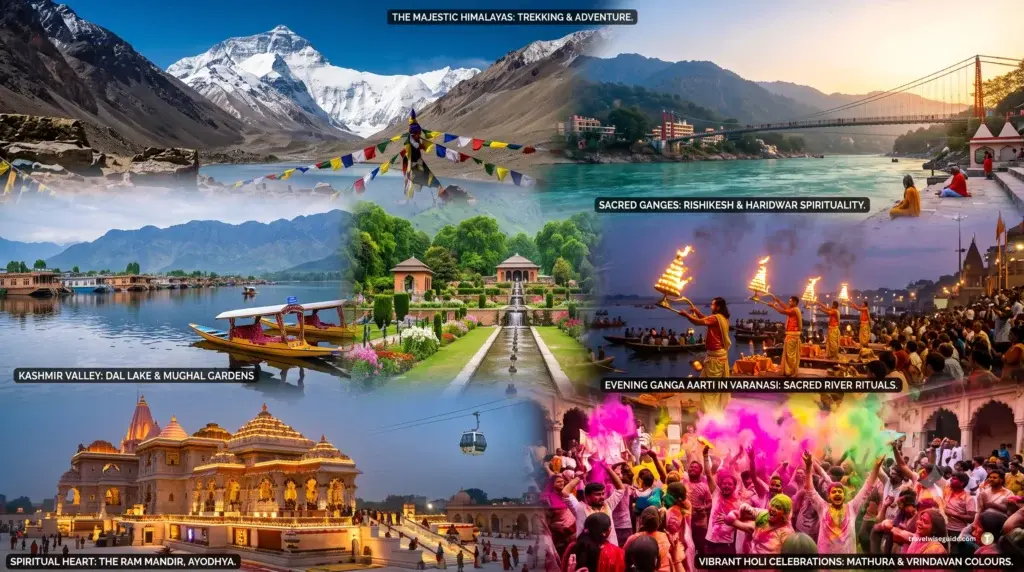
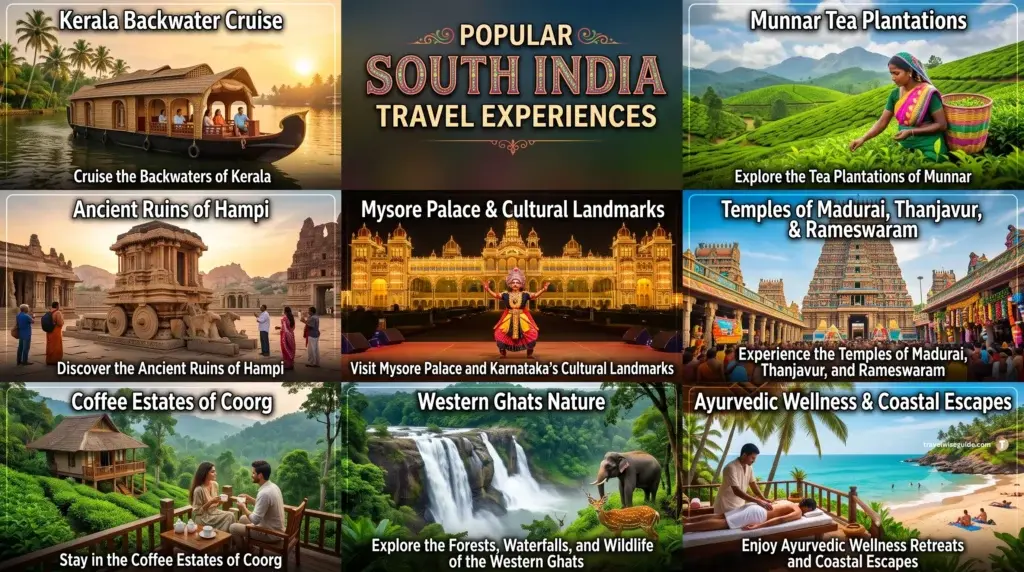
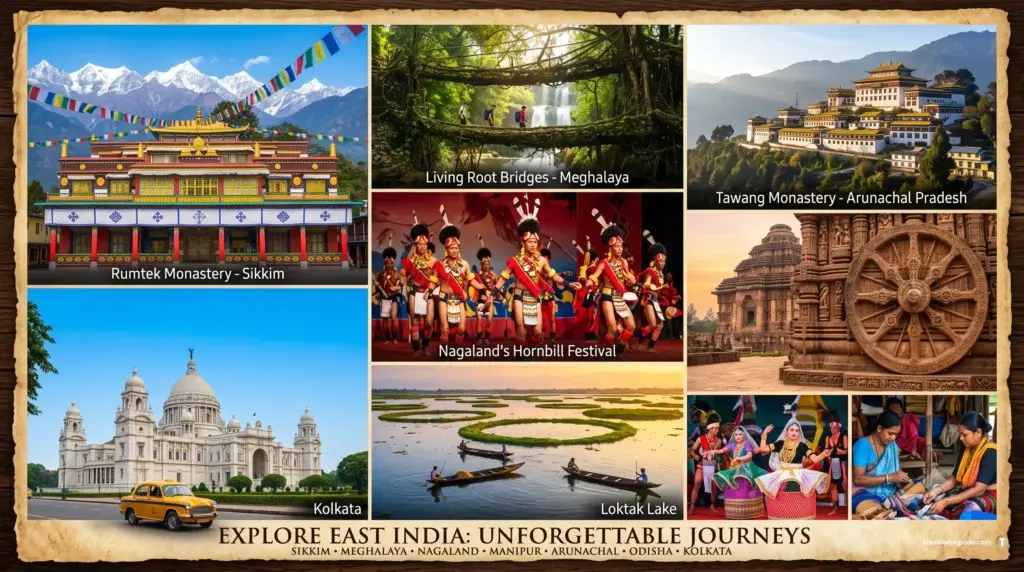
The Full Travel Guide to India

whatsapp image 2025 10 31 at 5.23.48 pm

Why India is the Journey of a Lifetime?

Travelling India as a first timer traveller has never been easier. Foreigners can get an e-Visa in a few clicks. There are few places on earth that awaken the senses quite like India. A land where time moves in many directions at once — ancient and modern, chaotic yet peaceful, familiar but endlessly surprising. From the icy peaks of the Himalayas to the tropical backwaters of Kerala, from desert forts glowing in the Rajasthan sun to the holy chants echoing on the ghats of Varanasi — India is not merely a country to see, but a story to feel.

Travelling through India is like turning the pages of a living epic. Every city hums with history; every village holds a festival; every traveller leaves a little transformed. Whether you come seeking spirituality, adventure, cuisine or culture — India offers a thousand journeys within one.

Summarized Tourist Information Guide for first -time travellers in India

This condensed guide provides essential quick-reference information on local etiquette, health, safety, and money matters.

🧘 Local Etiquette & Rules

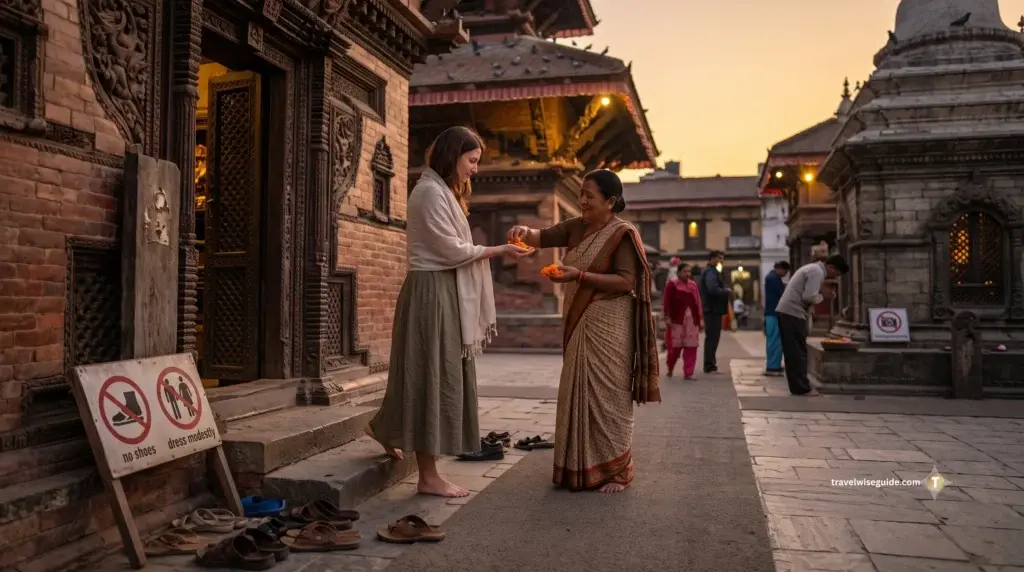
  • Temple Manners: Always remove shoes before entering a prayer area. Dress modestly (shoulders and knees covered). Be quiet and respectful during rituals.
  • Photography: Generally allowed at central monuments, but check signs for exceptions (e.g., inside the Taj Mahal mausoleum). Ask permission before photographing people, especially women or worshippers.
  • Drones: Strictly regulated. Prior registration/clearance via DGCA’s Digital Sky platform is mandatory. Avoid flying without proper authorisation.
  • Behaviour: Avoid public displays of affection. Follow all local signboards and security instructions, especially regarding mobile phone bans or specific dress rules at religious sites.

⚕️ Health & Safety Essentials

  • Helplines: Save these now: 112 (General Emergency), 1800-11-1363 / 1363 (24×7 Tourist Helpline), 181 (Women’s Helpline).
  • Insurance: Buy travel insurance that covers medical treatment and, crucially, medical evacuation.
  • Health Basics: Drink only bottled or boiled water; avoid ice and uncooked street salads. Check with your doctor about vaccinations and malaria prophylaxis.
  • Safety: Use registered app cabs (Ola/Uber) or pre-booked transfers. Keep photocopies of your ID/visa separate from the originals.

💰 Budget & Money Quick Guide

  • Currency: Indian Rupee ($₹$); carry cash for small vendors and rural areas, but cards and UPI are widely accepted in cities.
  • Budgeting (Per Person Daily):
    • Shoestring/Backpacker: $₹$800 – $₹$1,800
    • Mid-range/Comfort: $₹$3,500 – $₹$7,000
  • Tip for Savings: Rely on trains, buses, and street food for the biggest cost reductions. Be aware that peak seasons and festivals increase prices.

How to apply for an India e-Visa (step-by-step )

  1. Check eligibility on the official portal.
  2. Apply online (passport, photo, itinerary).
  3. Pay fee; track application.
  4. Receive e-Visa by email; print a copy.
  5. On arrival: biometric + entry stamp.
  6. Tip: Passport validity ≥6 months; 2 blank pages.

Small FAQ 

How long is the e-Visa valid? (tourist variants, typical stay windows?

  • Can I extend in India? (usually no, with rare exceptions)
  • Do I need a return/onward ticket? (yes, recommended)
  • Permits: ILP/AP permits for parts of Arunachal, Nagaland, Mizoram, Lakshadweep; check state sites

Money, SIM & Internet: Quick Setup

  • Payments: Cards widely accepted in cities. UPI is universal; foreigners can use UPI via select international cards/bank accounts (pilot corridors vary). Always keep ₹200–₹500 small notes for stalls/tolls.
  • ATMs: Cities—easy; rural—scarce. Withdraw in daytime, inside bank lobbies.
  • SIM: Buy Jio/Airtel at airport with passport + visa copy; ask for tourist plan (data + incoming). e KYC takes ~15–60 mins.

Tipping Guide (fast): Restaurants 5–10%; porters ₹50–₹100/bag; drivers ₹200–₹400/day on multi-day trips; guides ₹300–₹700/tour.


Power: 230V, plugs Type D/M (carry universal adapter).

 Worried About Your India e-Visa Getting Rejected? Make It Stress-Free – 2025 Complete Guide

Our another blog , think of this guide as your personal expert, walking you through the entire process, from landing until you step outside. India Airport Survival Guide: Navigating Delhi (DEL) & Mumbai (BOM) Customs & Immigration Follow these 6 essential stages, and you’ll clear any Indian airport like a seasoned pro, ensuring a smooth and confident beginning to your adventure.


Why Visit India? The Unique Appeal of the Country


Few places on Earth can awaken every sense the way India does . it’s a land where civilisation still breathes, colours still sing , and every journey feels like a discovery – of the world and of yourself .Here’s why It remains one of the most compelling travel destinations on the planet


Experience ThemeEssence of IndiaBest Months to ExperienceWhy It’s Unmissable
Ancient Soul5,000 years of living civilisation — from Indus Valley ruins to Mughal palacesOct – MarWalk through history that still breathes
Mosaic of Cultures28 states, 1.4 billion stories, infinite festivalsYear-round (esp. festival months)Hear temple bells, tribal drums, and church choirs in one journey
Nature in ExtremesFrom Himalayan snow to Andaman reefsOct – AprTrek, raft, dive — or simply breathe in beauty
Feast for the SensesColours, spices, bazaars, and flavours that never fadeAll seasonsEvery street corner feels like a celebration
Spiritual AwakeningHome of yoga, meditation, and inner peaceOct – MarFind stillness at Rishikesh, Bodh Gaya, Amritsar
People & Hospitality“Atithi Devo Bhava” — the guest is divineYear-roundIndia’s warmth leaves no one a stranger
Modern EnergyTech-savvy, fast, yet deeply rootedAll yeare-Visa, UPI, metros — modern travel meets ancient grace

🕉️ 1. An Ancient Soul – Where History Still Breathes

Civilisations here have thrived for over five millennia.
Standing before an age-worn stupa or temple echoing with Sanskrit chants, you feel time folding in on itself.
From the Indus Valley ruins to Mughal forts and colonial boulevards — India doesn’t just preserve history, it lives it.

🎭 2. A Mosaic of Cultures – Unity in Diversity

Crossing every state feels like crossing into a new world — dialects shift, cuisines change, festivals burst in colour.
Temple bells, church choirs, and tribal drums blend into one vast, living rhythm: India’s heartbeat of unity in diversity.

🏝️3. Nature in Extremes – From Himalayas to Ocean Reefs

From snow leopards in Ladakh to coral reefs in Lakshadweep, India’s geography rewrites every map of wonder.
The Himalayas pierce the sky, deserts shimmer in gold, and backwaters mirror the monsoon clouds — a landscape that feels infinite, yet intimate.

🎉4. A Feast for Every Sense – Colours, Flavours, and Sounds

The aroma of cardamom tea, marigolds at temple doors, bazaars humming at dusk — India is a living sensory symphony.
Every corner glows, every bite surprises, every sound tells a story.

🎨5. Spiritual Awakening – The Land of Inner Journeys

India doesn’t just show you temples — it helps you find your temple within.
From Rishikesh’s ashrams to Bodh Gaya’s sacred Bodhi Tree, this is a land where stillness is worshipped and peace is possible.

🙏6. People & Hospitality – Atithi Devo Bhava

Here, kindness needs no translation.
A stranger might share chai with you; a villager might invite you to their home.
Hospitality isn’t an act — it’s India’s instinct.

Closing Reflection

You might wake up to snow peaks and end your day beneath desert stars.
Sip tea from misty hills in the morning and dance to a Rajasthani drumbeat by night.
In India, every sunrise feels like a new story — and every traveller becomes part of its eternal poem.

Regional Overview of India


North India – The Land of Kings and Sacred Rivers

North India embodies India’s grandeur and its soul.
It’s where empires were forged and faiths took root; where palaces stand beside prayer flags.


1. Delhi – Where the Past and Future Collide

India’s capital is a time machine. Wander through the Mughal splendour of Humayun’s Tomb and Red Fort, then step into the futuristic skyline of Gurgaon. In Chandni Chowk, the aroma of parathas mingles with temple bells — a perfect symbol of India’s eternal duality.

India travel guide for first - time travellers


Quick Travel Snapshot – Delhi

Best Time: October – March (pleasant winter weather, clear skies)
How Long: 2 days – 3 days (ideal for highlights & food walks)
Budget Range: ₹2,000 – ₹15000 per day (budget → luxury)
Highlight: Mughal-era forts, colonial boulevards, bustling bazaars, and street-food culture all meeting modern India in one city.


2. Agra – The City of Eternal Love

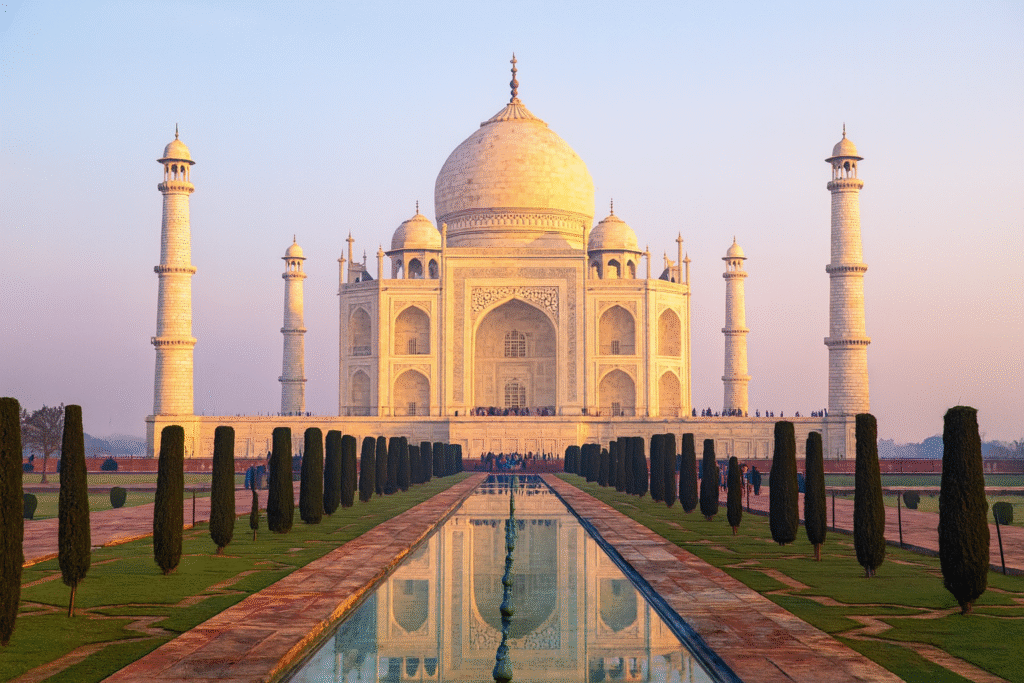
Taj Mahal, Agra — white-marble mausoleum reflected in the central pool at sunrise.

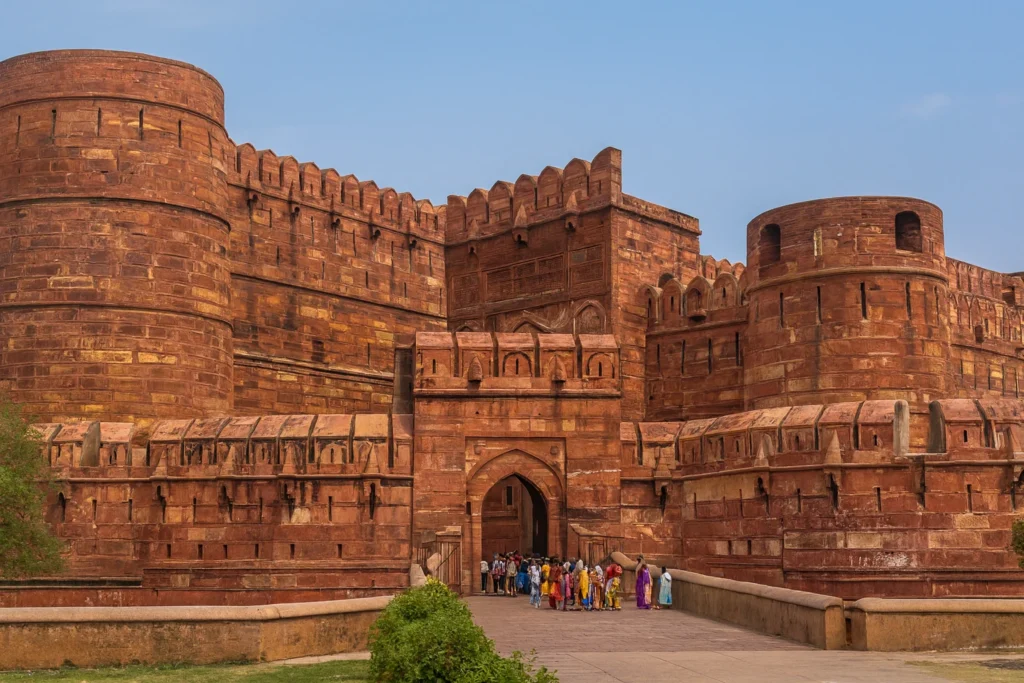
The Taj Mahal needs no introduction, yet it never ceases to move even the most seasoned traveller. Watching its marble blush pink at sunrise is to witness poetry in stone. Beyond it lies Agra Fort — a labyrinth of courtyards narrating Mughal tales of power and passion.

While exploring Agra, you can learn more about the Taj Mahal’s architecture and history in our detailed guide.

just 2 km. away from Taj Mahal there is another Mughal emperors’ architecural gem Agra Fort in Agra


Quick Travel Snapshot – Agra

Best Time: November – February (cool, clear mornings for Taj sunrise)
How Long: 1 – 2 days (Taj Mahal, Agra Fort, Fatehpur Sikri)
Budget Range: ₹1,500 – ₹5,000 per day (wide range of stays)
Highlight: The Taj Mahal glowing at dawn — love carved in marble, backed by Mughal splendour. 

Golden Triangle — 3 days (Delhi → Agra → Jaipur)

Ideal for first-timers and short stays. Best time: Oct–Mar.

Day 1 — Delhi: Arrival, Red Fort/Chandni Chowk short walk, India Gate & Humayun’s Tomb (evening: light & sound or Khan Market).
Day 2 — Agra (early train/drive): Sunrise at the Taj Mahal, Agra Fort, Mehtab Bagh (sunset if time). Travel to Jaipur by evening (or stay in Agra).
Day 3 — Jaipur: Amber Fort (elephant/jeep option), City Palace, Jantar Mantar, Hawa Mahal. Return to Delhi or onward travel.

Quick tips: Start early for Taj sunrise; book Taj and Amber Fort tickets in advance. Official Delhi Tourism runs Golden Triangle packages — good to cite/compare.


 3. Mathura & Vrindavan – Where Love Becomes Divine

Along the banks of the Yamuna, the air itself seems to sing the stories of Krishna. In Mathura’s temples and Vrindavan’s lanes, devotion dances in colour — from morning bhajans to the joyous swirl of Holi, every corner celebrates love in its purest, most playful form.  Experience spiritual tourism here.


Quick Travel Snapshot – Mathura & Vrindavan

Best Time: October – March (cool season; Holi & Janmashtami festivities)
How Long: 1 – 2 days (Krishna Janmabhoomi Temple, Banke Bihari Temple, ISKCON, Yamuna Ghats)
Budget Range: ₹1,500 – ₹4,500 per day (ashrams → boutique spiritual stays)
Highlight: Temple bells, flower-strewn ghats, and streets bursting with colours and chants — Mathura and Vrindavan feel like love made visible.


4. Ayodhya – Where Faith Finds Its Home

Cradled on the banks of the Sarayu, Ayodhya hums with timeless devotion. The chants of priests mingle with the glow of diyas as pilgrims gather before the grand Ram Mandir — not just a temple, but a symbol of faith reborn in stone and light

.

Ram idol at Shri Ram Janmabhoomi, Ayodhya — ornately dressed statue framed by carved white temple pillars and colourful garlands.

 Quick Travel Snapshot – Ayodhya

Best Time: October – March (pleasant weather; Deepotsav & Ram Navami celebrations)
How Long: 1 – 2 days (Ram Mandir, Hanuman Garhi, Sarayu Aarti, Kanak Bhavan)
Budget Range: ₹1,500 – ₹4,000 per day (pilgrim lodges → boutique hotels)
Highlight: Riverfront aartis, temple bells at dawn, and millions of lamps glowing in harmony — Ayodhya feels less like a city, more like a prayer come alive.


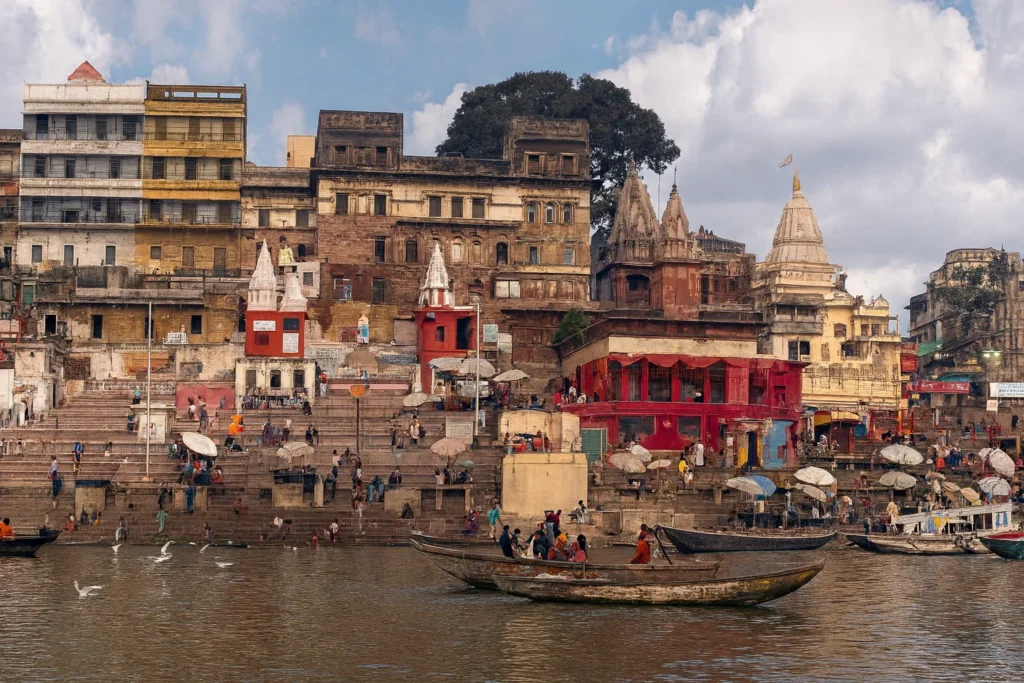
5. Varanasi – The City of Light

On the banks of the sacred Ganga, chants rise and lamps shimmer in the dusk air. Life and death flow side by side here, and every aarti feels like the universe breathing in rhythm


Quick Travel Snapshot – Varanasi

Best Time: October – March (ideal for boat rides & festivals like Dev Deepawali)
How Long: 1 – 2 days (ghats, temples, Sarnath)
Budget Range: ₹1,200 – ₹5,000 per day (guesthouse → boutique stay)
Highlight: Sunrise on the Ganga, sacred chants, flickering lamps, and spirituality that lingers long after you leave.


7 day india itinerary for first time travellers(Golden Triangle + Varanasi )

Adds spiritual Varanasi to the cultural trio. Best time: Oct–Mar.

Days 1–3 — Golden Triangle (as above, compress where needed).


Day 4 — Train/flight to Varanasi; evening Ganga aarti at Dashashwamedh Ghat.
Day 5 — Morning boat ride at sunrise, Kashi Vishwanath, explore old lanes; Sarnath afternoon (Buddha’s first sermon).
Day 6 — Relax/market + departure.

Tip: Use an early morning boat for best light and photos; book Ganga aarti experience with a reputable local guide.

For spiritual seekers, Varanasi represents India’s eternal cultural soul.Explore more on my blog


6.Himalayan Escapes

Head north still — to Himachal’s pine valleys or Kashmir’s alpine lakes — and the landscape turns dreamlike. Dharamshala echoes with Buddhist chants, while Gulmarg becomes a playground of snow.


Quick Travel Snapshot – Himalayan Escapes (Himachal & Kashmir)

Best Time: March – June (spring blooms & pleasant trekking) | December – February (snow season)
How Long: 4 – 6 days (Dharamshala, McLeod Ganj, Gulmarg, Pahalgam, Sonamarg)
Budget Range: ₹2,500 – ₹7,000 per day (mountain homestays → ski resorts & houseboats)
Highlight: Whispering pine valleys, chanting monasteries, and alpine lakes that mirror the sky — the Himalayas at their most peaceful and picturesque .


South India – Temples, Backwaters & Spice-Scented Hills

South India feels like another world altogether — slower, greener, more reflective


🏖️Kerala – God’s Own Country

Cruise along the backwaters of Alleppey, where coconut palms dip into emerald canals and fishermen paddle in silence. At dawn, the sound of conch shells greets the rising sun. Ayurveda retreats, houseboats, and homestays define Kerala’s gentle rhythm.


1. Alappuzha (Alleppey) — Backwater heartland

Alleppey is the gateway to Kerala’s famous backwaters: narrow canals fringed by coconut palms, wooden houseboats drifting past village life and paddy fields. An overnight houseboat stay or a day cruise gives you quiet canals, sunset skies and slow village rhythms — the classic Kerala experience, and natural beauty of india .

Traditional Kerala houseboat (kettuvallam) cruising the palm-lined backwaters, with reflections on the lagoon.

Quick Travel Snapshot — Alappuzha (Alleppey)

  • Best time: October–March (cool, pleasant weather for houseboats and outdoor cruising).
  • How long: 1–2 days (overnight houseboat + short village cruise or day trip).
  • Budget range: ₹2,000–₹7,000 per day (budget homestays → midrange houseboat packages).
  • Highlight: Overnight houseboat on the Vembanad backwaters — palm-fringed canals, village stops and sunset reflections.

2. Munnar — Tea-scented hills

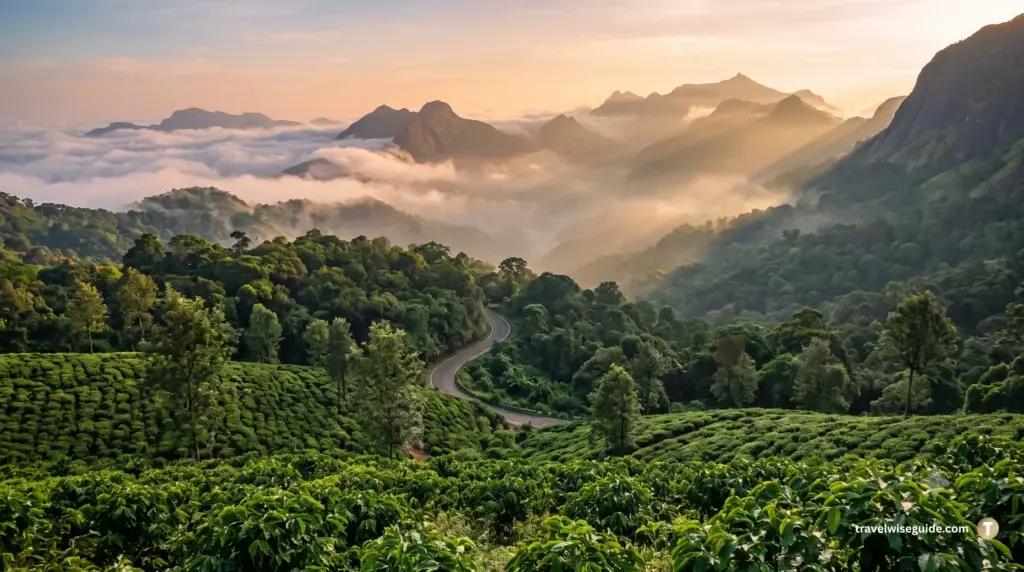
Munnar is a cool, emerald world of rolling tea terraces, misty peaks and quiet walking trails; early mornings are best for light and mist over the plantations. It’s perfect for slow walks, tea-estate tours and short hikes among colonial bungalows and viewpoints.


Quick Travel Snapshot — Munnar

  • Best time: October–February (cool, clear weather and the best visibility for tea-garden views).
  • How long: 2–3 days (tea-estate walks, Eravikulam viewpoint, short hikes).
  • Budget range: ₹2,000–₹6,000 per day (guesthouses → boutique hill resorts).
  • Highlight: Endless tea plantations, misty mornings and easy hill walks — ideal for photography and a slower pace.

5 days itinerary Kerala Backwaters + Hill Station (Cochin → Munnar → Alleppey)

Best for relaxation, houseboat experience. Best time: Oct–Feb.

Day 1 — Arrive Kochi: Mattancherry Palace, Jewish Quarter.
Day 2 — Drive to Munnar: tea gardens, Eravikulam NP (if open).
Day 3 — Munnar morning, afternoon drive to Alleppey.
Day 4 — Houseboat cruise in the backwaters (overnight).
Day 5 — Disembark, return to Kochi or proceed to the next destination.

Tip: Houseboats are popular — book well in advance for peak season.


🏰Karnataka

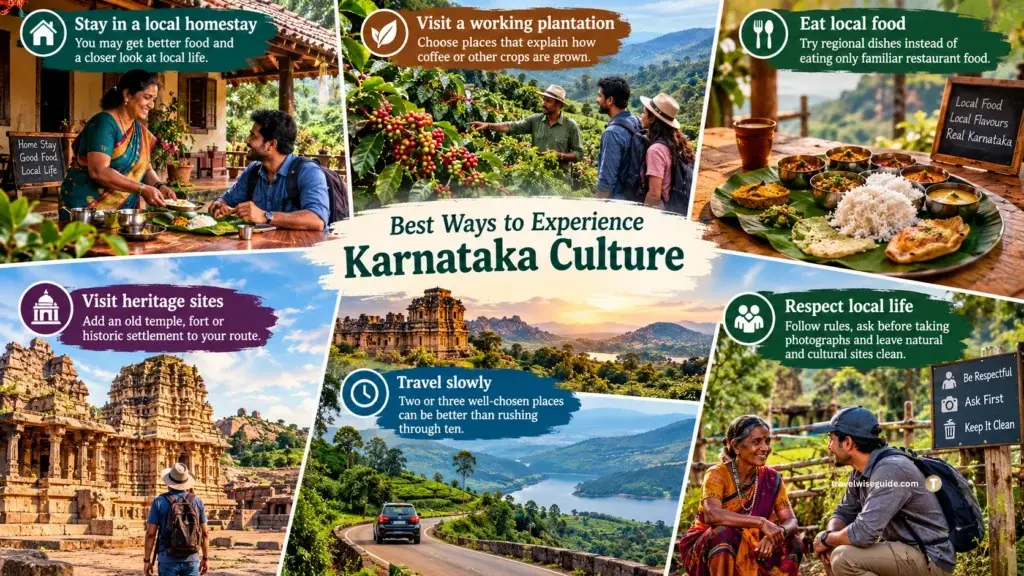
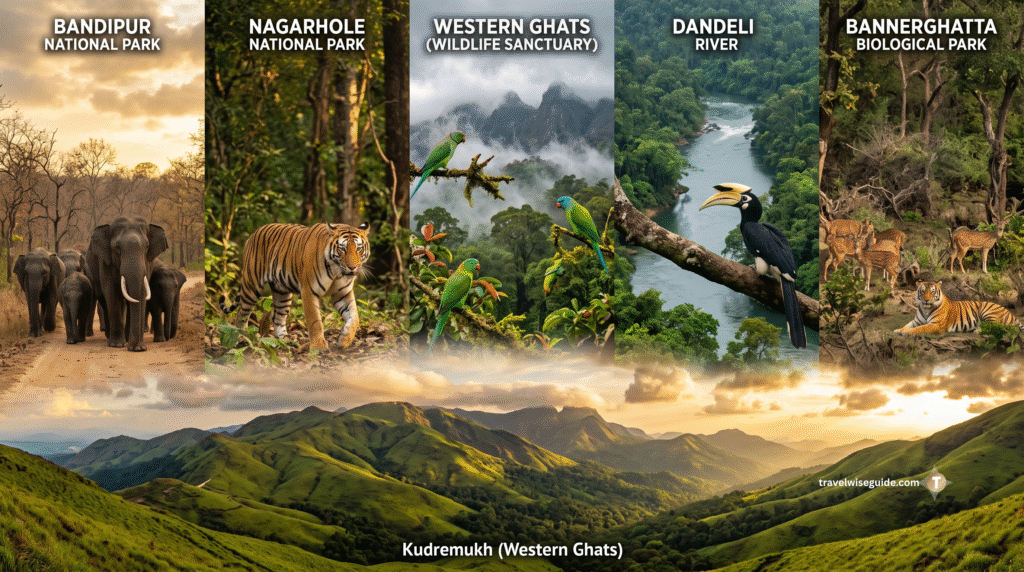
Karnataka stretches from the boulder-strewn ruins of Hampi to the regal palaces of Mysore and the coffee-scented hills of Coorg.

It blends spectacular heritage, verdant hill stations and wildlife, making it perfect for history buffs and nature lovers alike.

A compact, well-connected state ideal for short cultural circuits or relaxed hill escapes.


1. Hampi — Stone poems of the Vijayanagara Empire

Hampi’s surreal landscape of granite boulders, ruined palaces and carved temple halls feels like a lost city frozen in sunlight. Wander between Virupaksha Temple, the Royal Centre and the musical pillars of Vittala — the scale and detail reward slow exploration and photography.

Stone chariot at Vittala Temple, Hampi — detailed carved granite chariot and surrounding temple mandapas under a blue sky.

Quick Travel Snapshot — Hampi

  • Best time: October – February (cool, pleasant for sight-seeing).
  • How long: 1–2 days for main sights; 2–3 days for a relaxed pace and photo walks.
  • Budget range: ₹1,200 – ₹5,000 per day (guesthouses → mid-range hotels/heritage stays).
  • Highlight: Vittala Temple complex, Virupaksha Temple, boulder-strewn vistas and bicycle rides through ruins.

2. Mysore (Mysuru) — Palaces, gardens and cultural grace

Mysore is India’s gentle palace city: the domed Mysore Palace, the illuminated Dasara season and the manicured Brindavan Gardens give it a refined, walkable charm. It’s a compact cultural hub that pairs well with nearby wildlife reserves and silk/food trails.


Quick Travel Snapshot — Mysore

  • Best time: October – March (cool, dry weather; ideal for palace visits and gardens).
  • How long: 1–2 days (palace, Chamundi Hill, Brindavan Gardens; add a day for Nagarahole/Narayani safaris).
  • Budget range: ₹1,500 – ₹6,000 per day (guesthouses → heritage hotels).
  • Highlight: Mysore Palace, evening illumination (especially during Dasara), and nearby Brindavan Gardens.

3. (Kodagu) — Coffee hills and misty forests

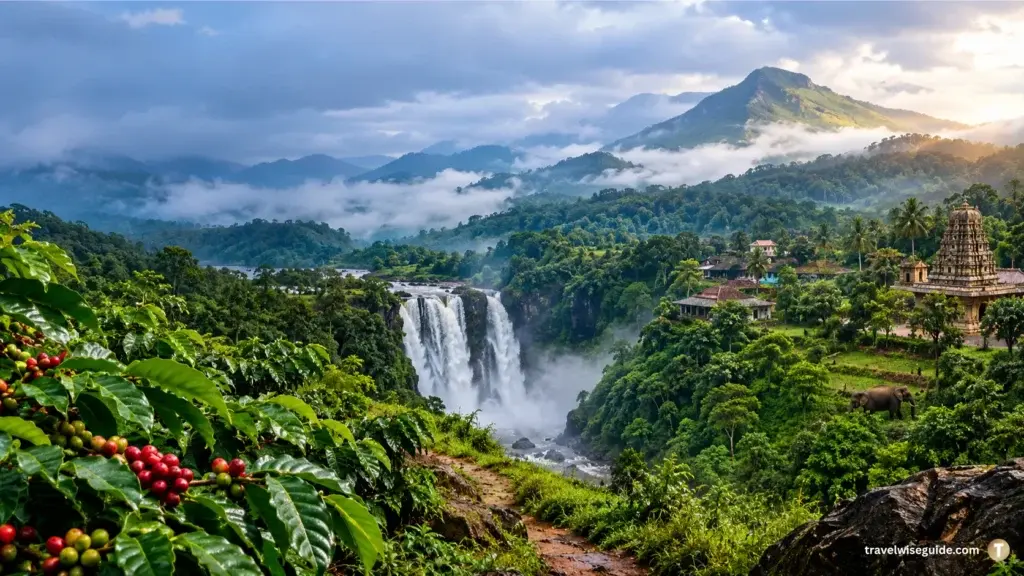
Coorg is a green, fragrant hill district where coffee estates, waterfalls and misty viewpoints create a cool, restorative escape — often called the “Scotland of India”. Madikeri and its surrounding estates are perfect for short treks, plantation tours and relaxed homestays.


Quick Travel Snapshot — Coorg (Madikeri / Kodagu)

  • Best time: October – March (post-monsoon clarity and pleasant temperatures).
  • How long: 2–3 days (plantation walks, Abbey & Iruppu Falls, Raja’s Seat, coffee tours)
  • Budget range: ₹1,800 – ₹7,000 per day (homestays → boutique hill resorts).
  • Highlight: Coffee estate tours, misty mornings, waterfalls and peaceful hill walks.

💃Tamil Nadu – Where Faith Touches the Sky

Temples here are not merely buildings — they’re living cities of gods. The towering gopurams of Madurai and Thanjavur are draped in vibrant sculptures, each telling mythic tales


1. Madurai — The Temple City of Eternal Flames

Madurai centres on the magnificent Meenakshi-Sundareshwarar Temple, where colour, ritual and crowds create an immersive Hindu pilgrimage experience. The city pairs lively bazaars and fragrant street food with a compact, walkable historic core that’s perfect for two-day exploration.

Meenakshi Amman Temple inner hall, Madurai — carved stone pillars and vibrant painted ceiling reflected on the polished floor.

Quick Travel Snapshot — Madurai

  • Best time: October–March (pleasant weather; cooler mornings best for darshan).
  • How long: 1–2 days (temple, Thirumalai Nayak Palace, evening markets).
  • Budget range: ₹1,500–₹5,000 per day (guesthouses → mid-range hotels).
  • Highlight: Meenakshi Temple’s colourful gopurams, evening aarti and bustling bazaars.

2. Thanjavur — The Chola Capital and the Big Temple

Thanjavur (Tanjore) is the beating heart of Chola art: the UNESCO-listed Brihadeeswarar Temple dominates the skyline with perfect proportions and stone carvings. Rich in music, dance and terracotta art, the city rewards slower exploration and early-morning temple visits.


Quick Travel Snapshot — Thanjavur

  • Best time: October–March (pleasant weather and best light for temple photography).
  • How long: 1 day (Brihadeeswarar Temple, Royal Palace, Saraswathi Mahal Library).
  • Budget range: ₹1,500–₹4,500 per day (budget guesthouses → heritage stays).
  • Highlight: The Brihadeeswarar Temple — an architectural masterpiece of the Chola era.

3. Rameswaram — Island Pilgrimage and Sacred Waters

Rameswaram sits at the tip of Pamban Island: a long causeway, powdery beaches and the Ramanathaswamy Temple’s long corridors define the pilgrimage experience. Pilgrims come for ritual baths and long darshan queues, but visitors also enjoy the Pamban bridge and coastal panoramas.

Rameshwaram Ramnathpuram 16x9 1920x1080 1

Quick Travel Snapshot — Rameswaram

  • Best time: October–March (cooler, drier weather for beach walks and temple rituals).
  • How long: 1–2 days (Ramanathaswamy Temple, Pamban Bridge, Agni Theertham).
  • Budget range: ₹1,500–₹4,000 per day (pilgrim lodges → modest hotels).
  • Highlight: Long temple corridors and sacred sea-baths at Agni Theertham.

3 days itinerary for Madurai → Rameswaram → Thanjavur

This is a compact pilgrimage / heritage circuit many travellers use; distances and day plan based on common local itineraries.

Day 1 — Madurai

  • Morning: Meenakshi-Sundareshwarar Temple early darshan and Thirumalai Nayak Palace.
  • Afternoon: Local markets, temple museum; overnight in Madurai.

Day 2 — Madurai → Rameswaram (approx. 170 km, ~3–4 hours by road/train)

  • Early departure to Rameswaram. Visit Pamban Bridge, Ramanathaswamy Temple and Agni Theertham; overnight in Rameswaram.

Day 3 — Rameswaram → Thanjavur (approx. 240 km, ~4–5 hours by road)

  • Travel to Thanjavur; visit Brihadeeswarar Temple, royal palace and Saraswathi Mahal Library. End circuit in Thanjavur or continue to Trichy/Chennai by rail/road.

karnataka & coorg

the hills of Coorg, coffee blossoms perfume the misty air. Meanwhile, Hampi’s surreal boulder-strewn ruins speak of a lost empire


Quick Travel Snapshot – Hampi / Mysore (Karnataka)

Best Time: October – February (cool, dry season for exploring ruins & palaces)
How Long: 3 – 4 days (2 in Hampi, 1–2 in Mysore)
Budget Range: ₹2,000 – ₹6,000 per day (guesthouses → heritage hotels)
Highlight: From the boulder-strewn ruins of the Vijayanagara Empire to Mysore’s illuminated palace — history and artistry glowing side by side.


Wayanad & The Western Ghats

A dream for eco-travellers, Wayanad is a lush blend of waterfalls, spice gardens, and bamboo bridges swaying over forest streams. Mist rolls through the hills at dawn, cardamom scents the air by dusk, and the rhythm of the Western Ghats invites you to slow down and simply breathe.

Quick Travel Snapshot – Wayanad & The Western Ghats

Best Time: October – February (cool, misty weather ideal for trekking & wildlife)
How Long: 2 – 3 days (Edakkal Caves, Soochipara Falls, Banasura Sagar Dam, Spice Plantations)
Budget Range: ₹1,800 – ₹5,500 per day (eco-lodges → boutique jungle resorts)
Highlight: Mist-draped hills, spice-scented air, and bamboo bridges leading to hidden waterfalls — a paradise for slow travellers and nature lovers.


  East India – Spiritual Calm and Hidden Beauty

Where the first light of dawn touches India, the East awakens in whispers — of prayer wheels, river chants, and rustling forests. Mist drifts over monasteries in Sikkim, while ancient temples rise from the sands of Odisha’s coast. Between tea gardens, sacred rivers, and stories carried by the wind, East India feels like a quiet conversation between earth and spirit — gentle, green, and deeply alive.

If India has a poetic heart, it beats here.

1. Sikkim – Serenity in the Clouds

Prayer flags flutter above snow lines; monasteries perch on cliffs. At dawn, Kanchenjunga blushes gold — a sight few forget

Buddha Park (Ralong Park), Sikkim — large seated Buddha statue on decorated plinth with the Himalayan peaks behind.

Quick Travel Snapshot – Sikkim

Best Time: March – June & October – December (clear skies and Kanchenjunga views)
How Long: 3 – 4 days (Gangtok, Tsomgo Lake, Nathula Pass, Rumtek Monastery)
Budget Range: ₹2,000 – ₹6,000 per day (budget guesthouses → scenic hill resorts)
Highlight: Misty monasteries, fluttering prayer flags, and snow-capped serenity — a Himalayan escape where peace feels tangible.


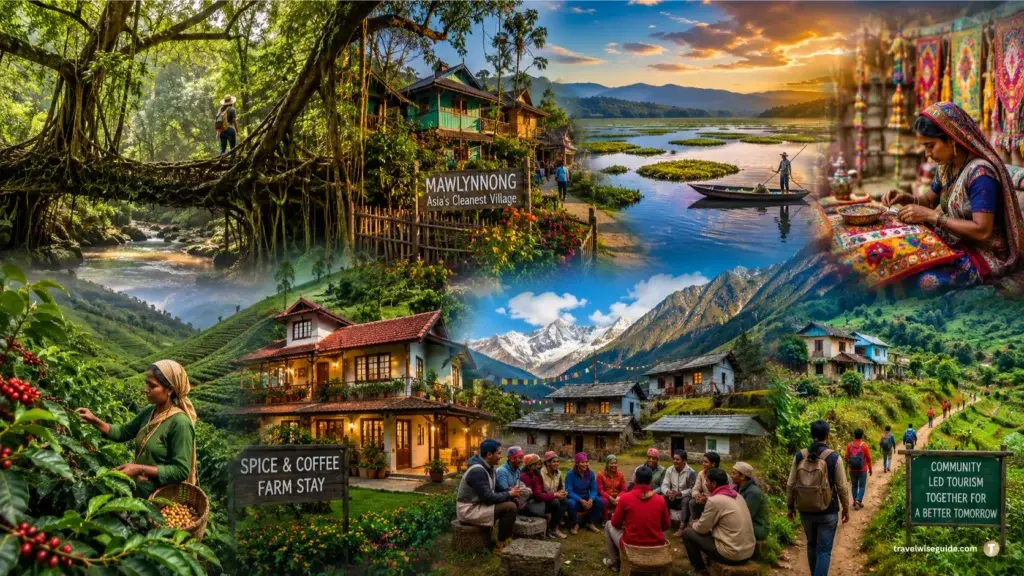
2. Meghalaya – crown of cleanest village in Asia

Home to the Living Root Bridges — nature’s own architecture. Villages like Mawlynnong, cleanest village in Asia redefine cleanliness and harmony with nature


Quick Travel Snapshot – Meghalaya

Best Time: October – April (dry, green, and perfect for trekking & waterfalls)
How Long: 3 days (Shillong, Cherrapunji, Mawlynnong, Living Root Bridges)
Budget Range: ₹1,800 – ₹5,000 per day (eco stays → boutique nature lodges)
Highlight: Waterfalls roaring through clouds, bamboo bridges over emerald valleys, and villages that live in perfect harmony with nature.

Social ,Cultural , Economical and behaviorual factors of the village how and why Mawlynong village is Asia’s cleanest vilage


3. Manipur – The Jewel of the East

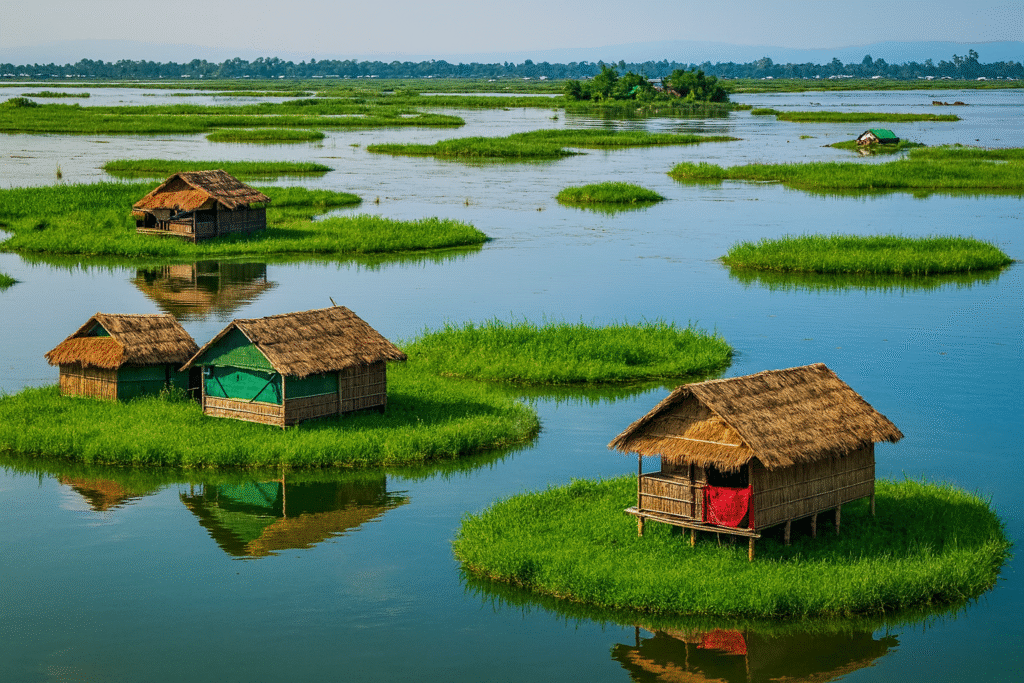
Cradled in green valleys and blue hills, Manipur shimmers with quiet grace. Loktak Lake glides with floating islands called phumdis, fishermen row through silver waters, and the rare Sangai deer moves like a dream through Keibul Lamjao National Park. Here, nature and tradition flow together like poetry

loktak lake in manipur

Best Time: October – March (cool, pleasant weather for lake visits & festivals)
How Long: 2 – 3 days (Imphal, Loktak Lake, Keibul Lamjao, Kangla Fort)
Budget Range: ₹1,800 – ₹4,500 per day (guesthouses → eco-resorts)
Highlight: Floating islands, shimmering lakes, women-run bazaars, and the serene rhythm of life that makes Manipur one of India’s most graceful hidden gems

word’s only Floating village on Lokatak Lake read my Blog to know more about it .


4. Nagaland – Land of Tribes and Fire

In Nagaland, the hills echo with drums, dances, and stories passed down through generations. Each village is a world of its own — wooden totems, handwoven shawls, and fierce pride in age-old traditions. Every December, the Hornbill Festival in Kohima turns the state into a living museum of colour, rhythm, and courage.


Quick Travel Snapshot – Nagaland

Best Time: November – February (cool weather and Hornbill Festival season)
How Long: 2 – 3 days (Kohima, Kisama Heritage Village, Khonoma, Mokokchung)
Budget Range: ₹2,000 – ₹5,000 per day (homestays → heritage lodges)

Highlight: Tribal culture alive in music, dance, and craft — Nagaland celebrates identity under open skies where bonfires glow and warriors sing.


5. Arunachal Pradesh – Where the Mountains Whisper Prayers

Tucked in India’s far northeast, Arunachal feels like a frontier between earth and sky. Prayer flags flutter over misty valleys, monasteries like Tawang glow golden at dawn, and rivers slice through forests alive with orchids and birdsong. It’s raw, remote, and breathtakingly peaceful.


 Quick Travel Snapshot – Arunachal Pradesh

Best Time: October – April (clear skies, blooming valleys, perfect for monasteries & treks)
How Long: 4 – 5 days (Tawang, Bomdila, Ziro Valley, Dirang, Namdapha National Park)
Budget Range: ₹2,500 – ₹6,500 per day (homestays → boutique mountain lodges)
Highlight: Snow peaks, ancient monasteries, tribal villages, and a silence so pure it feels sacred — Arunachal is the Himalayas in their most untouched form.


6. Odisha – Of Temples and the Sea

The Sun Temple at Konark gleams like a celestial chariot; Puri’s Jagannath Rath Yatra floods the streets with faith and fervour

Stone chariot wheel and carved panels of the Konark Sun Temple (Konark), Odisha, under a clear blue sky.

Quick Travel Snapshot – Odisha

Best Time: November – February (cool coastal weather for temples & beaches)
How Long: 2 – 3 days (Bhubaneswar, Puri, Konark, Chilika Lake)
Budget Range: ₹1,500 – ₹5,000 per day (pilgrim stays → beach resorts)
Highlight: Ancient temples carved like poetry, sea breezes over the Bay of Bengal, and festivals that light up the coast with devotion.

.

7. Kolkata – The Cultural Capital

Once the seat of the British Raj, Kolkata blends colonial grandeur with modern intellect — where art cafés, trams, and Tagore’s legacy live on

.

Victoria Memorial, Kolkata — white-marble memorial and museum reflected in the foreground water garden.

Quick Travel Snapshot – Kolkata

Best Time: October – February (pleasant weather; Durga Puja season at its peak)
How Long: 2 – 3 days (Victoria Memorial, Howrah Bridge, College Street, Kalighat Temple)
Budget Range: ₹2,000 – ₹5,500 per day (colonial hotels → boutique stays)
Highlight: The beating heart of art, literature, and sweets — trams, chai, and Tagore’s spirit in every corner.


 West India – Desert Sands and Coastal Charm

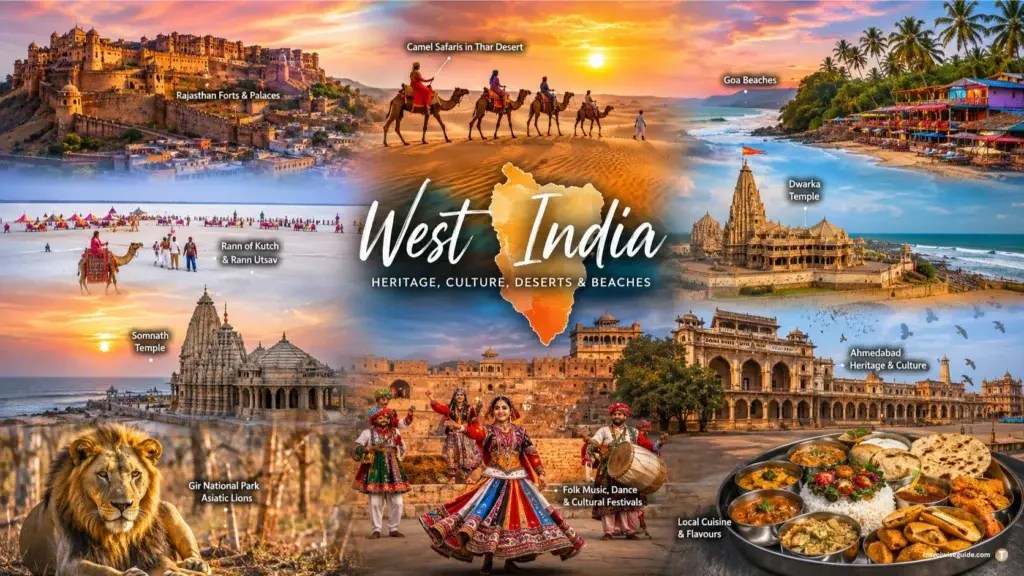
Where the desert winds meet the sea breeze, West India unfolds like a tapestry of gold and blue. Forts rise from sunlit dunes, palaces shimmer on lake mirrors, and white salt plains glow beneath moonlight. From Rajasthan’s royal echoes to Goa’s easy tides and Gujarat’s sacred shores, this region moves between splendour and simplicity — timeless, sun-kissed, and full of song.


1. Rajasthan – Where Legends Ride the Wind

From the golden dunes of Jaisalmer to the marble palaces of Udaipur, Rajasthan stages a spectacle of royal life. Camel caravans, mirror-worked havelis, folk music under star-spangled skies — timeless India at its most theatrical.

The Lake Palace, Udaipur, floating on Lake Pichola at dusk with violet reflections on the water.

Quick Travel Snapshot – Rajasthan

Best Time: October – March (cool desert weather, festival season at its peak)
How Long: 4 – 6 days (Jaipur, Jodhpur, Jaisalmer, Udaipur circuit)
Budget Range: ₹2,000 – ₹7,000 per day (heritage havelis → royal palace stays)
Highlight: Golden deserts, pink palaces, blue cities, and royal forts — Rajasthan feels like India’s soul dressed in colour, music, and majesty.

 Rajasthan Essentials — 7 days (Jaipur → Jodhpur → Jaisalmer → Udaipur)

An immersive heritage & desert circuit. Best: Oct–Mar.

Day 1 — Arrive Jaipur: City Palace, Jantar Mantar.
Day 2 — Amber Fort, local bazaars, depart for Jodhpur (evening train/drive).
Day 3 — Jodhpur: Mehrangarh, Jaswant Thada; night drive to Jaisalmer or next morning.
Day 4 — Jaisalmer: Fort, havelis, evening desert camp & camel safari.
Day 5 — Travel to Jaisalmer/Udaipur (long day) or add stop at Bikaner.
Day 6 — Udaipur: City Palace, boat trip on Lake Pichola.
Day 7 — Monuments, local crafts, onward travel.

Tip: If time is tight, drop Jaisalmer or split into two separate Rajasthan posts (one western forts, one lakes & palaces).


2. Goa – Where the Sun Meets the Soul

Beyond beaches and parties lies another Goa: spice farms, 17th-century churches, serene Portuguese villas. Sunset cruises on the Mandovi weave romance into every wave.


Quick Travel Snapshot – Goa

Best Time: November – February (sunny, breezy, and perfect for beaches & nightlife)
How Long: 3 – 5 days (North & South Goa blend — beaches, forts, churches, spice farms)
Budget Range: ₹2,000 – ₹8,000 per day (hostels → luxury beach villas)
Highlight: From sunrise yoga on quiet sands to sunset cruises on the Mandovi, Goa blends relaxation, heritage, and freedom in every golden ray.

 Goa — 3–4 days (Beaches & culture)

Beach + Portuguese heritage. Best time: Nov–Feb.

Day 1 — North Goa beaches (Baga/Calangute), evening beach shacks.
Day 2 — Old Goa churches (Basilica of Bom Jesus), Panaji Latin Quarter (Fontainhas).
Day 3 — South Goa for quieter beaches (Palolem/Colva) or spice plantation & backwater cruise.
Day 4 — Optional dolphin trip / day at leisure.

Tip: Pair with Golden Triangle for a mix of culture + beach (domestic flight).


3. Gujarat – Vibrant Heritage

Stepwells of Adalaj, white sands of Rann of Kutch, Sabarmati Ashram — Gujarat balances culture with craft.


Quick Travel Snapshot – Gujarat

Best Time: November – February (ideal for Rann Utsav & temple visits)
How Long: 3 – 4 days (Ahmedabad, Rann of Kutch, Somnath, Dwarka)
Budget Range: ₹1,800 – ₹6,000 per day (pilgrim lodges → boutique desert camps)
Highlight: A land of stepwells, salt deserts, lions, and legends — Gujarat glows with a quiet pride where history, spirituality, and craftsmanship meet.


CENTRAL INDIA – The Wild & Spiritual Heart of the Country

Between the deserts of the west and the hills of the east beats India’s quiet heart — a land where jungles breathe stories and stone whispers prayer. Tigers roam through mist-laced forests, while temple bells echo from Khajuraho to Ujjain. Here, faith and wilderness share the same sky — ancient, untamed, and endlessly alive.


1. Khajuraho, Madhya Pradesh – Temples that Breathe Art

UNESCO World Heritage Site — world-famous for its 1,000-year-old temples carved with gods, dancers, and intricate human emotions.
Cluster: Heritage & Architecture, UNESCO


Quick Travel Snapshot- Khajuraho

Best Time: October – March (pleasant, best for exploring temples)
How Long: 1 – 2 days (Western & Eastern Group of Temples, Light & Sound Show)
Budget Range: ₹2,000 – ₹5,000 per day (budget guesthouses → heritage stays)
Highlight: Intricately carved temples that capture divinity, beauty, and life’s grace in stone — timeless storytelling through sculpture


2. Bandhavgarh National Park – Realm of the Tiger

India’s top tiger-spotting reserve. Bandhavgarh National Park in Madhya Pradesh is a premier tiger reserve world-famous for its high density of Royal Bengal Tigers and the historic Bandhavgarh Fort.

Bengal tiger resting on a rock amid dense green foliage at Bandhavgarh Tiger Reserve, Madhya Pradesh.

Quick Travel Snapshot- Bandhavgarh

Best Time: November – April (cool weather, prime tiger-spotting months)
How Long: 2 – 3 days (morning & evening safaris, Bandhavgarh Fort, Tala Zone)
Budget Range: ₹4,000 – ₹8,000 per day (forest lodges → luxury resorts)
Highlight: Sal forests echoing with peacocks and alarm calls — one of the best places in India to meet the royal Bengal tiger in its wild home.


3. Kanha National Park  – The Jungle Book’s Heart

The forest that inspired The Jungle Book. Known for its Barasingha deer, lush meadows, and misty morning safaris.
 

Quick Travel Snapshot- Kanha National Park

Best Time: October – June (best visibility in March–May)
How Long: 2 – 3 days (safaris in Mukki & Kisli zones, nature walks, tribal villages)
Budget Range: ₹4,500 – ₹9,000 per day (eco-lodges → safari retreats)
Highlight: Rolling meadows, misty forests, and the golden deer (barasingha) grazing — Kanha feels like a living page of Kipling’s India.

Wildlife & Tigers — 3–4 days (Kanha / Bandhavgarh / Ranthambore)

Best time for sightings: Oct–Jun (varies by reserve).

Day 1 — Arrive gateway town, evening safari briefing.
Day 2 — Early morning safari + afternoon safari (or guided walk).
Day 3 — Village nature walk, afternoon safari; depart evening or next morning.

Tip: Book jeep safaris through the park’s authorised portals; guide quality matters for sightings.


 4. Sanchi Stupa (Near Bhopal)

One of India’s oldest Buddhist monuments — built by Emperor Ashoka, radiating peace and simplicity.
Cluster: Spiritual Tourism, UNESCO

Sanchi Stupa and carved torana gateways at Sanchi, Madhya Pradesh, India — ancient Buddhist monument (UNESCO)

Quick Travel Snapshot – Sanchi Stupa 

Best Time: November – February (pleasant & clear for heritage walks)
How Long: Half – 1 day (Stupa Complex, Museum, Ashoka Pillar)
Budget Range: ₹1,500 – ₹3,500 per day (nearby Bhopal stay options)
Highlight: One of India’s oldest Buddhist monuments — ancient gateways narrate the Buddha’s life through timeless carvings.


 5. Ujjain – The City of Mahakal

A Jyotirlinga site and one of the four Kumbh Mela destinations. The Mahakaleshwar Temple and evening aarti on the Shipra River make it deeply spiritual.

Quick Travel Snapshot –  Ujjain 

Best Time: October – March (cool and festive; Shivratri celebrations)
How Long: 1 – 2 days (Mahakaleshwar Temple, Shipra Aarti, Kal Bhairav Temple)
Budget Range: ₹1,500 – ₹4,000 per day (dharmshalas → mid-range hotels)
Highlight: The hypnotic sound of temple bells, lamps along the Shipra River, and the energy of devotion that never sleeps.


 6. Gwalior– A Symphony in Stone

Dominated by its massive hill fort, elegant palaces, and the Tansen Music Festival. A perfect link between Delhi-Agra and Central India.
Cluster: Heritage, Cultural Tourism

“Gwalior Fort, majestic hilltop fortress in Madhya Pradesh, India, showcasing Rajput architecture with sandstone walls and blue tile ornamentation

Quick Travel Snapshot – Gwalior

Best Time: October – February (pleasant for fort climbs & festivals)
How Long: 1 – 2 days (Gwalior Fort, Jai Vilas Palace, Tansen Tomb)
Budget Range: ₹2,000 – ₹5,000 per day (heritage stays → boutique hotels)
Highlight: A hill fort that sings with history, royal palaces gleaming in the sun, and music echoing through its ancient courtyard


 7. Bhopal & Bhimbetka Caves – Lakes and Living History

Bhopal — the serene “City of Lakes.” Nearby Bhimbetka (UNESCO) holds prehistoric cave paintings — proof of India’s earliest artistry.Prehistoric diorama at Indira Gandhi Rashtriya Manav Sangrahalaya, Bhopal — life-size figures in a cave exhibit

Prehistoric diorama at Indira Gandhi Rashtriya Manav Sangrahalaya, Bhopal — life-size figures in a cave exhibit.


Quick Travel Snapshot – Bhopal & Bhimbetka Caves

Best Time: October – March (ideal weather for heritage & outdoor visits)
How Long: 2 days (Upper Lake, Tribal Museum, Bhimbetka Rock Shelters)
Budget Range: ₹2,000 – ₹5,000 per day (city hotels → eco resorts)
Highlight: Peaceful lakeside charm meets prehistoric wonder — where early humans painted stories on stone, long before words existed.


 8. Orchha

A hidden riverside gem near Jhansi — ancient temples, palaces, and cenotaphs reflected in the Betwa River. Perfect for “Hidden Heritage Trails.”

Quick Travel Snapshot – Orchha

Best Time: October – March (pleasant for river walks & fort exploration)
How Long: 1 – 2 days (Orchha Fort Complex, Chaturbhuj Temple, Betwa River Ghats)
Budget Range: ₹1,800 – ₹4,500 per day (heritage homestays → riverside lodges)
Highlight: Royal cenotaphs mirrored in the river at sunset, echoing temples, and the timeless calm of a medieval town that never really left the past  Gwalior -Orchha -Bhopal 4 Days

Gwalior -Orchha -Bhopal 4 Days

Day 1: Reach Gwalior — half day sightseeing, overnight.

Day 2: Morning train/drive to Orchha (2–3 h), explore Orchha, overnight in Orchha.

Day 3: Morning more Orchha / relaxed start → afternoon drive to Bhopal (4–6 h) and check in.

Day 4: Full day Bhopal (museums, lakes, markets). Optionally add Day 5 for nearby Sanchi (half-day) or Van Vihar safari.


Themes of Indian Tourism

India’s tourism weaves faith, nature, art, and sustainability into journeys that transform both traveller and land.

Travelling in India isn’t just about geography — it’s about experience. Every traveller finds a theme that mirrors their spirit.


🕉️ Spiritual Tourism – A Journey Inward

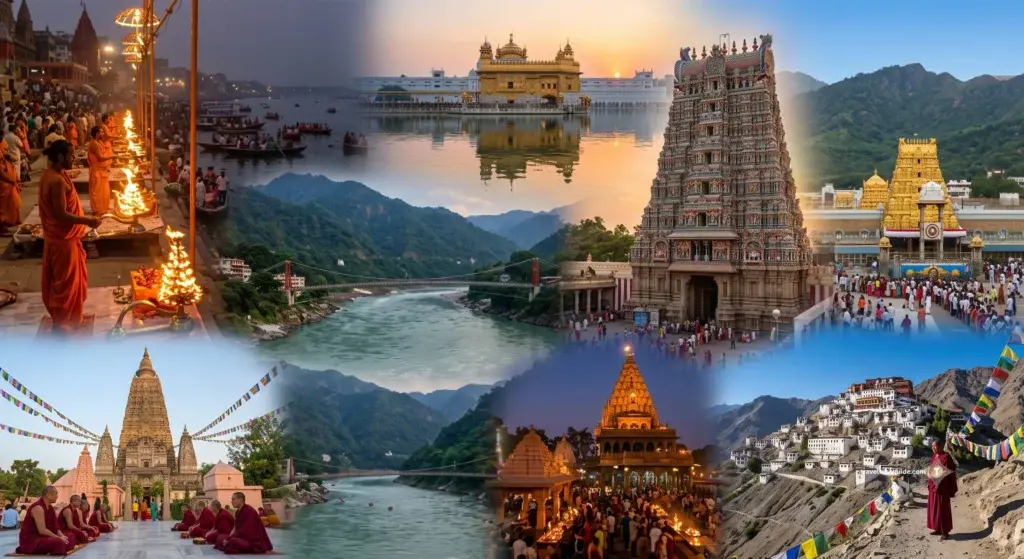
For centuries, India has been the world’s spiritual classroom. Pilgrims bathe in the Ganga, meditate in Himalayan monasteries, chant at Rishikesh’s ashrams, and circle the sacred shrines of Tamil Nadu.
Here, divinity isn’t distant — it breathes in rivers, bells, mountains, and silence.

✨ Sacred Journeys in India at a Glance

🏛️ Destination / Site📍 State / Region🌸 Faith / Tradition🗓️ Best Time to Visit💰 Budget Range (₹/day)🧭 Highlights / Experience
VaranasiUttar PradeshHinduismOct – Mar2 000 – 5 000Ganga Aarti, sunrise boat ride, Sarnath stupa
AyodhyaUttar PradeshHinduismOct – Mar1 500 – 4 000Ram Mandir, Sarayu Aarti, Deepotsav lights
Bodh GayaBiharBuddhismNov – Feb1 800 – 4 500Bodhi tree meditation, Mahabodhi Temple
Rishikesh & HaridwarUttarakhandHinduism & YogaSept – Apr2 000 – 5 000Ganga Aarti, yoga ashrams, rafting & meditation
MaduraiTamil NaduHinduismDec – Mar2 500 – 6 000Meenakshi Temple, night aarti, Dravidian art
RameswaramTamil NaduHinduismNov – Feb2 000 – 5 000Jyotirlinga temple, sea dip, Pamban Bridge
TirupatiAndhra PradeshHinduismOct – Mar2 000 – 5 000Balaji Darshan, hill sanctum, prasadam queue
AmritsarPunjabSikhismNov – Feb2 000 – 4 000Golden Temple, langar service, Wagah border
Leh & LadakhJammu & Kashmir / LadakhBuddhismMay – Sept3 000 – 6 000Monasteries of Hemis, Thiksey, Lamayuru

🌿 Pro Tip: Visit spiritual hubs early morning or during evening aartis — it’s when the energy feels most alive and peaceful.

 🛕Northern India – Where Faith Meets the River

1. Varanasi, Uttar Pradesh

On the ghats of the Ganga, lamps float like stars on water and chants rise into the mist. Life and liberation meet here in the same breath — every sunrise feels sacred.

2. Ayodhya, Uttar Pradesh

Cradled by the Sarayu, Ayodhya glows with timeless devotion. The grand Ram Mandir stands as faith reborn — its lights mirror the river’s calm.

3. Rishikesh & Haridwar, Uttarakhand

The air hums with mantras and the scent of sandalwood. Between ashrams and rapids, the Ganga flows like a living hymn


🌳Eastern India – The Path of Enlightenment

1. Bodh Gaya, Bihar

Beneath the Bodhi tree, silence itself feels awakened. Pilgrims meditate where the Buddha once sat — seeking not miracles, but mindfulness.


🙏Southern India – Temples of Living Divinity

1. Madurai, Rameswaram & Tirupati

In the north, Mughal artisans turned architecture into poetry.
The Taj Mahal blushes at sunrise, Fatehpur Sikri echoes with forgotten footsteps, and Agra Fort guards centuries of power and love.
Their design blended Persian elegance with Indian imagination — creating the golden age of symmetry, marble inlay, and charbagh gardens that still define northern India’s skyline.

🕊️Western & Himalayan Peace Circuits


1. Amritsar, Punjab

The Golden Temple shimmers like a reflection of heaven. Thousands share langar here daily — equality served on a plate.

Golden Temple (Swarn Mandir) in Amritsar illuminated at dusk, reflecting Sikh architecture in the Amrit Sarovar

2. Ladakh’s Monasteries

Perched high above silent valleys, prayer flags flutter against the sky. Meditation halls hum softly — stillness becomes a landscape.


India’s Major Spiritual Circuits

Circuit Name🛕 Key Sites🗓️ Ideal Duration✨ Experience
Char Dham YatraBadrinath, Dwarka, Puri, Rameswaram12–15 daysFour corners of Hindu faith; life’s full circle
Buddhist TrailBodh Gaya, Sarnath, Kushinagar, Lumbini (Nepal)7–10 daysJourney through Buddha’s enlightenment path
Jyotirlinga RouteSomnath, Rameswaram, Ujjain, Varanasi10–12 daysThe 12 shrines of Lord Shiva
Sikh Heritage TrailAmritsar, Anandpur Sahib, Patna Sahib5–7 daysFaith, history, and brotherhood
South India Temple TrailMadurai, Thanjavur, Tirupati, Kanchipuram7–9 daysDravidian art, devotion & architecture

Each circuit can be your own journey — not to a destination, but to understanding.


Closing Reflection

India doesn’t just build temples — it builds experiences that quiet the mind and awaken the heart.
Here, every river is sacred, every mountain feels alive, and even silence has a story to tell.


Nature & Adventure – Wild Horizons of India

India’s landscapes promise both thrill and tranquillity — from snow to sea, every horizon invites a different kind of heartbeat.
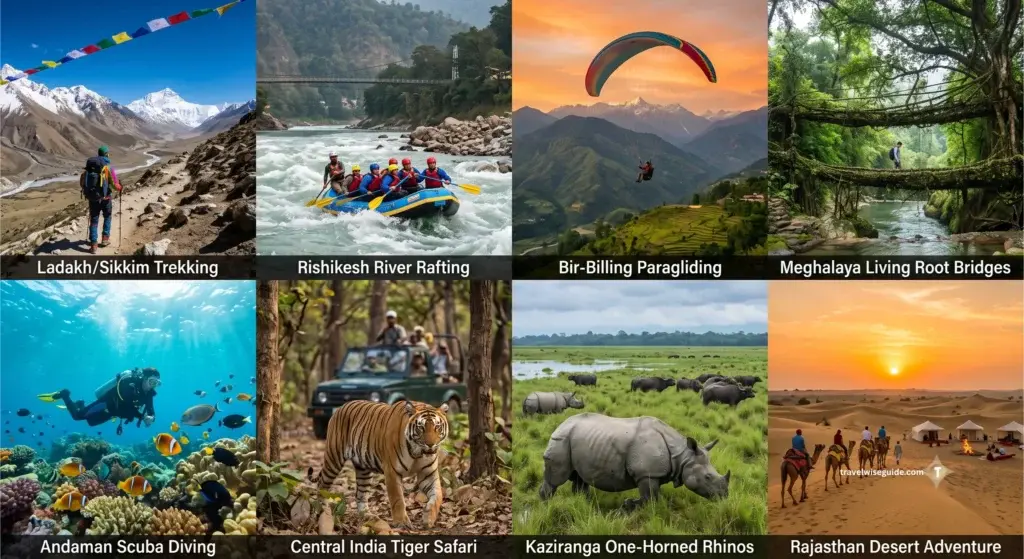
Whether you crave frozen treks, coral dives, jungle safaris, or sky-high glides, every region hides an adventure that feels both epic and intimate.


Adventure Matrix: Experiences at a Glance

🧗‍♀️ Adventure / Destination🗓️ Best Season⚡ Difficulty💰 Typical Cost (₹)📅 Book Ahead?🔒 Safety Tip
Ladakh – Chadar (Zanskar) TrekJan – Feb★★★★☆ (High altitude)25 000 – 40 000✅ Yes, limited slotsAcclimatise for 2 days before trekking
Sikkim – Flower Valley TrailsApr – Jun★★☆☆☆5 000 – 10 000OptionalCarry warm layers; weather changes fast
Meghalaya & Wayanad – Glass BridgesOct – Apr★☆☆☆☆500 – 1 500NoWear grip shoes; avoid in heavy rain
Rishikesh – Ganga River-RaftingOct – Jun★★☆☆☆800 – 2 000WeekendsAlways wear life jacket & helmet
Bir-Billing – ParaglidingMar – Jun, Oct – Nov★★★☆☆2 000 – 4 000Same-day okChoose licensed pilots only
Andamans – Scuba DivingNov – Apr★★☆☆☆3 000 – 6 000✅ YesCertified dive school essential
Kanha National Park – Tiger SafariOct – Jun★☆☆☆☆2 500 – 4 000✅ YesMorning safari = best sightings
Kaziranga NP – Rhino WatchingNov – Apr★☆☆☆☆2 000 – 3 500✅ YesKeep distance; silent photography only

🌿 Pro Tip: Mix one mountain, one water, and one wildlife experience — it gives your itinerary the perfect rhythm of adventure and calm.


❄️ High-Altitude Adventure

1. Ladakh’s Frozen Zanskar River Trek

 Walking on ice feels like stepping across a frozen galaxy — every crunch echoes between sheer canyons. Silence hums louder than sound.

Frozen Zanskar River Trek in Ladakh with icy trail between towering Himalayan mountains

2. Paragliding over Bir-Billing

The wind lifts you into sunlight; the Dhauladhar peaks unfold beneath your wings. Freedom suddenly feels tangible.


🌸 Nature Trails & Valley Blooms

1. Sikkim’s Flower-Filled Valleys

When spring arrives, rhododendrons burst like confetti across the hills, and monasteries chime       softly in the distance.


2. Glass Bridges of Meghalaya & Wayanad

Walk high above emerald forests where clouds brush your feet — equal parts thrill and serenity.

Wayanad Glass Bridge surrounded by lush green hills in Kerala’s misty Western Ghats  Image title:

Shows thrill and modern adventure tourism — perfect to show India’s new travel trends as Glass bridges in India


🌊 Water Adventures

1. River-Rafting on the Ganga in Rishikesh

The rapids roar, cold spray kisses your face, and temple bells echo from the banks — adrenaline with a touch of divinity.


2. Diving in the Andamans’ Coral Gardens

Scuba diver exploring colourful coral reef with tropical fish in clear blue ocean

Beneath turquoise waves, coral blooms like living sculpture and fish glitter like shards of light.


🐅 Wildlife & Jungle Safaris

1. Tiger Safari – Kanha National Park

A rustle in the tall grass… and there he is — orange, black, and utterly calm in his ancient kingdom

.

2. Rhino Watching – Kaziranga National Park

Misty wetlands, elephants on the horizon, and the quiet dignity of the one-horned rhino — nature’s own royalty.


🌠 Optional Add-Ons

  • Hot-Air Balloon Ride – Jaipur / Goa
    Sunrise views, aerial photography, and gentle thrills.
  • Desert Camping – Jaisalmer
    Camel rides, folk music, and starlit dunes.
  • Caving – Meghalaya’s Mawsmai or Arwah
    Underground waterfalls and ancient limestone formations.


Closing Reflection

Adventure in India isn’t about danger — it’s about discovery.
From Himalayan ice to coral light, every thrill brings you closer to the pulse of the planet — and the quiet courage within yourself. 


 Heritage & Architecture – Stones That Speak

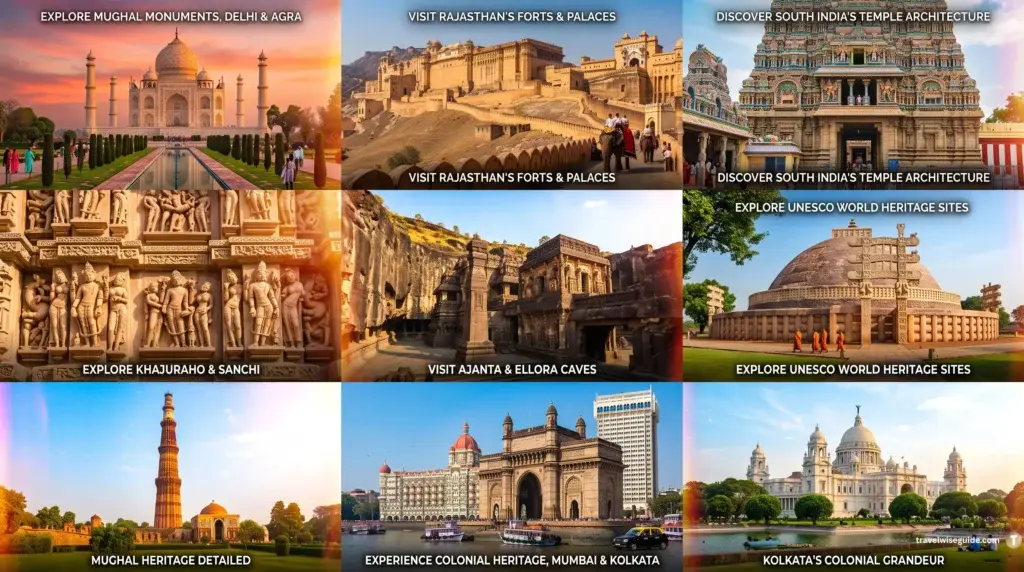
Every dynasty that touched India left behind its story in stone — walls that whisper, domes that glow, and pillars that still remember prayers. From the marble dreams of the Mughals to the towering temples of the Cholas, each era carved its own version of eternity


🌸 The Mughals – Symmetry and Soul in Stone

in the north ,Mughals tuned architecture into poetry .The Taj Mahal blushes at sunrise, Fatehpur Sikri echoes with forgotten foot steps,and Agra Fort guards centuries of Powrer and love .Their design blended Persian elegance with Indian imagination –creating the golden age of symmetry, marble inlay ,and charbagh gardensthat stilldefine northern india’s skyline.

🏰 The Rajputs – Desert Forts and Royal Legends

Across Rajasthan, the Rajput kings built citadels that rise like mirages from the dunes.
Mehrangarh towers above the blue lanes of Jodhpur, Amber Fort glows gold at dusk, and Chittorgarh stands proud in eternal silence.
Every carving, courtyard, and gate tells tales of honour, courage, and desert grandeur — history preserved in sandstone and legend

.

🕉️ The Cholas – Temples Carved in Devotion

In the deep south, the Cholas turned stone into prayer.
The Brihadeswara Temple of Thanjavur still radiates grace under the Tamil sun — its granite vimana towering over the city like a mountain of faith.
Each sculpture, dancer, and deity seems to move with rhythm, turning devotion into a living art form that still shapes Dravidian temple architecture today.

🕍 The British Era – Colonial Grandeur Reimagined

When the British arrived, India’s architecture embraced a new fusion — domes met Gothic spires, and Indian motifs blended with Victorian order.
The Chhatrapati Shivaji Terminus in Mumbai and Victoria Memorial in Kolkata are enduring icons of that cross-cultural experiment — where empire met elegance, and India absorbed the world without losing itself

.

🗓️ Timeline of Indian Architecture

🏺 Era / Dynasty (Approx. Period)🧱 Signature Style🏛️ Famous Monuments🌿 Legacy
Mauryan Empire (321 – 185 BCE)Rock-cut stupas, polished stone pillars, simple Buddhist formsSanchi Stupa, Ashokan PillarsBirth of monumental Buddhist architecture & symbolism of dharma
Gupta & Early Hindu Period (320 – 550 CE)Cave shrines evolving into free-standing templesAjanta Caves, Dashavatara Temple (Deogarh)Classical foundation of Hindu temple design & sculpture
Mughal Empire (1526 – 1857 CE)Symmetry, domes, pietra-dura marble inlay, Persian gardensTaj Mahal, Fatehpur Sikri, Red FortIndo-Persian fusion artistry & refined geometry
Rajput Kingdoms (8th – 18th Century CE)Fortified hilltop cities, havelis, sandstone carvingsAmber Fort, Mehrangarh, ChittorgarhHeroic desert grandeur & continuity of Hindu motifs
Chola & Dravidian South (9th – 13th Century CE)Towering gopurams, granite sculptures, temple complexesBrihadeeswara Temple, Gangaikonda CholapuramSouth India’s temple legacy — devotion in stone
British Colonial Period (1757 – 1947 CE)Gothic revival, Neo-Classical, Indo-Saracenic blendVictoria Memorial, CSMT MumbaiEast–West fusion shaping colonial urban identity

From stupas to spires, India’s architecture didn’t replace — it remembered. Each age added a verse to the same eternal poem of stone.


🗺️ Stone Trails of India

🧭 Trail Name✨ Route🧳 What You’ll Experience
Mughal Marvels RouteDelhi → Agra → Fatehpur SikriMarble domes, Persian gardens, and tales of empire & love
Rajput Royal CircuitJaipur → Jodhpur → Udaipur → JaisalmerDesert forts, palaces, and sunsets that glow like gold
Dravidian Temple TrailMadurai → Thanjavur → RameswaramGopurams, rituals, and the living soul of Chola devotion
Colonial Heritage WalksMumbai → Kolkata → PondicherryVictorian facades, Indo-Saracenic domes, and sea-side nostalgia
UNESCO Heritage ClusterKhajuraho → Sanchi → Ajanta → ElloraSacred carvings, ancient caves, and timeless spirituality

💡 Each trail is a journey through centuries — a museum beneath open skies.

🪶 Did You Know

  • 🐘 The Brihadeeswara Temple’s dome was lifted without cranes — a 6 km earthen ramp and elephants made it possible.
  • 🔊 The Red Fort’s Diwan-i-Khas has whispering walls where even a murmur carries.
  • 💎 The Taj Mahal’s minarets lean outward to protect the dome during earthquakes.
  • 🌇 The Vijay Stambh at Chittorgarh Fort glows golden at sunset, visible for miles.
  • 🕍 The Victoria Memorial was carved from the same Makrana marble as the Taj Mahal.

🌿 Eco & Village Tourism – Living Close to Nature

Far from the bustle, India’s villages sustain its soul. Here, life moves with the rhythm of rain and wind — where bridges grow out of trees, homes breathe with the earth, and every traveller rediscovers simplicity. From the bamboo trails of Meghalaya to the spice-scented hills of Kerala, these places remind us that sustainability isn’t modern — it’s ancestral.


🌱 Living Root Bridges of Meghalaya

In Meghalaya’s misty forests, ancient Khasi villagers guided the roots of fig trees across rivers, shaping bridges that feel alive beneath your feet. The air smells of moss and rain; the sound of water merges with birdsong. To walk here is to witness patience turned into architecture — a living lesson in nature’s engineering.

Represents India’s eco-tourism and natural wonders; know everything about Living Root Bridges in India in my blog

🪵 Mawlynnong Village, Meghalaya

Crowned as Asia’s Cleanest Village, Mawlynnong is proof that discipline can be beautiful. Every bamboo path gleams after the rain, every home glows with flowers, and the air itself feels freshly washed. Cleanliness here isn’t duty — it’s devotion, a quiet act of gratitude toward the land.


🛶 Loktak Lake, Manipur

Across Loktak’s glassy waters, floating islands drift like green clouds. Fishermen row past stilted homes while lotus blossoms shimmer under the sun. India’s only floating lake feels alive — breathing with the wind, the ripples, and the gentle rhythm of the lives it sustains.


🏜️ Kutch Villages, Gujarat

In the salt-white expanse of Kutch, colour thrives. Women weave mirrors into fabric, artisans carve mud walls into art, and the desert hums with music after sunset. Staying in a Bhunga hut here isn’t a vacation — it’s a dialogue with centuries of craftsmanship and courage.


☕ Wayanad Farms, Kerala

Nestled in the Western Ghats, Wayanad smells of cardamom, coffee, and rain. Bamboo bridges arch over rivers, fireflies light up the night, and life slows to the pace of a monsoon breeze. Here, every cup of chai feels like it’s brewed with the forest’s own calm.


🌾 Eco & Village Tourism Highlights


🌿 Eco Destination📍 Location🕓 Best Time to Visit🛖 Experience Type💫 Highlight / Unique Feature
Living Root BridgesMeghalayaOct – AprGuided eco-trek, nature walks100% organic bridges grown over centuries
Mawlynnong VillageMeghalayaOct – MarEco-homestays, village lifeAsia’s cleanest village with zero waste policy
Loktak LakeManipurNov – MarHouseboat stay, birdwatchingIndia’s only floating lake with “phumdis”
Kutch VillagesGujaratOct – FebCraft tours, cultural homestaysMud architecture & mirror-work handicrafts
Wayanad FarmsKeralaAug – FebFarm stays, spice trailsCoffee plantations & bamboo bridges
Spiti Valley HomestaysHimachal PradeshMay – SepMonastery stays, trekkingCold desert ecology & Buddhist village life

🌎 Green Trails of India

🧭 Trail Name🌿 Route✨ What You’ll Experience
North-East Eco CircuitShillong → Cherrapunji → Mawlynnong → Loktak LakeWaterfalls, root bridges, floating villages
Southern Spice TrailWayanad → Coorg → Nilgiris → ThekkadyFarm stays, spice gardens, rainforest treks
Desert & Craft RouteBhuj → Hodka → Rann of Kutch → Bishnoi VillagesRural art, eco-architecture, desert safaris

Did You Know?

  • 🌿 Living Root Bridges take over 25 years to grow strong enough for human use — some have lasted more than 500 years.
  • 🪵 Mawlynnong recycles 100% of its organic waste using bamboo bins and composting pits.
  • 🛶 Loktak’s “phumdis” are natural floating islands that host homes, farms, and even a national park.
  • 🏜️ In Kutch, traditional Bhunga huts are earthquake-resistant — crafted with mud, thatch, and love.
  • ☕ Wayanad farmers still use ancient rainwater-harvesting methods to protect the Ghats’ fragile ecosystem.

Travelling this way supports communities and preserves the environment — this is true responsible tourism, where every journey gives back.


 Only in India – Wonders You Won’t Find Anywhere in world

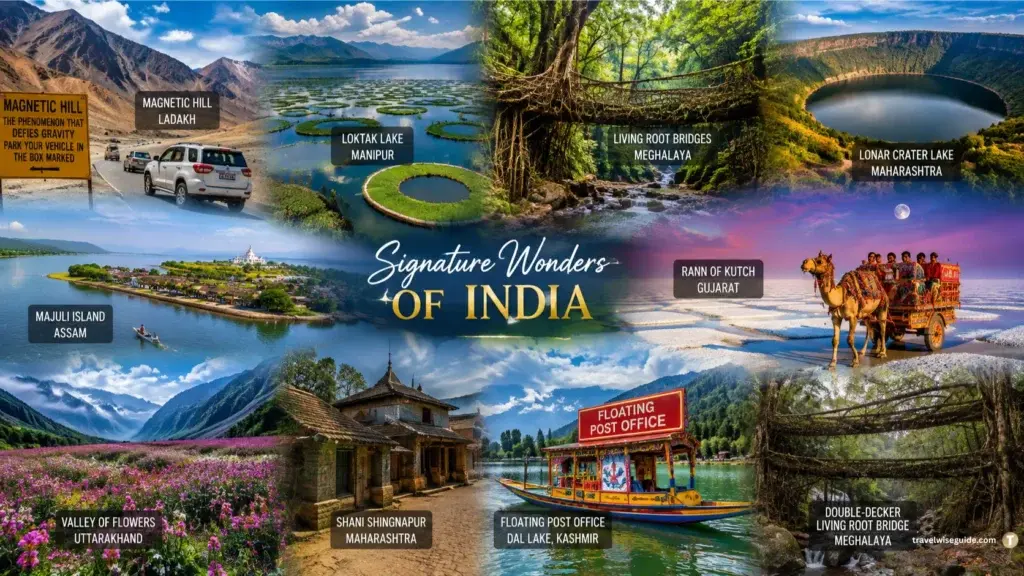
India is a land where logic often pauses for wonder.
Mountains pull cars uphill, lakes float entire villages, and bridges grow from living trees.
Here, every corner hides a phenomenon — part miracle, part mystery — reminding travellers that the extraordinary is everyday life in India.


🌍 Unmissable Marvels of India

In the cold desert of Ladakh, a magnetic hill seems to bend the laws of physics — cars roll uphill even when engines sleep.
Far to the east, Manipur’s Loktak Lake carries homes, gardens, and dreams on its floating phumdis — the world’s only living lake.
In the misty forests of Meghalaya, bridges aren’t built but nurtured; generations of Khasi villagers guide tree roots across rivers until nature itself becomes architecture.
Then there’s Gujarat’s Rann of Kutch, a salt desert so white it glows like moonlight, and Assam’s Majuli Island, the world’s largest river island, where monks paint devotion into dance.
Each wonder tells a story — of science, spirit, and time woven together.


📊 Quick Reference – India’s One-of-a-Kind Attractions

🏞️ Attraction📍 Location🌟 Why It’s Unique🧭 Category
Magnetic HillLadakhCars roll uphill even with engines off — an optical illusion that feels like magic.Natural Wonder
Loktak LakeManipurThe world’s only floating lake, dotted with circular phumdis and fishing villages.Eco-Heritage
Living Root BridgesMeghalayaHand-grown by Khasi tribes, these living bridges strengthen with age.Bio-Architecture
Lonar Crater LakeMaharashtraFormed by a meteor strike 50,000 years ago; alkaline waters in volcanic rock.Scientific Marvel
Majuli IslandAssamThe world’s largest river island, home to monasteries and vibrant art traditions.Cultural/Natural
Rann of KutchGujaratA glowing white salt desert that turns silver under the full moon.Landscape Wonder
Valley of FlowersUttarakhandA UNESCO alpine meadow bursting into rainbow bloom each summer.Natural Paradise
Shani ShingnapurMaharashtraA village with no doors or locks, protected purely by faith in Lord Shani.Spiritual Faith
Floating Post OfficeDal Lake, KashmirThe world’s only post office on water — letters sail across Himalayan reflections.Cultural Curiosity
Double-Decker Root BridgeNongriat, MeghalayaTwo living bridges stacked atop one another — a masterpiece of patience and ecology.Eco-Engineering

These are not just destinations — they’re living wonders, proof that India doesn’t imitate the world; it astonishes it.


 What is the best time to Visit India by region

Because India is huge, the weather depends on hight or altitude “best time” depends on where you’re headed.

SeasonMonthsWeatherIdeal RegionsMajor Festivals
WinterOct – MarPleasant days, cool nightsNorth, East, WestDiwali, Dev Deepawali, Holi
SummerApr – JunHot plains, cool mountainsHimalayas, Sikkim, CoorgBaisakhi, Thrissur Pooram
MonsoonJul – SepLush landscapes, fewer crowdsKerala, Meghalaya, GoaOnam, Teej

Tip: for photographers and festival-lovers, October – March is the golden window.

complete advise on weather and crowed for first -time travellers

Legend: 🟥 = Peak / very busy | 🟨 = Shoulder / moderate | 🟩 = Low / quieter
Icons: ☀️ hot / dry · 🌦️ monsoon / wet · ❄️ cold / snowy

RegionBest monthsCrowd (icon)Quick weather snapshotRapid tip
North India (Delhi, Agra, Varanasi, Jaipur, foothills)Oct–Mar🟥 🟨 (peak Oct–Feb)Cool, dry winters; very hot Apr–Jun; monsoon ends by Sept.Visit Oct–Mar for temples, palaces & safe sightseeing; avoid May–June heat.
Himalayan Hill Stations (Shimla, Manali, Dharamshala, Leh, Uttarakhand)Apr–Jun, Sep–Nov (winter for snow lovers)🟨 🟥 (Dec–Jan for snow)Mild summers, heavy winter snow in higher reaches; monsoon affects some areas.Spring/early summer for trekking; December–January for snow sports (expect crowds at peaks)
West India (Rajasthan, Gujarat)Oct–Mar🟥 (peak Nov–Feb)Pleasant winter days; extremely hot Apr–Jun.Best for desert safaris and festivals in winter; book early during peak months
South India (Kerala, Tamil Nadu, Karnataka, Goa)Oct–Mar (Kerala Oct–Feb; Goa Nov–Feb)🟥 (peak Dec–Jan beach season)Tropical coast: warm year-round; heavy SW monsoon Jun–Sep (Kerala has additional NE monsoon Oct–Dec).For backwaters & beaches choose Oct–Feb; monsoon is great for low-crowd greenery (Kerala).
East India (Kolkata, Odisha, West Bengal)Oct–Feb🟨Post-monsoon pleasant autumn/winter; very wet Jun–Sept.Ideal for cultural trips and festivals after the monsoon.
Northeast (Assam, Meghalaya, Sikkim, Arunachal)Oct–Apr🟨 🟩 (very quiet off-season)Heavy monsoon Jun–Sep; cool pleasant winters.Best Oct–Apr for trekking & viewpoints; monsoon may close some roads. Wikipedia
Central India (Madhya Pradesh, Chhattisgarh)Oct–Mar🟨Dry, cool winters; hot summers; monsoon Jun–Sep.Oct–Mar best for wildlife safaris (tigers) — mornings are best for sightings.

🏛️ Top UNESCO World Heritage Sites in India

India has 44 UNESCO World Heritage Sites (as of Oct 2025) — each a chapter in the world’s oldest living civilization. From marble mausoleums to tropical mangroves, they don’t just showcase architecture — they narrate human stories carved in stone, wood, and water.
To visit them is to walk through time itself.


🗺️ UNESCO Heritage sites in india at a Glance

🏛️ Site📍 State / Region🕰️ Era✨ UNESCO Category💫 Why Visit
Taj MahalUttar Pradesh17th centuryCulturalMarble poetry in motion; symbol of love eternal
HampiKarnataka14th–16th centuryCulturalRuins of the Vijayanagara Empire set in boulder-strewn plains
Kaziranga National ParkAssamNaturalNaturalHome to one-horned rhino; misty wetlands & safaris
Jaipur CityRajasthan18th centuryCulturalA planned city blending art, astronomy & architecture
SundarbansWest BengalNaturalNaturalWorld’s largest mangrove forest; Royal Bengal tiger habitat
Ellora & Ajanta CavesMaharashtra2nd BCE – 9th CECulturalRock-cut monasteries with breathtaking Buddhist art
Khajuraho TemplesMadhya Pradesh10th–11th centuryCulturalTemples of love & divinity carved in stone
Great Living Chola TemplesTamil Nadu11th centuryCulturalContinuously worshipped Dravidian masterpieces

🏯 North India – Marble, Faith & Majesty

1.Taj Mahal, Uttar Pradesh

At dawn, the marble blushes from silver to rose as mist drifts off the Yamuna. The air smells faintly of wet stone — love here doesn’t stand still; it breathes.


2. Jaipur City, Rajasthan

The Pink City hums with geometry and grace. From the Hava Mahal’s latticed windows to the astronomical instruments of Jantar Mantar, Jaipur balances science and splendour.


🏞️ South India – Temples, Stone & Serenity

1. Hampi, Karnataka

Among sunlit boulders rise ruins that once sang with trade and temple bells. Every pillar seems to remember a vanished empire — golden, grand, and hauntingly alive


2. Great Living Chola Temples, Tamilnadu

in Thanjavur and Gangaikonda Cholapuram, lamps flicker on granite that has seen a thousand years of prayer. The gods still live here; devotion never went silent.

Intricate stone mandapa at a Great Living Chola Temple, Tamil Nadu, showing Dravidian pillars, a sculpted chariot wheel, elephants and mythic guardians under a clear sky.

🕉️ Central India – Art and Eternity

1. Khajuraho, Madhya Pradesh

Each sculpture breathes with rhythm — gods, dancers, lovers — all carved into harmony. The warmth of the stone feels almost human, as if touched by centuries of faith.


2. Elora &Ajanta caves, maharastra

Inside these rock-hewn sanctuaries, monks once meditated by flickering oil lamps. Even now, the murals seem to whisper — stories of compassion painted on time’s own canvas.

🌿 East & North-East India – Nature’s Living Monuments

1.Kaziranga National Park, Assam

Where the grasslands meet morning mist, a rhino moves like a relic from another age. Here, nature itself feels sacred.


2. Sundarbans, West Bengal

Tides weave through tangled roots, the forest breathing with salt and silence. Somewhere in that breath, the tiger waits — invisible but very real.


📖 Legacy of UNESCO Heritage sites in India

CategoryNumber of Sites            Examples
Cultural Heritage      36Taj Mahal, Hampi, Ajanta, Khajuraho
Natural Heritage        7Kaziranga, Sundarbans, Western Ghats
Mixed (Cultural + Natural)        1Khangchendzonga National Park (Sikkim)

🕰️ India’s earliest UNESCO site: Ajanta Caves (1983).
🌿 Newest addition: Maratha Military Landscapes of India in (2025)


💡 Did You Know?

  • The Taj Mahal changes colour with the day — white at noon, rose at dusk, and silver under moonlight.
  • Kaziranga shelters over 70% of the world’s one-horned rhinos.
  • The Ajanta murals still use natural pigments made from crushed minerals and plants.
  • The Great Chola Temples were aligned with precise astronomical calculations — centuries before modern tools.

💬 Closing Reflection

To explore India’s UNESCO sites is to walk through a library without pages — where walls, forests, and rivers tell stories older than language.
Each monument, each landscape, isn’t frozen in time; it’s still breathing, still teaching, still waiting for you to list

India’s diversity shines through its UNESCO World Heritage Sites, offering a journey through history and architecture


Festivals & Cultural Highlights of India

🌈 Where Every Day Feels Like a Celebration

India celebrates life not in moments, but in seasons. Every month brings a new rhythm — the sparkle of diyas, the splash of colours, the beat of drums.
Festivals here aren’t just holidays; they are emotions that light up the streets, skies, and hearts alike.
To travel through India is to move through a calendar that dances.


Festival Calendar of India at a Glance

FestivalMonth / SeasonKey Regions    Highlight /              Experience   Theme
DiwaliOct – Nov (Autumn)Pan-IndiaHomes lit with diyas, fireworks, sweetsTriumph of light over darkness
HoliMarch (Spring)North & Central IndiaClouds of colour, drums, joyUnity and renewal
DussehraSept – OctNorth & South IndiaRam Leela plays, Ravana effigiesVictory of good over evil
Durga PujaSept – OctWest Bengal, East IndiaArt-filled pandals, music, danceFeminine power & artistry
OnamAug – SeptKeralaSnake-boat races, flower carpets, feastsHarvest & homecoming
Eid-ul-FitrVaries (Lunar)NationwidePrayers, biryani feasts, charityGratitude & generosity
ChristmasDecemberGoa, Kerala, NE statesMidnight mass, carols, lightsPeace & goodwill
Guru Nanak JayantiNovemberPunjab & DelhiHymns, langar, devotionEquality & compassion

Bookmark this calendar to plan your trip around India’s celebrations — every season tells a different story.


🪔 Festivals of Light and Colour


1.Diwali – The Festival of Lights

Cities glow with millions of lamps, fireworks paint the night, and homes overflow with sweets. In Ayodhya, rivers shimmer under a million diyas; in Jaipur, palaces sparkle like gold.


2.Holi – The Festival of Colours

In March, India becomes a canvas. Mathura and Vrindavan burst into a storm of pinks and greens as drums beat and laughter echoes through the air.


3.Dussehra –  of Good Over Evil

From Mysore’s grand processions to Varanasi’s fiery Ram Leela, Dussehra unites the country in Triumph retelling the timeless victory of virtue.

🌾 Harvest and Home coming

King Mahabali’s legend lives on in floral carpets and grand feasts. Snake boats slice through rivers while families share the 20-dish Onam Sadya on banana leaves.


1. Baisakhi & Pongal – Feasts of Gratitude

In Punjab, drums and bhangra mark the harvest. In Tamil Nadu, pots of milk boil over in thanksgiving as sugarcane and sunlight bless the fields.


✨ Faith and Devotion

1. Eid-Ul-Fitr – Feast After Fasting

After a month of restraint, mosques echo with prayers and homes brim with biryani and sheer khurma. The air feels soft with generosity and gratitude.


2.Guru Nanak Jayanti – Light of Wisdom

Processions glow with saffron flags; hymns float through Amritsar’s dawn air; langars feed thousands — a living lesson in equality.


3. Maha Shivratri & Navratri

From the chants at Varanasi’s ghats to Garba nights in Gujarat, these festivals show how India worships both energy and stillness.


🌎Global Celebrations with Indian Warmth1.

1. Christmas

Goa’s beaches sparkle with stars, choirs fill Kerala’s churches, and even faraway hill towns hum carols beneath pine trees.


2.New Year & Republic Day

Cities turn festive again — fireworks by the Gateway of India, flag hoists on Rajpath, and hope renewed with every anthem sung.

Cultural Trails of India

Trail NameBest TimeRoute / RegionExperience
Festival of Colours TrailMarchMathura → Vrindavan → BarsanaHoli processions, temple rituals, Lathmar Holi
Festival of Lights TrailOct – NovVaranasi → Jaipur → AmritsarDiwali lamps, Ganga Aarti, Golden Temple glow
Harvest & Dance TrailAug – SeptKochi → Thrissur → AlleppeyOnam feasts, Vallam Kali boat races, Kathakali
Winter Cultural TrailDec – JanGoa → Pondicherry → ShillongChristmas markets, coastal concerts, music fests

Did You Know?

  •  Ayodhya’s Dev Deepawali lights over a million diyas along the Saryu  ghats.
  •  Golden Temple, Amritsar, burns more than 2,000 kg of desi ghee lamps during Diwali.
  •  Onam’s Vallam Kali (boat races) can feature 100 rowers per boat.
  •  Over 50,000 artisans work each year to create Kolkata’s Durga Puja pandals.

Closing Reflection

From the chants of temples to the laughter of streets, India’s festivals remind the world that joy itself is sacred.
Here, celebration is not an escape from life — it is life, sung in a thousand colours and a million hearts. 

20-Day India Itinerary for First-Time Tourists.

Phase 1: Delhi – History and Modernity (Day 1 – 4)

DayDestinationKey Places to VisitLocal Food RecommendationsTransport & Essential Tips
1Arrival in New DelhiArrive at Indira Gandhi International Airport (DEL). Check into your accommodation.Dinner at Connaught Place (CP). Try a mid-range Indian thali.Use a pre-paid taxi or the Metro (Airport Express Line). Tip: Get your local SIM card at the airport.
2Old DelhiRed Fort, Jama Masjid, stroll through Chandni Chowk Market, Gurudwara Sis Ganj Sahib.Local Food: Parathas from Parathe Wali Gali, Chaat (street snacks) from Chandni Chowk, Jalebi.Use the Delhi Metro or Auto-rickshaws for transport. Be prepared for crowds!
3New DelhiIndia Gate, Lotus Temple, Qutub Minar, Humayun’s Tomb.Mid-range: Try Nizam’s Kathi Kabab near Humayun’s Tomb.Use Uber/Ola or the Delhi Metro (Yellow Line).
4Travel to AgraTake an early morning train/taxi to Agra. In the afternoon, visit Agra Fort.Agra’s Petha (sweet) and try local Mughlai cuisine in the Tajganj area.Recommended Transport: Train (Shatabdi Express – NDLS to AGC) is fast and comfortable.

Phase 2: Agra and Jaipur – Mughal and Rajputana Grandeur (Day 5 – 8)

DayDestinationKey Places to VisitLocal Food RecommendationsTransport & Essential Tips
5AgraTaj Mahal (ideally at sunrise), sunset view from Mehtab Bagh across the river.Dinner in Sadar Bazaar.Tip: The Taj Mahal is closed on Fridays. Book your tickets online in advance.
6Travel to JaipurMorning travel from Agra to Jaipur. Check in and visit the City Palace in the afternoon.Local Food: The classic Rajasthani meal: Dal Baati Churma.Recommended Transport: Pre-booked taxi/driver—you can stop at Fatehpur Sikri on the way.
7JaipurAmber Fort (jeep/elephant ride), Jal Mahal, and the iconic facade of Hawa Mahal.Lassi from Lassi Wala (MI Road), Pyaaz Kachori from Rawat Mishthan Bhandar.Use auto-rickshaws or taxis.
8JaipurView the city from Nahargarh Fort, visit Jantar Mantar, and Albert Hall Museum.Tip: Explore the local bazaars (Johari Bazar, Bapu Bazar) for handicrafts and textiles.You can watch the Sound and Light Show at Amber Fort in the evening.

Phase 3: Udaipur and Varanasi – Lakes and Spirituality (Day 9 – 14)

DayDestinationKey Places to VisitLocal Food RecommendationsTransport & Essential Tips
9Travel to UdaipurMorning flight or overnight train from Jaipur to Udaipur. Check into a hotel near Lake Pichola.Local Food: Try Laal Maas (if non-vegetarian) or a local Thali.Recommended Transport: An Overnight Train or a Flight is best for this long distance.
10UdaipurBoat ride on Lake Pichola, visit Jag Mandir, the main City Palace complex, and Jagdish Temple.Dinner at a Rooftop Cafe with a view of the Lake Palace at sunset.The main sights are close—explore the area on foot.
11UdaipurSaheliyon Ki Bari, watch the sunset from Monsoon Palace (Sajjangarh Fort).Tip: Hire a taxi/auto-rickshaw to reach Sajjangarh Fort.
12Travel to VaranasiMorning flight from Udaipur to Varanasi (usually a connecting flight). Evening Ganga Aarti at Dashashwamedh Ghat.Local Food: Tamanna Chat Bhandar (for Chaat), Malaiyo (a sweet, seasonal dish).Recommended Transport: Flight is necessary for this major distance change.
13VaranasiSunrise boat ride on the Ganges River, visit Kashi Vishwanath Temple.Local Food: Kachori-Sabzi for breakfast and a famous Banarasi Paan.Tip: Be respectful at the ghats and arrive early to get a good spot for the Ganga Aarti.
14VaranasiDay trip to Sarnath (where Buddha gave his first sermon).

Phase 4: Kerala – Tranquil Backwaters and Hills (Day 15 – 20)

DayDestinationKey Places to VisitLocal Food RecommendationsTransport & Essential Tips
15Travel to KochiFlight from Varanasi to Kochi (Cochin/COK). Check into your hotel in Fort Kochi.Local Food: Sea Food, Kerala’s Appam and Stew.Recommended Transport: Flight—this crosses from North to South India.
16Fort KochiChinese Fishing Nets, Mattancherry Palace, St. Francis Church, Jewish Synagogue.Tip: Watch a Kathakali Dance Performance in the evening.Explore Fort Kochi best on foot or by a rented bicycle.
17Alleppey (Alappuzha)Take a cab from Kochi to Alleppey. Check into a Houseboat in the backwaters.Local Food: Enjoy freshly prepared Kerala-style Fish Curry on the houseboat.Cab/Taxi: Kochi to Alleppey (approx. 1.5 – 2 hours).
18MunnarCheck out of the houseboat. Take a cab from Alleppey to the hill station of Munnar.Munnar Tea.Cab/Taxi: Alleppey to Munnar (hilly route, approx. 5 hours).
19MunnarExplore the Tea Plantations, Eravikulam National Park, Mattupetty Dam.Tip: Pack warm clothes as the climate is cool here.
20DepartureTake a taxi from Munnar to Kochi Airport (COK) for your onward journey.Allow ample time (4-5 hours) for the travel to the airport.

What are the local Etiquette & Rules for India — quick box

India is a country where every relation every place every thing is seen bound with etiquettes and manners which is relative to each other.


Temple manners

  • Remove shoes before entering the prayer area; many temples provide shoe racks. Dress modestly (shoulders & knees covered); some temples enforce stricter dress codes or gender-specific rules — always check ahead.
  • Be quiet and respectful during puja/rituals; accept prasad with your right hand. Avoid touching idols or priestly paraphernalia unless invited.

Photography & filming

  • Photography is generally allowed at most centrally protected monuments, but some sites are exceptions (e.g. the Taj Mahal mausoleum, Ajanta paintings) and professional shoots or tripods/monopods need prior ASI permission. Always look for signs and ask staff.
  • Don’t photograph people (especially women) or worshippers without permission; avoid using flash during rituals.

Drones


Drones require registration/clearance on DGCA’s Digital Sky platform and follow NPNT / UIN/UAOP rules — permissions vary by zone; many cities and sensitive areas are no-fly unless authorised. In practice foreign tourists are frequently not allowed to operate drones without Indian registration/permissions — check DGCA / Digital Sky before you travel.


Behaviour & local rules

Avoid public displays of affection; don’t smoke or spit in temple/heritage precincts; follow signboards and security instructions. Local committees sometimes ban mobiles or set strict dress rules — comply respectfully


.If in doubt, follow the local crowd: bow, say Namaste, and keep your tone low.


Short checklist (paste-ready)

  • Remove shoes; cover shoulders & knees.
  • Ask before photographing people or rituals.
  • No tripods / commercial filming at ASI sites without Form-IX permission.
  • Don’t fly drones without Digital Sky permission / UIN — check local no-fly zones.
  • Respect local dress rules & mobile/phone deposits where enforced.

Travel Planning Tips for first -timer travellers to India

A few smart preparations make your journey smoother:

Visa & Entry: Most nationalities can apply online through India’s official e-Visa portal (https://indianvisaonline.gov.in).

Currency: Indian Rupee (₹); cards and UPI widely accepted, but rural areas need cash.

Transport: Domestic flights, trains (book via IRCTC), and app cabs in major cities.

Health: Stick to bottled water; carry basic medication; consult your doctor for vaccinations.

Safety: India is largely safe for tourists; just stay alert in crowded places.

Dress & Etiquette: Modest clothing near temples; shoes off before entering.

Connectivity: Local SIM (Airtel/Jio) with data plans is cheap and reliable


what are the Health & Safety measures in India— Essentials (box)


Quick headline: Stay well, stay safe — practical tips every traveller needs.

Emergency & helplines (save Emergencymobile numbers in your phone)

  • General emergency (Police / Ambulance / Fire): 112 (pan-India).
  • Tourist helpline (24×7): 1800-11-1363 / short code 1363 (Ministry of Tourism).
  • Women’s helpline: 181 (national women helpline; 1091 also used in distress situations).

Before you travel

  • Insurance: Buy travel insurance that covers medical treatment and medical evacuation — check policy exclusions for adventure activities (trekking, motorcycling). (See government travel advice pages for recommended cover).

Vaccinations & prophylaxis: Ensure routine vaccinations are up to date. Discuss malaria risk and prophylaxis with your doctor if you’ll visit rural/forest/monsoon areas; yellow-fever certificates may be required if arriving from endemic countries


On the ground — health basics

  • Water & food: Drink bottled or boiled water; avoid ice/uncooked street salads unless you trust the vendor. Carry oral rehydration sachets for diarrhoea.
  • Mosquito protection: Use repellents, long sleeves after dusk, and a mosquito-net in high-risk areas (dengue & malaria seasons vary by region).
  • Heat & altitude: For summer travel carry sunscreen, hydrate often; for Himalayan trips acclimatise gradually to avoid altitude sickness.
  • First-aid: Pack a small kit (plasters, antiseptic wipes, pain relief, antihistamine, prescription meds, blister plasters). Keep digital & paper copies of prescriptions.

Safety & practical tips

  • Local medical care: Note the nearest hospital/clinic and how to contact your insurer’s 24-hour emergency helpline. Hotel staff can usually call ambulance or translate.
  • Transport safety: Use registered taxis / apps (Ola, Uber) at night; prefer pre-booked transfers for early/late flights.
  • Valuables & scams: Keep photocopies of passport/visa; use hotel safes; be cautious of overly friendly strangers offering “help”. (Register with your embassy if you wish.)

Is India safe for solo female travellers 2025

yes India is safe for solo female traveller having the knowledge of below written points .

  • Travel with a copy of local emergency numbers and a charged phone with offline maps.
  • Prefer well-lit, busy routes late at night; share ETA with someone you trust.
  • Use the 181 women’s helpline or 112 in emergencies; contact the local Tourist Police (1363) for immediate assistance if you’re a visitor

Short paste-ready checklist (one line each)

  • Buy travel insurance with evacuation cover.
  • Check vaccines & malaria advice with your doctor.
  • Save 112, 1363 and 181 in your phone.
  • Carry a small first-aid kit + photocopies of ID & prescriptions.
  • Use hotel / tourist police help if unsure — they speak local protocols.

Budget Breakdown — What to Expect Per Day

Below is a compact, ready-to-paste daily cost range table for India. Amounts are shown in INR with an approximate GBP conversion (rounded) using £1 ≈ ₹119 (Oct 2025 exchange range). Figures are typical daily totals per person and include: accommodation + food + local transport + a couple of activities — not international flights. Numbers are indicative (season, city and travel style change costs a lot) .Exchange rate used: £1 = ₹119 (approx). Exchange Rates

Traveller typeINR / day (typical)Approx. GBP / day (rounded)What this usually covers (example)
Shoestring / Backpacker₹800 – ₹1,800£6.7 – £15.1Dorm or very basic guesthouse; street food & cheap restaurants; local buses/long-route trains; a few paid sights or free walking. (Great for hostels, slow travel, shared transport).
Budget / Value₹1,800 – ₹3,500£15.1 – £29.4Basic private room / budget hotel; mix of street food and restaurants; short taxis or occasional domestic bus/train; 1–2 paid attractions / small guided tours.
Mid-range₹3,500 – ₹7,000£29.4 – £58.83★ hotel / comfortable guesthouse; sit-down restaurants; one domestic flight or frequent taxis; guided day tours, entry fees, modest souvenirs. (Most travellers fall here for comfort + sightseeing).
Premium / Luxury₹7,000 – ₹20,000+£58.8 – £168+4–5★ hotels or boutique stays; restaurant meals; private drivers or business flights; premium guided experiences, private excursions and higher tipping/incidentals.

Quick notes (important)

If you want a one-line rule: train travel + street food + budget stays = biggest savings; flights, private cars and hotels drive costs up.

These ranges come from travel-cost datasets and recent guide articles — daily spend in India varies heavily by region (Delhi / Mumbai and tourist beach/resort areas are pricier; small towns and many backpacking hubs are far cheaper).

Peak seasons & festivals (Diwali, New Year, Holi, high-season months) push prices up for accommodation and transport — budget 20–50% more during these times

Accessibility & Dietary Notes (short)


Accessibility

  • Standards vary; India runs the Accessible India / Sugamya Bharat programme and Ministry of Tourism issues accessible-tourism guidelines — call ahead to confirm facilities.
  • Ask hotels, airlines and IRCTC for assistance (wheelchair/e-wheelchair booking available at nominated stations).
  • Save emergency & tourist numbers: 112 (all-emergency), 1800-11-1363 / 1363 (tourist helpline) and 181 (women’s helpline).

Dietar

  • Vegetarian options are widely available; many places can prepare no-onion / no-garlic (Jain) dishes on request.
  • For allergies: carry translated allergy cards, a doctor’s note and a list of local hospitals in your destination.

Mistakes to Avoid – Learn Before You Land

Top 10 Mistakes for first -time trevellers (and how to avoid them)

  1. Assuming you won’t need the right visa / valid passport — check entry rules well before you fly (passport valid for 6+ months; visa required unless OCI). Fix: sort visa paperwork early.
  2. Not carrying (or scanning) ID & emergency numbers — keep digital + paper copies and save helplines (112, Tourist Helpline 1800-11-1363). Fix: store copies in cloud & phone.
  3. Skipping travel insurance — medical evacuation and trip-cancellation cover are essential. Fix: buy a policy that includes medical & evacuation cover before departure.
  4. Ignoring health precautions (vaccines, water & food safety) — travellers should check recommended jabs and hygiene advice. Fix: visit a travel clinic 6–8 weeks ahead for vaccines & advice.
  5. Underestimating distances and transport rules (train bookings / Tatkal / Aadhaar updates) — booking systems and ID rules change often. Fix: read IRCTC rules and book early; authenticate your IRCTC profile if you may need Tatkal.
  6. Drinking tap water / eating suspicious street food without caution — tummy troubles ruin trips. Fix: use bottled/boiled water, choose busy stalls and carry oral rehydration.
  7. Disrespecting local customs (temple rules, dress, photography) — this causes offence and sometimes fines. Fix: cover shoulders/knees at religious sites, ask before photographing people.
  8. Relying on cash only or, conversely, assuming cards everywhere work — small towns may be cash-heavy while cities accept cards/UPI. Fix: carry a mix of small notes + a card that has low foreign transaction fees.
  9. Flying drones without checking permissions — India requires DigitalSky/DGCA registration and zone permissions. Fix: consult DigitalSky and get UIN/authorisation before bringing/using a drone. digitalsky.dgca.gov.in
  10. Not planning for weather & festivals (monsoon, heat, Diwali/New Year crowds) — weather or festival crowds can affect travel, transport and costs. Fix: check seasonality, book ahead for peak times and plan alternatives for monsoon/heat.

Conclusion – Discover, Learn, Transform

Travelling across India is less about distance and more about discovery. You arrive expecting sights; you leave with stories.
In the hum of a temple bell, in the laughter of children chasing kites, in the fragrance of jasmine and spice — India reveals itself slowly, like a raga unfolding note by note.
Whether you seek enlightenment on the ghats of Varanasi, adrenaline in the Himalayas, serenity in Kerala’s lagoons, or history in Rajasthan’s forts — each journey will change the way you see the world, and yourself.
So pack curiosity, patience, and an open heart. Because in India, the journey never ends — it simply deepens. 

Do I need a visa to enter India?

Yes. Most foreign nationals require a visa to enter India. You should apply for it well in advance of your trip.

What is an e-Visa?

The e-Tourist Visa (eTV) is the most common option for tourists. It’s applied for and granted online (on the official Indian government website), and you receive the electronic authorization before you travel. You will get a sticker visa on arrival at the designated ports of entry.

How long is the e-Visa valid for?

The e-Tourist Visa typically offers options for 30 days, 1 year, or 5 years with multiple entries, depending on the fee paid and your nationality. Validity starts from the date of visa issuance, not your date of arrival, so plan accordingly

What are the basic e-Visa requirements?

You will generally need a passport valid for at least six months from your arrival date, a recent front-facing photograph with a white background, and a copy of the passport’s photo page. You’ll also need a return or onward journey ticket and sufficient funds.

Where do I apply for the e-Visa?

You must apply through the official Indian government visa website (search for “Indian Visa Online”). Be cautious of unofficial third-party websites

Should I carry copies of my visa and passport?

Absolutely. It is a legal requirement to always carry a copy of your passport and visa. Guesthouses/hotels are required to register your stay with the government and will need copies.

What are General Safety precautions ?

Stay Aware: Keep a low profile and monitor your surroundings, especially in crowded areas. Valuables: Keep them secure and avoid flashing expensive items. Scams: Be cautious when strangers offer unsolicited tours, deals, or claim a site is closed—always verify information.

What are the precautions about Health and Food ?

Water: Only drink sealed, bottled water from reputable brands. Avoid tap water, and be wary of ice in drinks unless you are certain it’s made from purified water. Food: Start with freshly cooked, hot food from busy, reputable establishments. Avoid raw vegetables, salads, or unpeeled fruits initially. Medication: Carry a basic first-aid kit and any necessary prescription medicines.

How to use Transportation

Book Smart: Use pre-paid taxis, airport transfers, or ride-hailing apps like Uber or Ola for safer and fairer fares. Trains: Booking in advance is essential. Opt for higher classes (AC-2 tier or AC-3 tier) for greater comfort.

Recommendations for Women Travelers

Dress Code: Dress modestly, especially outside of major cities and at religious sites, covering shoulders, cleavage, midriff, and legs. Loose-fitting attire is generally best. Night Time: Avoid walking alone at night, especially in isolated areas. Use reputable transport and go out in groups if possible. Confidence: Be assertive if approached by touts or unwanted attention; don’t be afraid to firmly say “No.

Why should come to India for tourism ?

The only country on earth which gives full package to the tourists snow covered mountains , desert, sea, national parks , lot of only in India things or places, India is a food paradise too, culture of india requires a wide vision to understand it , lots of festivals , differant folk dances or songs . it is highly recommended to visit India .

Start Planning your trip now

“Don’t just read about it – Start planning your trip today.”

Leave a Comment

Your email address will not be published. Required fields are marked *

Scroll to Top