The Ultimate South India Travel Guide: Backwaters, Temples & Eco-Retreats
Last Updated on
29 May 2026
Imagine waking up to the gentle sound of water against a wooden boat, surrounded by endless green palms—if this sounds like a dream, this South India travel guide is exactly what you need.
South India feels like stepping into a completely different world where life beautifully slows down. Instead of rushing, you sip strong filter coffee amidst the misty tea hills of Munnar, wander through giant stone temples in Tamil Nadu that touch the sky, and watch golden sunsets over Kerala’s quiet backwaters.
Planning a trip across this huge, colourful map can feel overwhelming. But do not worry! Grab a cup of coffee, settle in, and let this simple guide help you easily plan the perfect, stress-free journey.
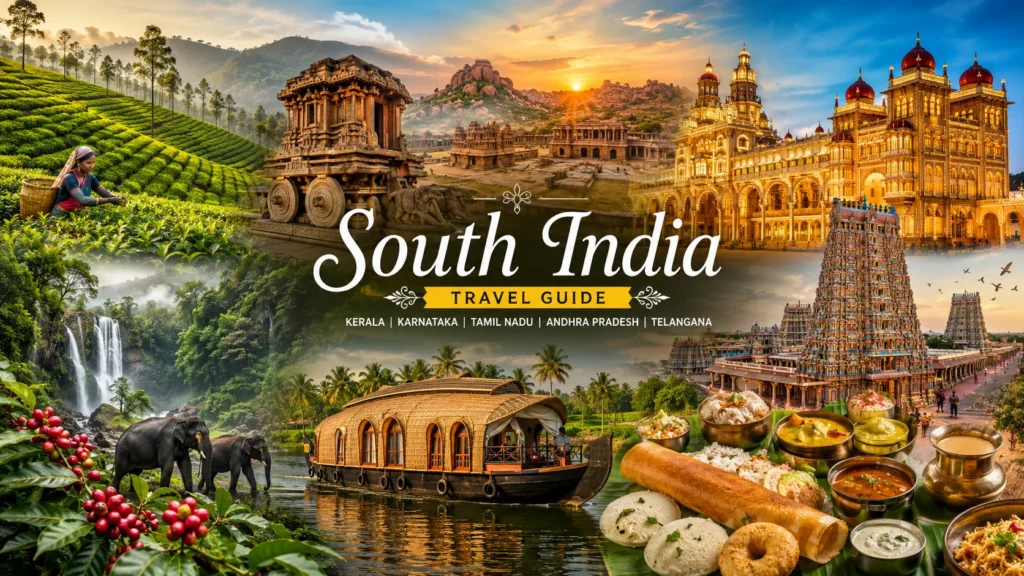
- 🏖️ Kerala : God’s Own Country
- 🏰 Karnataka :Ruins, Palaces & Plantations
- 💃 Tamil Nadu : Where Faith Touches the Sky
- 🛕 Diverse Themes of South India
- 🏛️ Southern India’s Engineering Mysteries
- 🌦️ Navigating South India’s Climate
- 🎉 Rhythms of the South: Festivals & Harvest Feasts
- Authentic Regional Souvenirs & GI-Tagged Treasures
- A Taste of the South :Culinary Guide
- 🗺️ The Bigger Picture
- 🚂 How to Get Around (A Practical Addition to Your South India Travel )
- 🌴 The Tropical Finale
- 🌴 Conclusion: Ready to Experience the South?
🏖️ Kerala : God’s Own Country
No South India travel guide is complete without experiencing Kerala. Cruise along the backwaters of Alleppey, where coconut palms dip into emerald canals and fishermen paddle in silence. At dawn, the sound of conch shells greets the rising sun. Ayurveda retreats, houseboats, and homestays define Kerala’s gentle rhythm. Ayurveda retreats, houseboats, and homestays define Kerala’s gentle rhythm. For official travel updates, certified homestay directories, and government-approved tour operators, always refer to the [Kerala Tourism Department]
1. Alappuzha (Alleppey) — Backwater Heartland
Alleppey is the gateway to Kerala’s famous backwaters: narrow canals fringed by coconut palms, wooden houseboats drifting past village life, and paddy fields. An overnight houseboat stay or a day cruise gives you quiet canals, sunset skies, and slow village rhythms — the classic Kerala experience.
- Best time: October–March (cool, pleasant weather).
- How long: 1–2 days (overnight houseboat + village cruise).
- Budget range: ₹2,000–₹7,000 per day.
- Highlight: Overnight houseboat on the Vembanad backwaters.
🚤 Plan the Perfect Houseboat Experience
While a backwater cruise is the classic Kerala experience, planning the logistics perfectly makes all the difference. If you are confused about which canals and villages to explore, our detailed [Kerala Houseboat Itinerary 2026: Best Routes Guide] will help you choose the most scenic path.
Budgeting for this experience is also crucial, as boats range from standard to floating palaces. Before you finalize anything, I highly recommend comparing your options using our [Kerala Houseboat Booking Price 2026: Deluxe vs Luxury Guide] to ensure you get exactly what you pay for.
And finally, the absolute best part of the cruise? The food! From fresh pearl spot fish to traditional sadya served by your private chef, you can sneak a peek at exactly what mouth-watering dishes await you in our complete [Kerala Houseboat Food Menu 2026: Taste & Night Vibe].
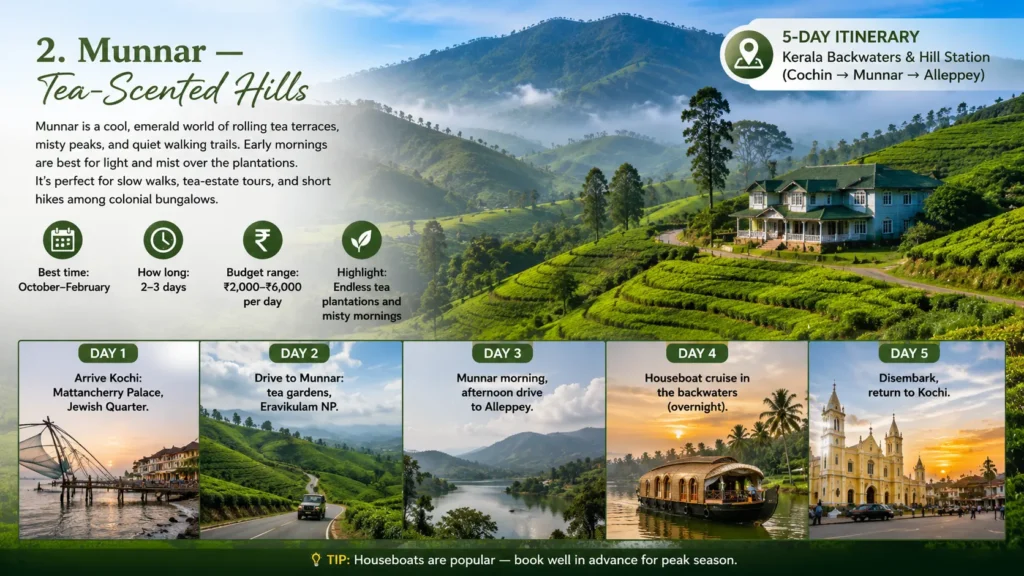
2. Munnar : Tea-Scented Hills
Munnar is a cool, emerald world of rolling tea terraces, misty peaks, and quiet walking trails. Early mornings are best for light and mist over the plantations. It’s perfect for slow walks, tea-estate tours, and short hikes among colonial bungalows.
- Best time: October–February.
- How long: 2–3 days.
- Budget range: ₹2,000–₹6,000 per day.
- Highlight: Endless tea plantations and misty mornings.
5-Day Itinerary: Kerala Backwaters & Hill Station (Cochin → Munnar → Alleppey)
- Day 1: Arrive Kochi: Mattancherry Palace, Jewish Quarter.
- Day 2: Drive to Munnar: tea gardens, Eravikulam NP.
- Day 3: Munnar morning, afternoon drive to Alleppey.
- Day 4: Houseboat cruise in the backwaters (overnight).
- Day 5: Disembark, return to Kochi.
- Tip: Houseboats are popular — book well in advance for peak season.
🌴 Bonus: The Lakshadweep Island Extension
If you are already travelling down South, especially to Kochi (Kerala), you are just a step away from India’s most pristine island paradise—Lakshadweep. Adding this tropical heaven to your South India itinerary is the ultimate travel hack for 2026.
https://epermit.utl.gov.in/pages/signupPlanning an island getaway requires a bit of extra preparation. Before you pack your bags, the very first step is securing your [Lakshadweep entry permit online 2026] . Make sure to apply only through the official [Lakshadweep Administration ePermit portal] to avoid unnecessary delays Once the paperwork is sorted, the biggest confusion most travellers face is the commute—should you take a [ ship or flight to go Lakshadweep ] (Link your transport article here)?
Once you reach the turquoise waters, the real magic begins. Move beyond the tourist traps and discover the untouched [Lakshadweep 7 secrets of Coral paradise] (Link your secrets article here) that most guides miss. If you are an adrenaline junkie, the coral reefs offer some of the best underwater experiences in the world. Dive into our complete guide on [Lakshdweep water sports 7 adventure secrets]
Finally, to truly understand the island, you need to connect with its people. Read our honest breakdown of [Lakshdweep local life 9 reality checks & best souvenirs] (Link your local life article here) to know what to expect and what authentic items to bring back home.
🏰 Karnataka :Ruins, Palaces & Plantations
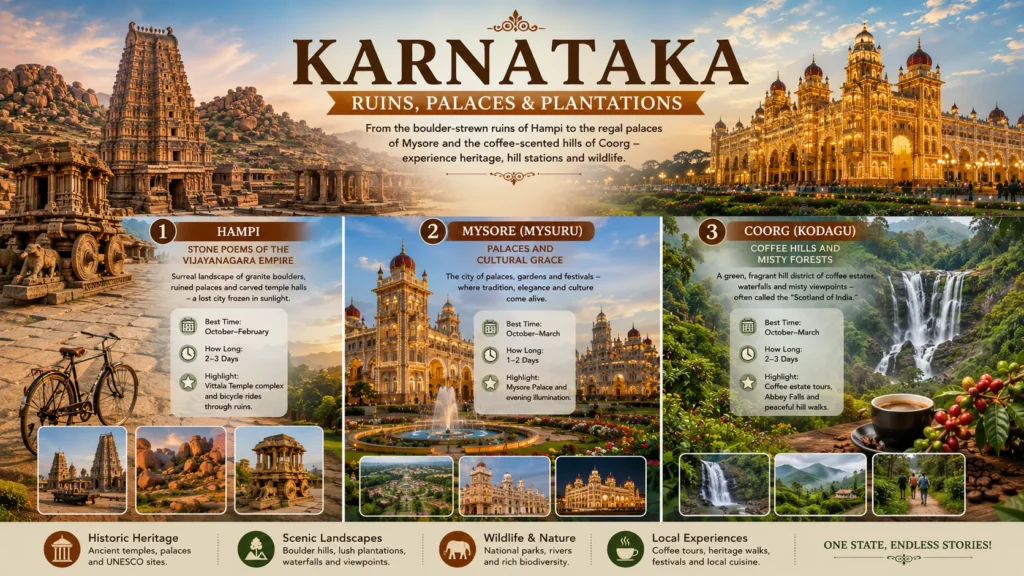
Continuing our South India travel guide, Karnataka stretches from the boulder-strewn ruins of Hampi to the regal palaces of Mysore and the coffee-scented hills of Coorg. It blends spectacular heritage, verdant hill stations, and wildlife. .It blends spectacular heritage, verdant hill stations, and wildlife. To explore detailed regional maps and discover the latest heritage circuit updates, check out the [Karnataka State Tourism Portal]
1. Hampi : Stone Poems of the Vijayanagara Empire
Hampi’s surreal landscape of granite boulders, ruined palaces, and carved temple halls feels like a lost city frozen in sunlight. Wander between Virupaksha Temple and the musical pillars of Vittala.
- Best time: October–February.
- How long: 2–3 days.
- Highlight: Vittala Temple complex and bicycle rides through ruins.
2. Mysore (Mysuru) : Palaces and Cultural Grace
Mysore is India’s gentle palace city. The domed Mysore Palace, the illuminated Dasara season, and the manicured Brindavan Gardens give it a refined, walkable charm.
- Best time: October–March.
- How long: 1–2 days.
- Highlight: Mysore Palace and evening illumination.
3. Coorg (Kodagu) : Coffee Hills and Misty Forests
Coorg is a green, fragrant hill district where coffee estates, waterfalls, and misty viewpoints create a cool, restorative escape — often called the “Scotland of India.”
- Best time: October–March.
- Highlight: Coffee estate tours, Abbey Falls, and peaceful hill walks.
💃 Tamil Nadu : Where Faith Touches the Sky
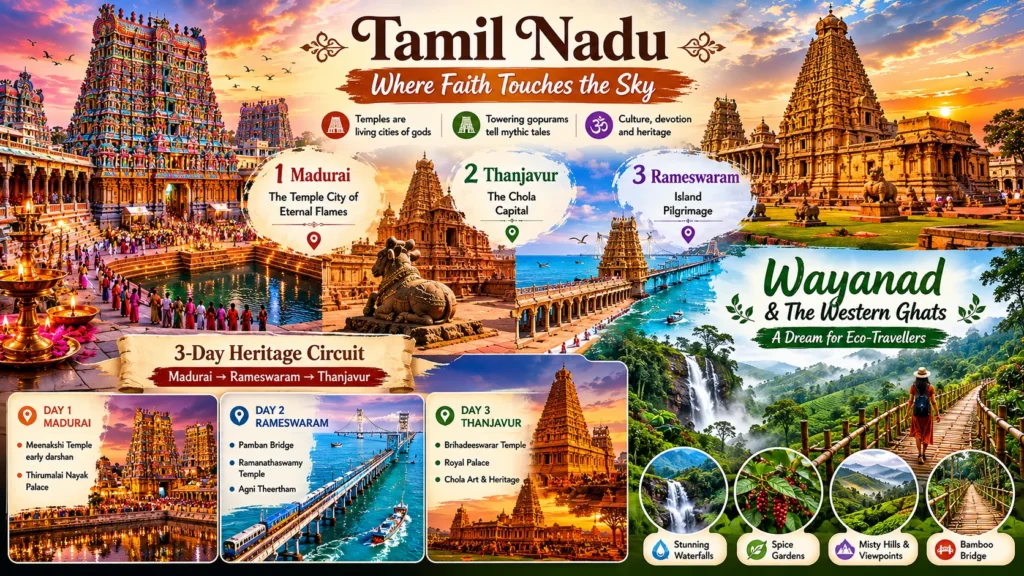
An essential part of any South India travel guide is Tamil Nadu. Temples here are not merely buildings — they’re living cities of gods. The towering gopurams of Madurai and Thanjavur are draped in vibrant sculptures, each telling mythic tales. Madurai centers on the magnificent Meenakshi-Sundareshwarar Temple, where color, ritual, and crowds create an immersive Hindu pilgrimage experience. Before you visit, it is highly recommended to check official darshan timings, dress codes, and e-ticket bookings directly on the [TN HR&CE Department website].
1. Madurai :The Temple City of Eternal Flames
Madurai centers on the magnificent Meenakshi-Sundareshwarar Temple, where color, ritual, and crowds create an immersive Hindu pilgrimage experience.
2. Thanjavur :The Chola Capital
Thanjavur (Tanjore) is the beating heart of Chola art. The UNESCO-listed Brihadeeswarar Temple dominates the skyline with perfect proportions and stone carvings.
3. Rameswaram : Island Pilgrimage
Rameswaram sits at the tip of Pamban Island. A long causeway, powdery beaches, and the Ramanathaswamy Temple’s long corridors define the pilgrimage experience.
3-Day Heritage Circuit: Madurai → Rameswaram → Thanjavur
- Day 1 (Madurai): Meenakshi Temple early darshan and Thirumalai Nayak Palace.
- Day 2 (Rameswaram): Visit Pamban Bridge, Ramanathaswamy Temple, and Agni Theertham.
- Day 3 (Thanjavur): Travel to Thanjavur; visit Brihadeeswarar Temple and Royal Palace.
🌿 Wayanad & The Western Ghats
A dream for eco-travellers, Wayanad is a lush blend of waterfalls, spice gardens, and bamboo bridges swaying over forest streams. Mist rolls through the hills at dawn, cardamom scents the air by dusk, and the rhythm of the Western Ghats invites you to slow down.
🛕 Diverse Themes of South India
Every good South India travel guide must highlight the region’s incredible diversity. India’s tourism weaves Dravidian art and Ayurvedic wellness into journeys that transform both traveller and land.
- Spiritual Tourism: Devotion is a living art form, from the Meenakshi Temple’s night aarti to the Jyotirlinga at Rameswaram.
- Heritage: The Cholas turned stone into prayer. The Brihadeswara Temple of Thanjavur radiates grace under the Tamil sun.
- Eco & Village Tourism: Nestled in the Western Ghats, Wayanad smells of cardamom, coffee, and rain.
- Adventure: Walk high above emerald forests on the glass bridges of Wayanad, or scuba dive in the Andamans.
🏛️ Southern India’s Engineering Mysteries

A unique feature highlighted in this South India travel guide is the region’s architectural marvels. The master artisans of the South didn’t just carve stone; they engineered structures that continue to astound modern science.
The Hanging Pillar of Lepakshi: In the 16th-century Veerabhadra Temple of Andhra Pradesh, out of 70 intricately carved stone pillars, one stubbornly refuses to touch the ground. You can literally slide a piece of cloth right under this ‘hanging pillar’.
🌦️ Navigating South India’s Climate
When planning with this South India travel guide, remember that the South doesn’t have a traditional freezing winter; instead, it offers tropical monsoons perfect for healing and cooler months ideal for temple trails.
- Winter (Nov–Feb): The most comfortable time for the Dravidian Temple Trail and enjoying the beaches.
- Summer (Mar–May): Best time to escape to hill stations like Wayanad, Coorg, and Ooty.
- Monsoon (Jun–Sep): The traditional time for Ayurvedic treatments in Kerala.
Our South India travel guide recommends the Oct–Mar window for coastal weather and low crowds. However, if you want lush greenery and Ayurvedic retreats, the monsoon season is magical.
🎉 Rhythms of the South: Festivals & Harvest Feasts
A highlight of this South India travel guide is the festival calendar. In the South, festivals are deeply connected to the land, the rivers, and ancient temple traditions.
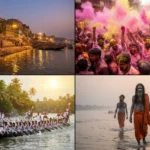
- Onam (Kerala): King Mahabali’s legend lives on in floral carpets. Snake boats slice through rivers while families share the 20-dish Onam Sadya.
- Pongal (Tamil Nadu): Pots of milk boil over in thanksgiving as sugarcane and sunlight bless the fields.
- Dussehra (Mysore): Mysore’s grand, royal processions unite the region in celebrating the victory of good over evil.
📅 Plan Your Trip Around the Celebrations: > While these are the absolute highlights of the South, India is a land of year-round celebrations. If you want to align your travel dates with the biggest cultural events across the country, bookmark our complete guide to [Festivals in 2026: Indian Festivals Calendar & Dates]. It will help you plan the perfect itinerary without missing out on the magic!
Authentic Regional Souvenirs & GI-Tagged Treasures
South India is not just about temples, beaches, and hill stations — it is also a paradise for authentic regional shopping. Travelers visiting South India in 2026 should definitely explore its famous GI-tagged products and handcrafted treasures that reflect the culture and heritage of each state.
What to Buy in South India
- Kanjeevaram Silk (Tamil Nadu) – World-famous for its luxurious texture, vibrant colors, and traditional craftsmanship. Perfect for saree lovers and wedding shopping.
- Coorg Arabica Coffee (Karnataka) – Premium aromatic coffee grown in the misty hills of Coorg, ideal for coffee enthusiasts.
- Alleppey Green Cardamom (Kerala) – One of India’s finest spices, known for its strong aroma and export-quality flavor.
- Mysore Sandalwood & Mysore Silk (Karnataka) – Authentic sandalwood products, soaps, perfumes, and elegant silk fabrics are among the best souvenirs from Mysore.
Adding regional shopping experiences to your South India itinerary makes the journey more immersive and culturally rich.
A Taste of the South :Culinary Guide
The Moment I Realised Food Is the Journey
There’s a moment — somewhere between the first spoonful of coconut curry and the last sip of filter coffee — when South India stops being a destination. It becomes a feeling. A warmth that sits in your chest long after you’ve returned home.
I didn’t plan to fall in love with South Indian food. It just happened, one banana leaf at a time.
🍲 Explore Beyond the South: > While South Indian food has its own unique magic, it is just one incredible chapter of a much larger story. If you want to explore how flavours change as you travel across the country, check out our master pillar post on the [Cuisines of India], where we break down authentic regional dishes from North to South.
🌴 Kerala : Where Every Meal Feels Like a Festival
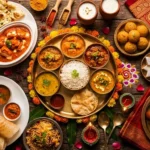
Picture this: you’re seated cross-legged on the floor, a fresh banana leaf stretched out before you, and within minutes, seventeen different dishes land on it without you asking. That’s a Sadya — Kerala’s legendary feast — and nothing quite prepares you for it.
The rice is fluffy, the papadum shatters with a satisfying crunch, and the avial (a medley of vegetables in coconut and yoghurt) tastes like someone bottled a rainforest into a bowl.
Then there’s the Appam — a lacy, soft rice pancake with crisp edges and a pillowy centre. Paired with a gentle coconut stew, it’s the kind of breakfast that makes you want to cancel your plans and just… sit.
🌊 Pro-Tip: Head to the backwater villages near Alleppey for the freshest seafood curries. The fish, caught the same morning, is cooked in raw coconut milk — simple, local, and absolutely unforgettable.
🏰 Karnataka :Bold Sweets and Bolder Flavours
Karnataka sneaks up on you. You think you know what to expect, and then a tiny square of Mysore Pak dissolves on your tongue — rich with ghee, faintly grainy with chickpea flour — and you genuinely consider moving to Mysore permanently.
The sweet shops in the old city lanes sell it warm, and the aroma alone is enough to stop you mid-street.
But Karnataka’s food story doesn’t end with sweets. Udupi cuisine — vegetarian, temple-style cooking born from the coastal town of Udupi — is where the humble dosa became an art form. The idlis here are cloud-soft, the sambhar is tangy and deep, and the coconut chutney is freshly ground daily.
☕ Pro-Tip: If you’re heading to Coorg, don’t miss the estate-fresh Coorg coffee brewed with jaggery instead of sugar. It’s earthy, slightly sweet, and completely addictive.
🌶️ Tamil Nadu :Fire, Tradition, and That One Filter Coffee
Walking into a traditional Tamil home at 7 AM and being handed a steel tumbler of filter coffee — frothy, strong, and poured from a height to cool it — is a ritual I think about far too often.
Tamil Nadu doesn’t ease you in. It invites you fully, immediately, unapologetically.
Chettinad cuisine is perhaps the most complex regional cooking style in all of India. The spices aren’t just added — they’re built, layered carefully over hours of slow cooking. Dishes like Chettinad chicken curry or Kavuni Arisi (black rice pudding) carry centuries of culinary memory in every bite.
Start your mornings with a crispy dosa and sambar, then ease into a traditional Tamil meals (saapadu) by afternoon — rice, rasam, kootu, and a generous helping of ghee. It’s not just lunch. It’s a love language.
🫙 Pro-Tip: In Chennai, visit the Mylapore or Besant Nagar neighbourhoods for authentic, no-frills Tamil meals. Lunch is usually served between 12–2 PM and costs as little as ₹80–₹150 — and it’s often better than anything you’ll find in a fancy restaurant.
🗺️ The Bigger Picture
| State | Must-Try Dish | Best Time to Eat | Approximate Cost |
|---|---|---|---|
| Kerala | Sadya on banana leaf | During Onam or weekends | ₹150–₹400 |
| Karnataka | Mysore Pak | Any time, any sweet shop | ₹30–₹80 for 100g |
| Tamil Nadu | Chettinad Chicken Curry | Dinner at local restaurants | ₹200–₹500 |
Food lovers travelling across South India in 2026 won’t just find great meals — they’ll find stories, rituals, and a kind of generosity that only a region this proud of its kitchen can offer. Pack light. But come hungry. 🍽️
🚂 How to Get Around (A Practical Addition to Your South India Travel )
Planning your trip and looking for the ultimate South India travel guide? Feels big — I know. But once you understand the flow, it’s actually quite simple.
✈️ Step 1 : Pick the Right Airport
South India is basically a triangle. Each corner has a well-connected airport. Land at the right one, and half your journey is sorted.
- Kochi (COK) — Best for Kerala. As of winter 2025–26, it handles 1,520 weekly flights with 27 airlines.
- Chennai (MAA) — Your gateway to Tamil Nadu, making it the perfect starting point if you are planning a South India temple tour. Connected to almost every major city.
- Bengaluru (BLR) — Ideal for Karnataka and Coorg.
💡 Tip: Book flights 3–4 weeks early. Prices climb fast between October and March.
🚆 Step 2 : Let Trains Handle the Long Haul
Trains are South India’s best-kept secret. And in 2026, they’re better than ever.
- Vande Bharat Express — 164 trains running across India right now. Key South routes include Chennai ↔ Mysuru, Bengaluru ↔ Hyderabad, and Bengaluru ↔ Kalaburagi. Fast, clean, air-conditioned — honestly feels more like flying than train travel.
- Nilgiri Mountain Railway — The UNESCO heritage route to Ooty. Slow ride, but the views are worth every minute.
Need to cover long distances (Chennai to Kochi, Bengaluru to Trivandrum)? Take an overnight train. Sleep in one city, wake up in another.
🎟️ Tip: Book IRCTC tickets 30–60 days ahead. Missed the window? Tatkal opens 24 hours before departure.
🚖 Step 3 : Local Cabs for Everything Else
Trains get you between cities. Cabs get you to the most beautiful places to visit in South India, especially the hidden ones.
- Bengaluru, Chennai, Kochi — Ola and Uber work just fine.
- Munnar, Coorg, Ooty — No trains here. Private taxis charge ₹1,500–₹6,000.
- Between states (Kerala–Karnataka, Tamil Nadu–Karnataka) — Interstate cabs are widely available.
🗺️ Quick Cheat Sheet
| Journey | Best Option | Approx. Cost |
|---|---|---|
| Arriving in South India | Flight (COK / MAA / BLR) | Depends on origin |
| City to city | Vande Bharat / overnight train | ₹400–₹1,500 |
| Hills & beaches | Private cab | ₹1,500–₹6,000 |
| Within a city | Ola / Uber | ₹50–₹400 |
That’s it. Fly in, ride a scenic train, grab a cab for the hidden spots — and suddenly navigating these amazing places to visit in South India stops feeling like a puzzle. It just feels like a good trip. 🗺️
⚠️ Disclaimer: Prices and schedules change. Always check IRCTC, airline websites, or local operators before you travel.
🌴 The Tropical Finale
Wrapping up this South India travel guide, a perfect final leg of any extensive Indian tour brings you to the calming greenery of the South:
- Days 1–2: Fort Kochi – Colonial history and Chinese fishing nets.
- Day 3: Alleppey – An overnight stay in a traditional Kerala houseboat.
- Days 4–6: Munnar – Winding through tea plantations before your final departure.
🌴 Conclusion: Ready to Experience the South?
Wrapping up your journey through the peninsula isn’t just about ticking destinations off a list; it is about taking home a piece of its soul. Whether you are mesmerized by the architectural brilliance of a South India temple tour, seeking the silent misty mornings of Coorg, or craving the gentle sway of a Kerala houseboat, the magic of this region is undeniable.
We hope this comprehensive South India travel guide has given you the clarity and inspiration to finally pack your bags for 2026. From royal palaces and ancient ruins to tropical islands, there are endless places to visit in South India that cater to every kind of traveler.
Over to you! Which southern destination is calling your name first? Are you heading to the backwaters, or are the heritage temples on your mind? Drop a comment below and let us know!
What is the best time to visit South India?
According to our South India travel guide, the best time to visit is during the winter months from October to March. This period offers pleasant, cool weather ideal for coastal areas and heritage sites. However, summer (March–May) is great for hill stations, and the monsoon (June–September) is perfect for Ayurvedic retreats in Kerala.
What are the top places to visit in South India for a first-time traveler?
For first-time visitors, the best places to visit in South India include the serene backwaters of Alleppey (Kerala), the historic stone ruins of Hampi (Karnataka), the majestic tea gardens of Munnar, and the grand Meenakshi Temple in Madurai.
How many days are required for a complete South India temple tour?
A dedicated South India temple tour typically requires 3 to 5 days depending on your route. A highly recommended 3-day heritage circuit covers Madurai (Meenakshi Temple), Rameswaram (Ramanathaswamy Temple), and Thanjavur (Brihadeeswarar Temple) to experience the best of Dravidian architecture.
How do I travel locally between different places to visit in South India?
You can easily navigate between major places to visit in South India using three main modes: flights into major hubs like Kochi, Chennai, or Bengaluru; Vande Bharat Express or overnight trains for intercity travel; and private cabs or ride-sharing apps for local sightseeing and reaching hill stations.
How much does a Kerala houseboat cruise cost?
An overnight houseboat stay in Alleppey typically ranges from ₹2,000 to ₹7,000 per day. The cost varies based on whether you book a standard, deluxe, or luxury boat, and usually includes backwater cruising, village tours, and traditional Kerala meals prepared by an onboard chef.
What is the most famous food to try in South India?
Every state has its own culinary magic. Must-try regional foods include the 20-dish traditional Sadya feast and Appam in Kerala, the rich Mysore Pak and Udupi dosa in Karnataka, and spicy Chettinad Chicken paired with frothy filter coffee in Tamil Nadu.
What are the best authentic souvenirs to buy in South India?
The top authentic regional souvenirs include Kanjeevaram Silk sarees from Tamil Nadu, premium Arabica coffee and Sandalwood products from Coorg and Mysore (Karnataka), and export-quality Alleppey Green Cardamom from Kerala.
Can I add Lakshadweep to my South India travel guide itinerary?
Yes, Lakshadweep is an excellent extension to your South India travel guide. You can easily take a flight or ship directly from Kochi (Kerala) to the islands. Just ensure you apply for your mandatory entry permit online through the official Lakshadweep Administration portal before your trip.