Beyond the Glaciers: My Journey into Ladakh Culture, Its Rare Flavours, and Ancient Genius
Last Updated on
13/02/2026
Ladakh culture hit me like a revelation the moment I stepped off the plane at Leh Airport. At 11,500 feet, the thin Himalayan air was nothing compared to the profound silence, broken only by distant monastery chants echoing from impossible rocky heights.
What I didn’t expect were the secrets most travellers never discover: ancient water systems without pumps, houses staying warm at -30°C without heating, midnight water ceremonies, secret high-altitude medicine recipes, and weather-predicting songs passed down through generations. These aren’t tourist attractions—they’re living traditions few outsiders experience.
During my fortnight of homestays in remote villages, I witnessed technologies that modern engineers are only now understanding and rituals absent from any guidebook. I knew immediately that this journey would reshape everything I understood about Indian heritage.
In the pages that follow, I’ll share these rare discoveries—the hidden facets of Ladakhi life that transformed a simple holiday into a profound education in sustainable living and indigenous wisdom.


- The Spiritual Heartland: Key Monasteries and Sacred Etiquette
- Festivals & Celebrations: The Rhythm of High Desert Life
- The Ladakhi Table: 15+ Traditional Dishes You Can't Miss
- Special Local Produce: The High Desert's Hidden Treasures
- Authentic Shopping Guide: Treasures of the Trans-Himalayas
- Ancient Hidden Technology of Ladakh: A Masterclass in Sustainability
- The Economy of the High Desert: Balancing Tourism and Tradition
- The Homestay Experience: Living the Culture
- Living the Culture: Personal Reflections and Lasting Lessons
- Official Reference
- Related Posts
- Conclusion: The Call of the High Desert
- FAQs About : Ladakh Culture: 15+ Rare Foods|Untold Secrets Revealed
The Spiritual Heartland: Key Monasteries and Sacred Etiquette
The soul of Ladakh culture beats strongest in its ancient monasteries, where centuries-old traditions continue unchanged despite the modern world pressing at their gates. During my fortnight among these sacred spaces, I discovered that understanding monastery etiquette Ladakh isn’t just about following rules—it’s about stepping into a living spiritual ecosystem where every gesture carries meaning. Each gompa I visited taught me something profound about respect, mindfulness, and the delicate art of being a conscious observer in sacred spaces.
Hemis Monastery: The Crown Jewel of Ladakhi Spirituality
My first monastery visit was to Hemis, and I made every possible rookie mistake. I wore shorts (inappropriate), spoke loudly (disrespectful), and nearly walked clockwise around the prayer wheels (deeply offensive). The elderly monk who gently corrected me became my first teacher in monastery etiquette Ladakh.
Essential Visiting Rules:
- Dress modestly: Full sleeves, long trousers, covered shoulders
- Silence is sacred: Whisper or remain quiet in prayer halls
- Remove shoes: before entering main halls
- Walk clockwise: around stupas and prayer wheels
- No photography: inside prayer halls without permission
- Morning visits: (7-9 AM) offer the most authentic experience
📿 Expert Tip: The monks at Hemis are incredibly welcoming to respectful visitors. I learned basic Ladakhi greetings—”Julley” (hello/goodbye) and “Kusumpo” (thank you)—which opened doors to conversations I’ll treasure forever.
Thiksey Monastery: The Little Potala
Perched 140 metres above the Indus Valley, Thiksey resembles a smaller version of Tibet’s Potala Palace. The 6 AM morning prayers here are transformative—the deep resonance of 10-foot copper horns reverberating through the valley while butter lamps flicker in the pre-dawn darkness.
Diskit Monastery: Guardian of Nubra Valley
The 32-metre Maitreya Buddha statue at Diskit took my breath away (what little I had left at that altitude). Local legend says this statue was positioned to face Pakistan, symbolically protecting the region from negative energies.
🎯 Traveller’s Note: I once accidentally interrupted a prayer session by entering during prostrations. The embarrassment taught me to always ask a monk about appropriate visiting times. They’re remarkably patient with genuine cultural curiosity.
Festivals & Celebrations: The Rhythm of High Desert Life
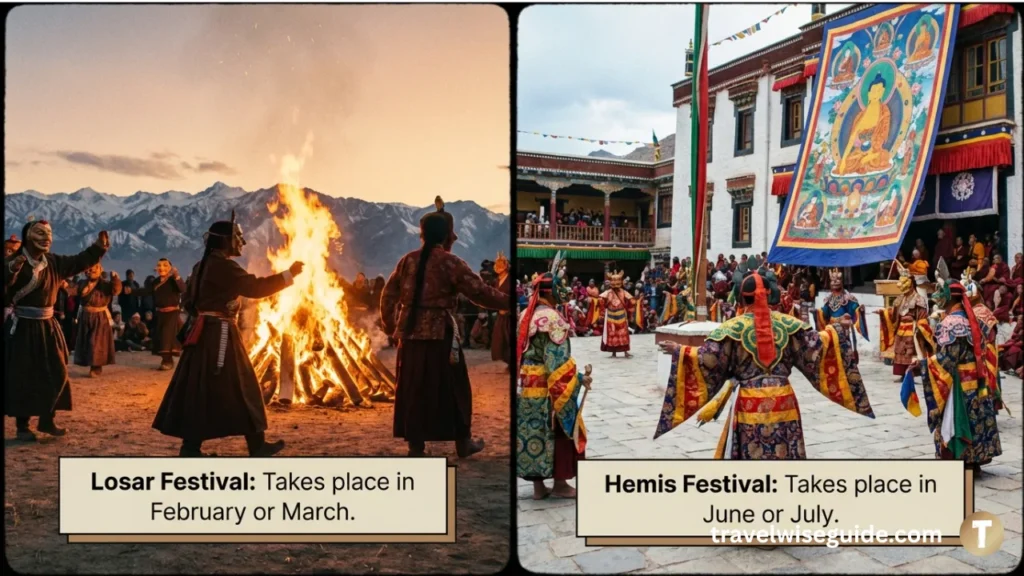
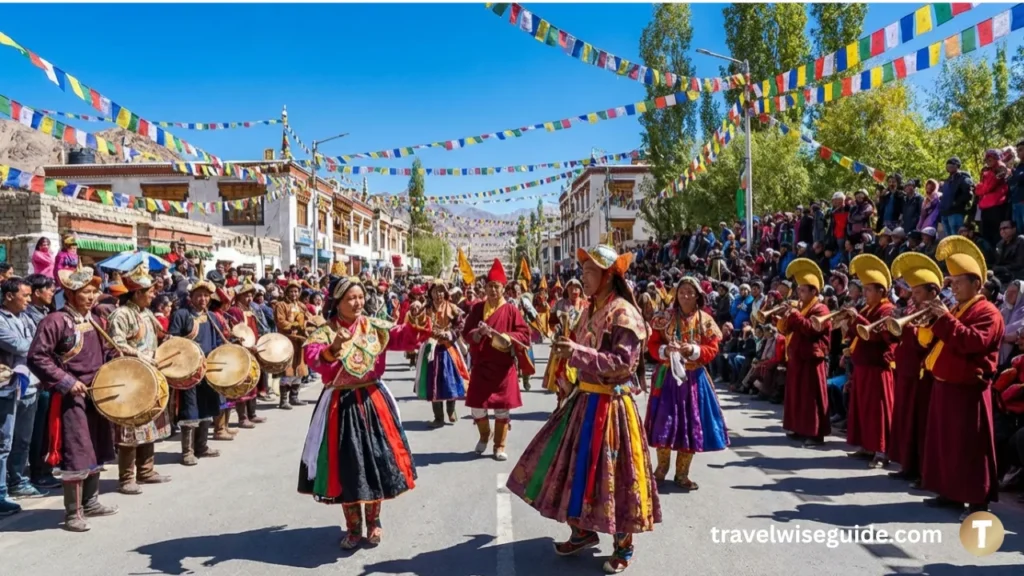
Ladakh’s festival calendar follows both the Tibetan lunar calendar and ancient seasonal rhythms, creating a year-round tapestry of celebration and devotion.
The Festival Calendar
| Festival | Month | Significance | Experience |
| Losar | February/March | Tibetan New Year | Three-day celebration with traditional dances |
| Hemis Festival | June/July | Guru Padmasambhava’s birth | Masked dances, colourful costumes |
| Ladakh Festival | September | Cultural showcase | Perfect introduction to local arts |
| Dosmoche | February | Evil spirits exorcism | Dramatic masked performances |
🎭 Local Legend: During Dosmoche, I witnessed monks creating an intricate sand mandala over three days, only to destroy it ceremoniously—a powerful reminder of impermanence.
But the festivals are merely punctuation marks in a culture that celebrates the everyday…
The Ladakhi Table: 15+ Traditional Dishes You Can’t Miss

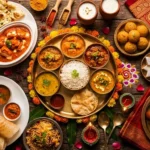
The aroma hit me first—roasted barley flour mixed with yak butter and salt tea. I was sitting cross-legged in a traditional Ladakhi kitchen, watching Amma-la (grandmother) knead dough with weathered hands that had prepared thousands of meals in this very spot. This was my introduction to Ladakhi traditional food—cuisine born from necessity, elevated by tradition, and perfected by generations of high-altitude cooking.
The Essential 15+ Dishes
1. Thukpa (Hearty Noodle Soup)
The soul-warmer Hand-pulled wheat noodles floating in a rich broth with vegetables and yak meat. After a day of trekking in sub-zero temperatures, thukpa literally saved my life at a remote teahouse.
2. Skyu (Pasta-like Comfort)
The mountain pasta Thumb-sized wheat pasta cooked with root vegetables in a thick stew. The texture reminded me of rustic Italian gnocchi, but the flavours were entirely Himalayan.
3. Momos (Himalayan Dumplings)
The crowd-pleaser These aren’t your street-side momos—Ladakhi versions are larger, stuffed with yak meat or vegetables, and steamed to perfection.
4. Paba (Roasted Barley Bread)
The foundation Dense, nutritious flatbread made from roasted barley flour. I watched it being cooked on a cast-iron griddle over dried yak dung—surprisingly flavourful!
5. Churpi (Yak Cheese)
The protein powerhouse Rock-hard cheese that softens as you chew. Locals consume it like chewing gum, and it’s packed with protein essential for high-altitude life.
6. Butter Tea (Po Cha)
The controversial classic Salty tea mixed with yak butter. My first sip was… challenging. By day three, I craved it. By day seven, I understood why Ladakhis drink 30+ cups daily.
7. Chang (Barley Beer)
The social lubricant Mildly alcoholic beverage served in traditional wooden bowls. Perfect for acclimatisation (in moderation).
8. Tingmo (Steamed Bread)
The fluffy companion Soft, steamed bread perfect for soaking up curry gravies.
9. Lukser (Leg of Lamb)
The celebration dish Slow-cooked lamb leg reserved for special occasions. I was fortunate to experience this during a village wedding.
10. Khambir (Traditional Bread)
The daily staple Local bread baked in traditional ovens, with a distinctive flavour from the wood smoke.
11. Chutagi (Pasta Soup)
The winter warmer Bow-tie pasta in vegetable broth—comfort food perfected over centuries.
12. Tsampa (Roasted Barley Flour)
The trail food Mixed with tea to create an instant, nutritious meal. Essential for trekkers and nomads.
13. Apricot Jam & Products
The sweet tradition Made from local apricots, this jam is unlike anything you’ve tasted—intensely flavoured and naturally preserved.
14. Yak Meat Curry
The protein special Rich, gamey curry that’s surprisingly tender when properly prepared.
15. Sea Buckthorn Juice
The vitamin C explosion Tart, orange-coloured juice packed with more vitamin C than oranges—essential for scurvy prevention at altitude.
🥘 Expert Tip: Always accept food offerings graciously, even if you’re not hungry. Refusing food in Ladakhi culture is considered deeply offensive. I learned this the hard way during my first homestay.
Special Local Produce: The High Desert’s Hidden Treasures
Beyond the monastery walls and festival celebrations, Ladakh’s true wealth lies hidden in its orchards and wild landscapes. The traditional food Ladakh that sustained ancient Silk Route traders still grows here, transformed by extreme altitude and intense UV radiation into superfoods that modern nutrition science is only beginning to understand. Walking through village orchards and foraging expeditions with local families, I discovered that every fruit, berry, and grain tells a story of adaptation, survival, and unexpected abundance in the world’s highest desert.
Apricots in Ladakh: Liquid Gold
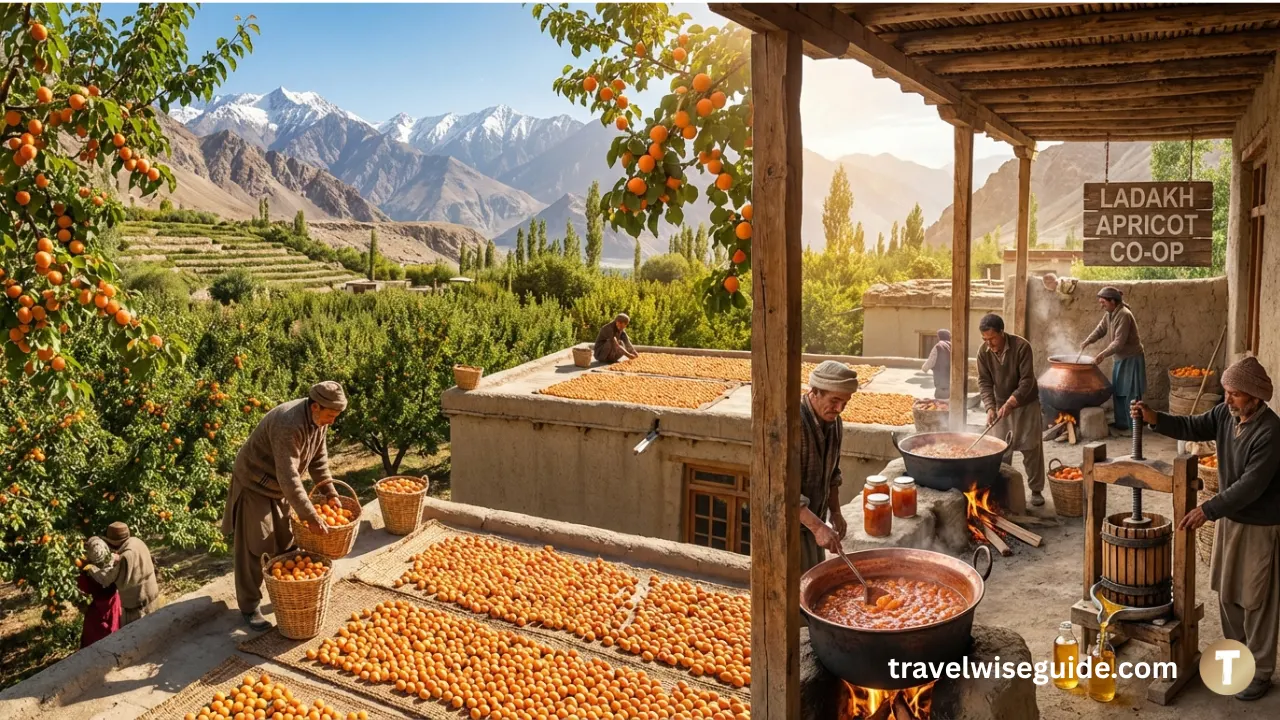
Walking through Turtuk village in June, I witnessed something magical—families harvesting apricots that seemed to glow with inner light. These aren’t ordinary apricots; they’re smaller, more intensely flavoured, and incredibly sweet due to the high UV radiation and temperature fluctuations.
🍑 Processing Methods:
- Sun-dried: Naturally dehydrated on rooftops
- Oil extraction: Apricot kernel oil for cosmetics
- Jam making: Without artificial preservatives
- Fresh consumption: Peak season July-August
Sea Buckthorn: The Himalayan Superfruit

The first time I tasted sea buckthorn juice, my face contorted involuntarily—it’s incredibly tart. But this orange berry contains 15 times more vitamin C than oranges and was historically crucial for preventing scurvy among ancient traders on the Silk Route.
💊 Health Benefits:
- Extremely high in vitamin C
- Rich in omega fatty acids
- Natural antioxidant powerhouse
- Used in traditional medicine
🧪 Local Processing: I watched a family in Nubra Valley process sea buckthorn into juice, oil, and dried supplements—all using traditional methods passed down through generations.
Authentic Shopping Guide: Treasures of the Trans-Himalayas
After falling victim to my fair share of tourist traps and fake handicrafts, I became obsessed with understanding how to identify genuine Ladakhi traditional crafts from mass-produced imitations flooding the markets. The art of authentic Pashmina shopping became my crash course in supporting local artisans while avoiding the heartbreak of discovering your “handwoven treasure” was machine-made in a factory thousands of miles away.
Pashmina Shopping Tips: Separating Silk from Scam
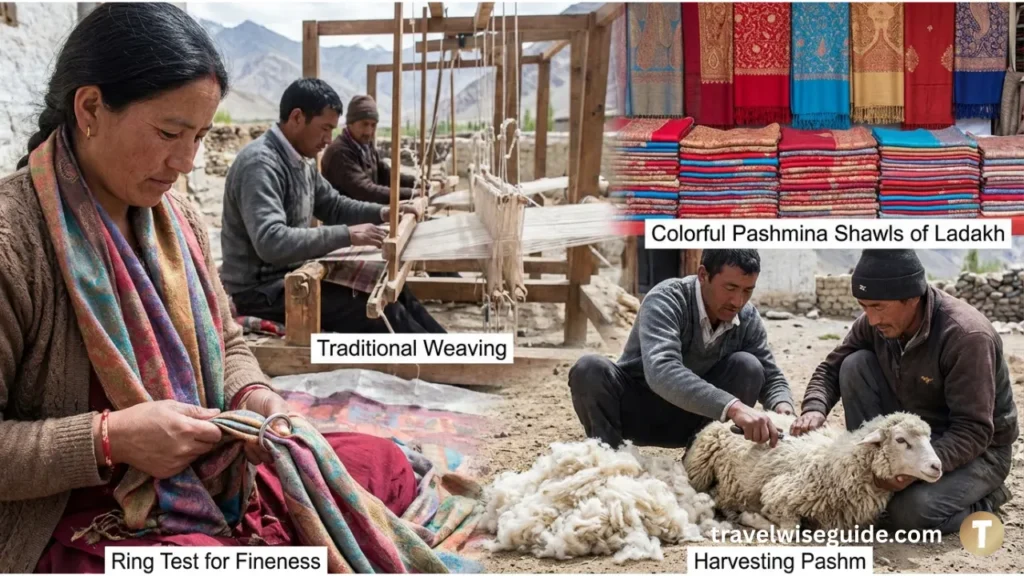
The shopkeeper held up two scarves—both labelled “100% Pashmina,” both priced identically. One was genuine Changthang goat wool; the other was machine-made synthetic. After being fooled twice, I learned the authentic Pashmina guide.
The Authenticity Tests
1. The Burn Test: Real pashmina burns slowly and smells like burnt hair. Synthetic fibres melt and smell chemical.
2. The Touch Test: Authentic pashmina feels slightly coarse initially but becomes softer with handling. Fake versions feel uniformly smooth.
3. The Ring Test: A genuine pashmina shawl should pass through a wedding ring entirely.
4. The Warmth Test: Hold it against your skin—real pashmina provides immediate warmth.
💰 Price Reality Check:
- Authentic Pashmina: ₹8,000-₹25,000+
- Good Quality Mix: ₹3,000-₹8,000
- Synthetic: Under ₹2,000
Thangka Painting Ladakh: Sacred Art Shopping

Thangkas aren’t mere decorations—they’re sacred Buddhist art requiring months of meticulous work. I spent an afternoon with master thangka painter Tenzin, learning about the spiritual preparation required before even touching brush to canvas.
🎨 Quality Indicators:
- Hand-painted details vs. printed versions
- Natural mineral pigments (more expensive but permanent)
- Cotton canvas vs. silk base
- Artist signature and monastery authentication
Bargaining Ethics in Ladakh
Unlike aggressive haggling common elsewhere in India, Ladakhi bargaining is gentle and respectful.
📝 The Respectful Approach:
- Start at 70% of asking price
- Negotiate gradually with genuine interest
- Walk away politely if prices don’t meet
- Remember: aggressive bargaining is culturally offensive
Ancient Hidden Technology of Ladakh: A Masterclass in Sustainability
The moment I understood the genius of Ladakhi architecture, I felt simultaneously humbled and amazed. Standing in a 400-year-old house that maintained comfortable temperatures without any modern heating, I realised I was witnessing ancient hidden technology Ladakh that contemporary green architects are only now rediscovering.
The Yura System: Masters of Water in the Desert
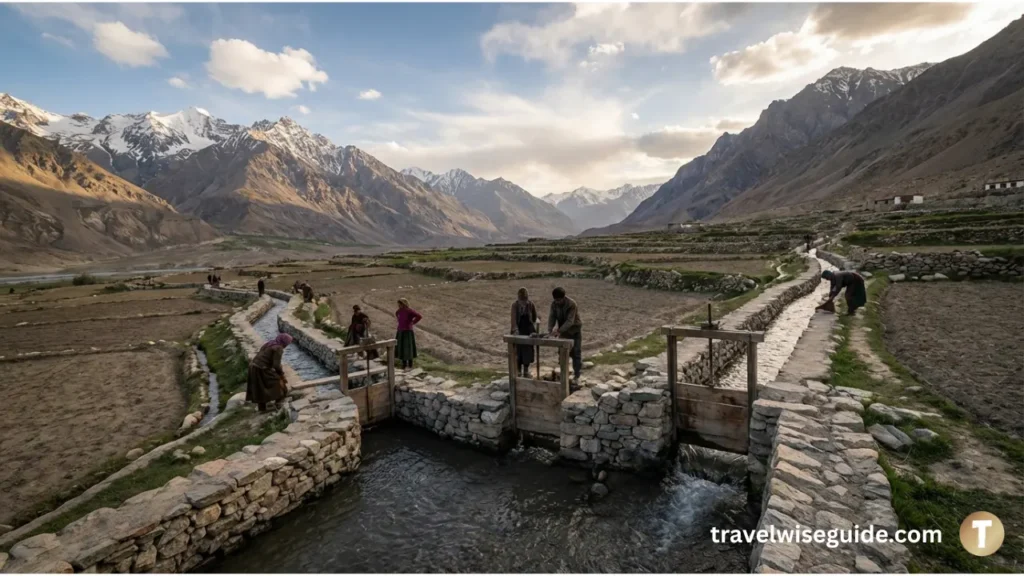
At first glance, Ladakh appears to be a water-scarce desert. This misconception shattered when I met Churpon Konchok, the village water master who showed me the intricate yura (water channel) system that has sustained settlements for over a millennium.
🌊 How Yura Works:
- Glacier melt capture: Channels divert snowmelt from high altitudes
- Gravity-fed distribution: No pumps needed—pure physics
- Community management: Each village has a Churpon (water master)
- Scheduled irrigation: Water rights distributed by traditional calendar
- Maintenance ceremonies: Annual community cleaning rituals
💡 Modern Relevance: These systems inspired contemporary drip irrigation and demonstrate sustainable water management that modern cities desperately need.
Sustainable Mud Architecture: Passive Solar Perfection
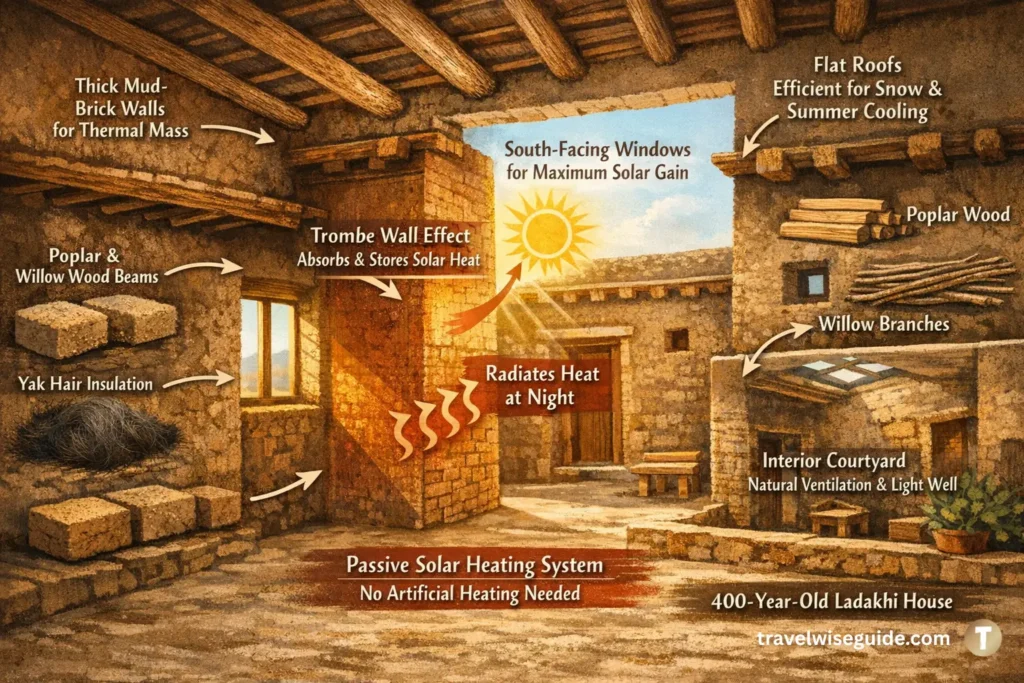
Standing inside a 400-year-old house that maintained perfect temperatures without any modern heating, I realized I was witnessing ancient hidden technology Ladakh in action. These aren’t primitive structures—they’re sophisticated passive solar heating Ladakh techniques that contemporary green architects are desperately trying to recreate.
The Genius of Ladakhi Construction
Walking through old Leh, I noticed houses that stayed cool in 30°C summer heat and warm during -30°C winters—without any artificial heating or cooling. The secret lies in passive solar heating Ladakh techniques perfected over centuries.
🏠 Architectural Features:
- South-facing windows: Maximum solar gain in winter
- Thick mud-brick walls: Thermal mass for temperature regulation
- Flat roofs: Efficient for snow load and summer cooling
- Small windows on north side: Minimise heat loss
- Interior courtyards: Natural ventilation and light wells
🧱 Building Materials:
- Mud bricks: Made from local clay and barley straw
- Poplar wood: Fast-growing, lightweight timber
- Willow branches: Flexible reinforcement
- Yak hair: Natural insulation material
⚡ Passive Heating System: The genius lies in the “trombe wall” effect—thick south-facing walls absorb solar heat during the day and radiate it slowly throughout the night, maintaining comfortable temperatures without fuel.
Ice Grafting: Artificial Glacier Creation
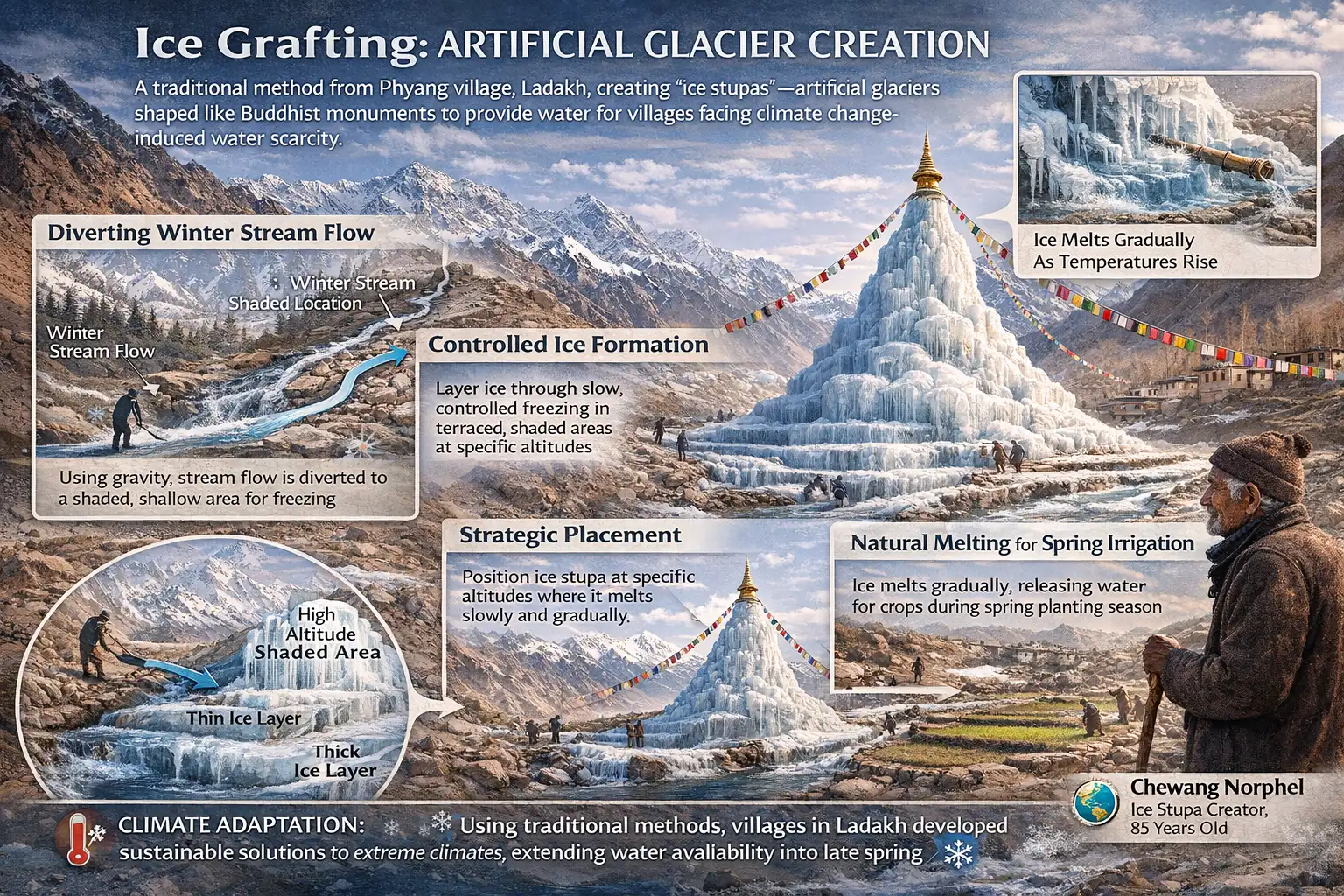
Perhaps the most remarkable traditional technology I encountered was artificial glacier creation. In Phyang village, I met 85-year-old Chewang Norphel, who learned from his grandfather how to create artificial glaciers to extend water availability into late spring.
❄️ The Process:
- Divert winter stream flow into shallow, shaded areas
- Layer ice formation through controlled freezing
- Strategic placement at specific altitudes
- Natural melting schedule aligned with planting seasons
This ancient knowledge inspired modern “ice stupas”—artificial glaciers shaped like Buddhist monuments that provide water for villages facing climate-change-induced water scarcity.
🌡️ Climate Adaptation: These traditional techniques demonstrate how indigenous communities developed sustainable responses to extreme climates—knowledge that’s increasingly valuable as global temperatures rise.
The Economy of the High Desert: Balancing Tourism and Tradition
Watching traditional barley fields being converted into guesthouses while Ladakh economy tourism brings unprecedented prosperity, I found myself witnessing a region caught between preserving its soul and embracing survival. The question isn’t whether change will come—it’s whether sustainable tourism Ladakh can evolve fast enough to protect what makes this place magical in the first place.
The Delicate Dance of Development
Sitting in a traditional kitchen in Turtuk, the last village before the Pakistan border, I witnessed a conversation that encapsulated Ladakh’s economic dilemma. Grandmother wanted to maintain traditional apricot drying methods passed down through generations. Her grandson argued for investing in modern processing equipment to meet tourist demand. Both were right, and both were wrong.
This tension defines modern Ladakh’s economy—a region where responsible tourism Ladakh can either preserve ancient culture or accidentally destroy it.
Traditional Economy vs. Tourism Impact
📊 Economic Transformation:
| Traditional Economy | Tourism-Driven Economy | Balanced Approach |
| Subsistence farming | Guest house income | Agro-tourism integration |
| Barter system | Cash transactions | Local currency initiatives |
| Seasonal migration | Year-round employment | Sustainable season extension |
| Community labour | Individual entrepreneurship | Cooperative enterprises |
The Sea Buckthorn Economy
The sea buckthorn industry exemplifies sustainable economic development. I visited a women’s cooperative in Nubra Valley where traditional harvesting methods combine with modern processing to create products sold across India.
💰 Economic Impact:
- Direct employment: 200+ women in processing
- Seasonal income: ₹15,000-₹30,000 per family
- Value addition: Raw berries ₹100/kg → processed juice ₹800/litre
- Export potential: Growing demand in health-conscious markets
🌱 Sustainability Factors:
- No chemical inputs required
- Grows on marginal land unsuitable for other crops
- Prevents soil erosion
- Provides wildlife habitat
Responsible Tourism Impact
The statistics are sobering: Ladakh receives over 200,000 tourists annually in a region with only 270,000 permanent residents. I’ve seen the best and worst of this impact.
✅ Positive Impacts:
- Economic opportunity: Tourism provides 60% of regional income
- Cultural preservation incentive: Tourists seek authentic experiences
- Infrastructure development: Better roads, healthcare, education
- Women’s empowerment: Homestays create female entrepreneurship
❌ Negative Impacts:
- Water scarcity: Tourist consumption strains limited resources
- Waste generation: Inadequate disposal systems
- Cultural commodification: Sacred practices becoming performances
- Seasonal employment: Most jobs last only 4-5 months
🔄 Sustainable Solutions I’ve Witnessed:
- Community-based tourism: Villages collectively managing homestays
- Waste management cooperatives: Local recycling initiatives
- Cultural education programmes: Tourist orientation about local customs
- Off-season skill development: Winter training programmes for guides and hospitality workers
💡 Expert Tip: Choose accommodations and tour operators that demonstrate genuine commitment to local communities—look for businesses that employ locals, source food locally, and contribute to community development projects.
The Homestay Experience: Living the Culture
After countless sterile hotel stays, stumbling into my first Ladakh homestay experience felt like being adopted by a mountain family who treated me less like a tourist and more like a long-lost relative. What I initially booked as budget accommodation became my crash course in authentic Ladakhi culture, where every meal, conversation, and shared chore revealed layers of tradition no guidebook could capture.
More Than Accommodation: A Cultural Immersion
My most transformative Ladakh experience wasn’t at a famous monastery or during a festival—it was drinking morning tea with Phunsok-la on his rooftop in Likir village, watching his granddaughter learn traditional weaving while yaks grazed in the distance. This is the soul of homestays in Ladakh—authentic cultural exchange that benefits both traveller and host.
What to Expect in a Traditional Homestay
What to Expect in a Traditional Homestay
Forget alarm clocks—in a traditional Ladakh homestay, the rhythm of ancient mountain life becomes your wake-up call, where every sound tells the story of a family preparing for another day exactly as their ancestors did centuries ago.
The Morning Ritual
- 5:30 AM: Sound of grinding barley for tsampa
- 6:00 AM: First butter tea of the day
- 6:30 AM: Family prayers in the household shrine room
- 7:00 AM: Sharing breakfast while discussing the day ahead
Daily Life Participation
- Farming activities: Harvesting, winnowing, water channel maintenance
- Cooking lessons: Learning to make tingmo, thukpa, and traditional bread
- Animal care: Feeding yaks, milking, collecting dung for fuel
- Craft learning: Basic weaving, wool processing, traditional games
Evening Traditions
- Storytelling: Local legends and historical accounts
- Traditional music: Learning basic Ladakhi songs
- Chang sharing: Mild barley beer in wooden bowls
- Family discussions: Understanding local perspectives on modernisation
Homestay Etiquette and Cultural Exchange
🏠 Respectful Guest Behaviour:
- Remove shoes before entering living areas
- Accept food offerings graciously, even small portions
- Participate in daily prayers if invited (respectful observation)
- Learn basic Ladakhi phrases: “Julley” (hello), “Kusumpo” (thank you)
- Help with household tasks when appropriate
🎁 Meaningful Contribution: Rather than cash tips, bring gifts that benefit the entire family:
- Educational materials: English books for children
- Solar lights: Practical technology for remote areas
- Medicine: Basic first aid supplies (if requested)
- Seeds: Vegetable varieties not locally available
📱 Digital Courtesy:
- Ask permission before photographing family members
- Share photos taken during your stay
- Maintain contact after departure—these relationships often last for years
Economic Impact of Authentic Homestays
During my stay with the Angchok family in Hemis Shukpachen, I learned how homestay income transformed their economic situation:
💵 Financial Benefits:
- Daily income: ₹800-₹1,500 per guest per day
- Season earnings: ₹80,000-₹1,50,000 (May-September)
- Value addition: Meals, guide services, cultural programmes
- Female empowerment: Women manage most homestay operations
🌍 Cultural Benefits:
- Language practice: Children learn English through interaction
- Global perspective: Understanding different cultures and customs
- Pride in tradition: Renewed appreciation for local customs
- Cultural documentation: Guests often help preserve family histories
But the most profound impact isn’t economic—it’s the mutual understanding created when cultures meet respectfully…
Living the Culture: Personal Reflections and Lasting Lessons
As I sit here writing this, months after returning from Ladakh, I can still taste the salt of butter tea and feel the thin mountain air in my lungs. But what stays with me most powerfully isn’t the breathtaking landscapes or even the delicious food—it’s the people who opened their homes, shared their stories, and taught me what it truly means to live in harmony with the environment and each other.
The Wisdom of High-Altitude Living
Ladakh culture isn’t just about preservation—it’s about intelligent adaptation. Every tradition I encountered, from the yura water systems to the passive solar architecture, represents generations of problem-solving in one of Earth’s most challenging environments. These aren’t museum pieces; they’re living solutions to problems that the modern world is only beginning to face.
Lessons for Responsible Travellers
🌟 What I Learned About Cultural Respect:
- Slow down: Ladakhi culture operates on mountain time—rushing is not just impractical, it’s offensive
- Listen more: The most profound insights come from quiet observation, not constant questioning
- Contribute meaningfully: Tourism should leave communities better than it found them
- Accept discomfort: Growth happens when you step outside familiar patterns
The Future of Ladakh Culture
The greatest challenge facing Ladakh today isn’t climate change or tourism pressure—it’s the balance between preserving ancient wisdom and embracing beneficial change. During my stays, I met young Ladakhis who are creating this balance: solar engineers using traditional passive heating principles, organic farmers combining ancient techniques with modern knowledge, and cultural centres that teach traditional crafts while adapting to contemporary markets.
Your Role as a Cultural Ambassador
When you visit Ladakh, you become part of this delicate cultural ecosystem. Your choices—where you stay, what you eat, how you interact with locals—all contribute to either preserving or eroding centuries of accumulated wisdom.
🤝 The Responsible Tourism Commitment:
- Choose local operators and homestays over chain hotels
- Learn basic cultural customs before arriving
- Support local artisans by purchasing authentic handicrafts
- Respect photography restrictions and sacred spaces
- Minimise waste and resource consumption
- Share your experiences to inspire others to travel responsibly
Official Reference
- 1. Ladakh Tourism (Official Websites)
- Website: utladakh.gov.in/tourism/
- What you’ll find: traditional Ladakhi dishes and special delicacies during local festivals. reliable source for festival calendars, monastery history, and cultural etiquette (rules of conduct).
- 2. Incredible India (Ministry of Tourism)
- Website: incredibleindia.org
- What you’ll find: Detailed narratives and descriptions of staple foods like Thukpa, Skyu, Paba, and Butter Tea. It provides deep insights into why these specific dishes are vital for human survival in high-altitude, cold-desert environments.
- 3. Leh District Administration – Cultural & Tourism Wing
- Web Link: https://leh.nic.in/tourism/
- Key Information: Detailed monastery circuits, official festival calendars, sacred site etiquette, historical landmark context, and traditional lifestyle insights.
Related Posts
- 1.Indian Cuisine Travel Guide: Understanding Regional Food, Culture & Flavours
- https://travelwiseguide.com/indian-cuisine-travel-guide/
- Why is Indian cuisine so unique? Regional cuisine of India , regional thaali of India , street food , fast food .
- 2.The Ultimate Indian Festival Calendar 2026: Dates, Rituals, and Itineraries for 25+Major Celebrations
- https://travelwiseguide.com/indian-festivals-calendar-2026/
- Major festivals of india , Spiritual , cultural ,harvest based all festivals of india
- 3.Golden Triangle India Itinerary: Perfect 7-Day Route for First-Time Travellers
- https://travelwiseguide.com/golden-triangle-india-itinerary/
- 7 days itinerary for golden triangle , essential apps , costing and budget ,
Conclusion: The Call of the High Desert
Standing on the roof of Thiksey Monastery at sunrise, watching the first light paint the Indus Valley in gold, I understood why Ladakh transforms everyone who visits with an open heart. This isn’t just a destination—it’s a masterclass in sustainable living, cultural preservation, and finding joy in simplicity.
The ancient hidden technology Ladakh offers solutions to modern sustainability challenges. The Ladakhi traditional food teaches us about nutrition, community, and making the most of limited resources. The monastery etiquette and festival traditions remind us of the importance of ritual and reverence in daily life.
But perhaps most importantly, Ladakh culture demonstrates that it’s possible to maintain authentic traditions while adapting to changing circumstances—a lesson our rapidly changing world desperately needs.
Your Ladakh Journey AwaitsThe monasteries will continue their morning prayers, the yura channels will flow with glacier melt, and families will gather for butter tea and stories. The question is: will you experience this incredible culture as a respectful participant or merely as a passing observer?
The choice—and the opportunity—is yours.
What aspect of Ladakh culture intrigues you most? Have you experienced similar sustainable traditions in your travels? Share your thoughts and help build a community of conscious travellers in the comments below.
FAQs About : Ladakh Culture: 15+ Rare Foods|Untold Secrets Revealed
About the Author: This guide draws from extensive fieldwork and cultural immersion across Ladakh’s villages, monasteries, and homestays. Every experience described here comes from personal observation and respectful cultural exchange with local communities.