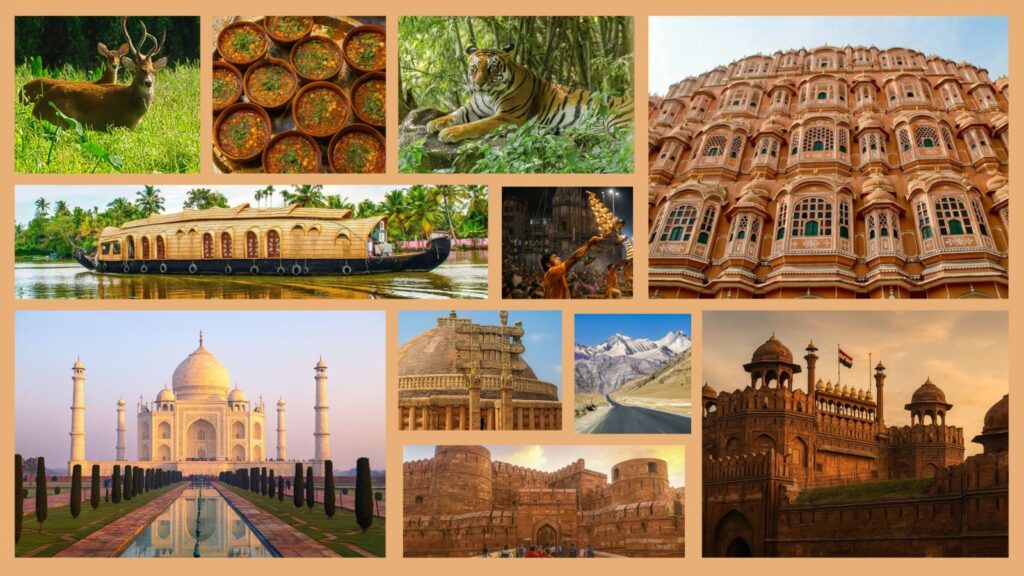
Taj Mahal Architecture – Secrets of monuments
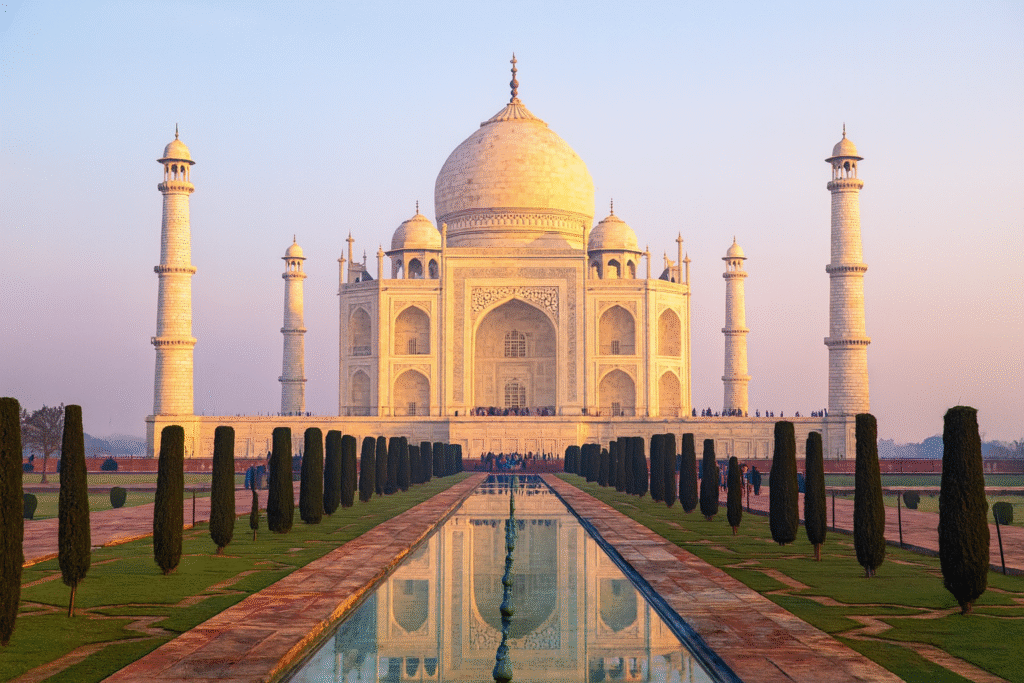
- Taj Mahal Architecture – Secrets of monuments
- Why Was the Taj Mahal Built? (Taj Mahal History)
- Taj Mahal Architecture ,Structural Engineering & Foreign Expertise
- Materials Used in the Taj Mahal – Origins & Secrets
- Dimensions of the Taj Mahal (Measurements & Design)
- Foundation Secrets of the Taj Mahal
- Quranic Inscriptions and Calligraphy in the Taj Mahal
- Construction Timeline of the Taj Mahal (1631–1653)
- Binding material for Taj Mahal – Lime Mortar
- Mysteries and Myths of the Taj Mahal (Hidden Facts)
- UNESCO World Heritage Status of the Taj Mahal
- Popular Myths – Were Workers’ Hands Cut Off?
- Taj Mahal Travel Guide 2025 – Tickets, Best Time & Tips
- How to reach Taj Mahal
- Luxury Hotels & Resorts Near the Taj Mahal, Agra
- FAQs of Taj Mahal
- Conclusion
Standing proudly on the banks of the Yamuna River in Agra, due to the architecture and design of the Taj Mahal, it is one of the Seven Wonders of the World and a UNESCO World Heritage Site (since 1983). Built in the 17th century, it still stands today as one of the greatest architectural marvels in history.
This guide brings you the complete story of the Taj Mahal in 2025—its history, architecture, foundation secrets, materials, myths, and everything you need to know before visiting.
Why Was the Taj Mahal Built? (Taj Mahal History)
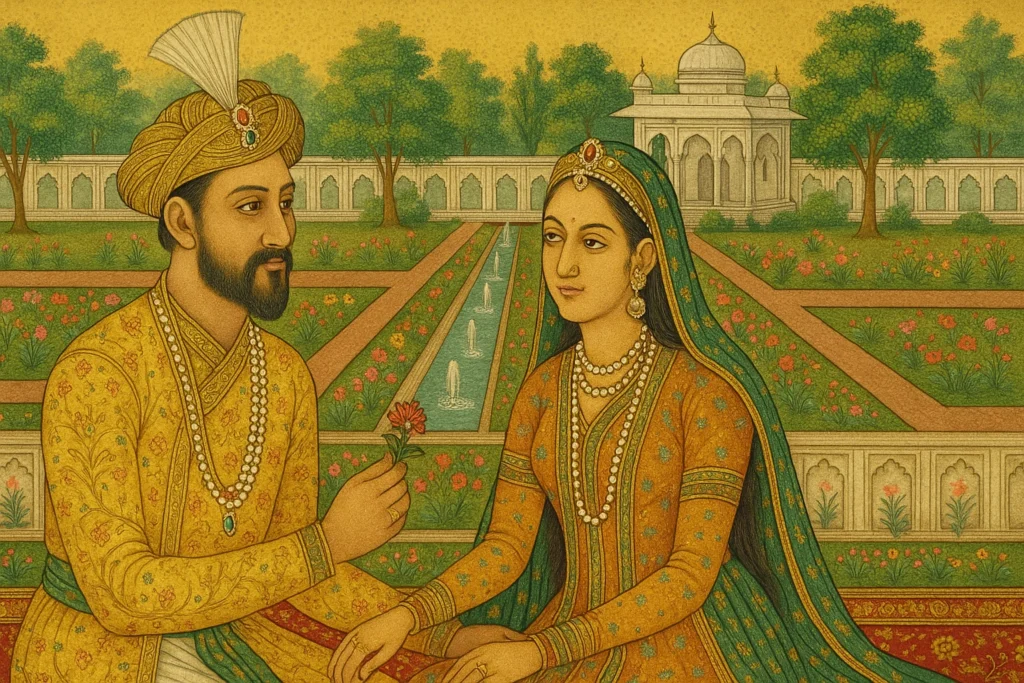
The Taj Mahal was started in 1632 CE by Shah Jahan in the memory of his wife, Mumtaz Mahal; her real name was Arjumand Bano Begum. She passed away on 17 June 1631 while giving birth to their 14th child. Heartbroken, Shah Jahan decided to build a grand mausoleum in her honour.
Nearly four centuries later, the Taj Mahal continues to symbolise eternal love and devotion, drawing millions of visitors from around the world.
Taj Mahal Architecture ,Structural Engineering & Foreign Expertise
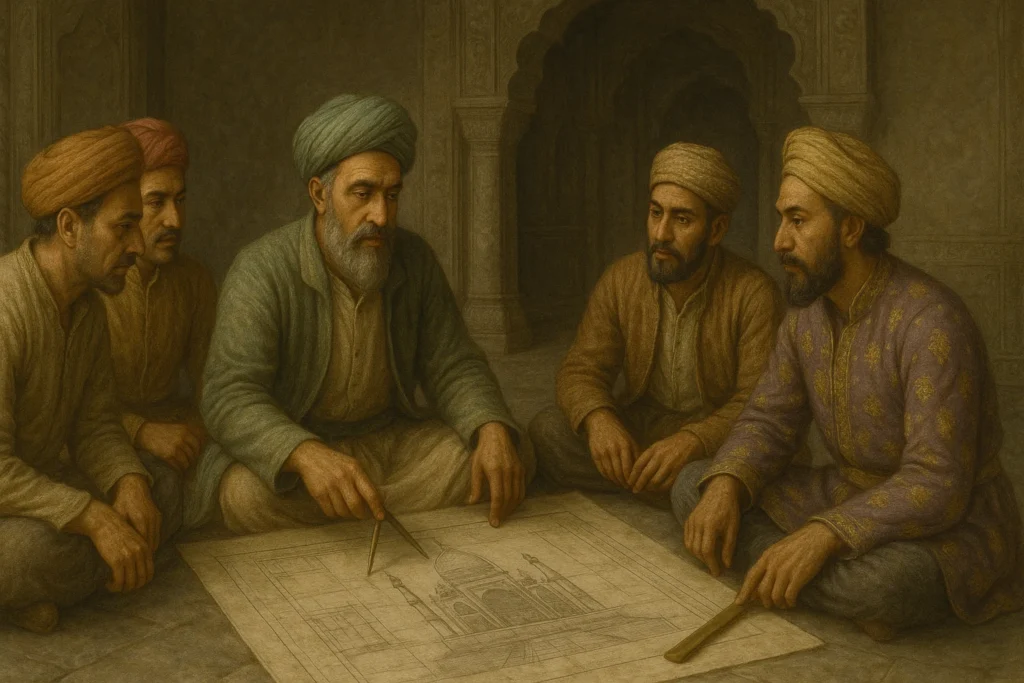
The Taj Mahal is not only a symbol of love but also a masterpiece of Mughal engineering and design. While Indian artisans did much of the stonework, the engineering brainpower came from a mix of Persian, Turkish, and Central Asian experts.
Key People Behind the Taj Mahal
Ustad Ahmad Lahauri (Persian origin) – Chief architect credited with the overall design.
Ismail Khan Rumi (Turkey) – Structural engineer from the Ottoman Empire (Rumi = from “Rome,” a term used for Ottoman lands).
Qazim Khan, Chiranjilal, Amanat Khan, and others – Metalwork, calligraphy, and ornamentation specialists
Samarkand artisans – Experts in mosaic tiling, geometric design, and dome proportions.
Turkish Contributions
Turkish engineers were masters of large-scale dome construction and earthquake-resistant designs, honed in Ottoman mosques like Hagia Sophia and Sultan Ahmed Mosque.
Key influences on the Taj:
Double Dome Engineering
The Taj’s main dome is 73 meters tall and uses a double-dome system:
- Outer dome for grandeur.
- Inner dome for acoustics and visual proportion inside.
This technique, perfected in Ottoman Turkey, was adapted for the Taj.
Earthquake Stability
The minarets are slightly tilted outward to prevent collapse onto the tomb during earthquakes — a Turkish engineering trick.
Arch and Load Distribution
Turkish engineers used pointed arches and squinches (curved supports) to evenly distribute the dome’s massive weight.
Samarkand Contributions
Samarkand (Uzbekistan) was a hub of Timurid architecture and inspired much of Mughal style:
Symmetry and Geometry
The Taj is a perfect bilateral symmetrical plan, a hallmark of Timurid architecture.
The “Charbagh” (four-part garden) design, originating in Persia and perfected in Samarkand, was used around the Taj.
Tile & Ornamentation Expertise
Craftsmen from Samarkand were specialists in mosaic tilework and floral motifs.
Their designs influenced the marble inlay (pietra dura) decoration on the Taj.
Proportion Science
The Taj’s 1:1 height-to-base ratio and its perfectly balanced elements are based on architectural knowledge developed in Samarkand.
How This Collaboration Worked
Shah Jahan invited over 20,000 artisans and specialists from Persia, Turkey, Samarkand, and India.
The Turkish structural engineers focused on dome construction, foundation, and stability.
Samarkand artisans concentrated on decoration, tile design, and proportional layout.
Indian craftsmen brought marble carving and calligraphy to life, making it a true fusion.
The Taj Mahal is essentially a fusion masterpiece:
Turkish brains for structure.
Samarkand brains for geometry and decoration.
Materials Used in the Taj Mahal – Origins & Secrets
The Taj Mahal is known for its design but tiny pieces of semi-precious stones were embedded into pure white marble, forming intricate floral and geometric designs .Which is called Pietra Dura inlay work. Materials were sourced from across India and beyond.
The white marble came from Makrana in Rajasthan, red sandstone from Fatehpur Sikri, jasper from Punjab, lapis lazuli from Afghanistan, turquoise from Tibet, and sapphires from Sri Lanka. Carnelian and agate arrived from Arabia and Persia, while diamonds were brought from the famous Golconda mines of Telangana.
In total, 28 different types of precious and semi-precious stones were used to give the Taj its unmatched brilliance, which shines differently under sunlight and moonlight.
Dimensions of the Taj Mahal (Measurements & Design)
The Taj Mahal’s design reflects perfect symmetry and proportion. The central dome rises to a height of 35 metres (115 ft), topped with a finial reaching 42 metres (138 ft). The four surrounding minarets each stand at 40 metres (130 ft).
The entire structure is set on a massive platform measuring 300 × 300 metres, surrounded by lush Charbagh gardens of equal size, divided into quadrants with flowing water channels. The main gateway, standing 30 metres high, adds grandeur to the entrance.
The precision in measurements and balance in design is what makes the Taj Mahal a masterpiece of Mughal architecture.
Foundation Secrets of the Taj Mahal
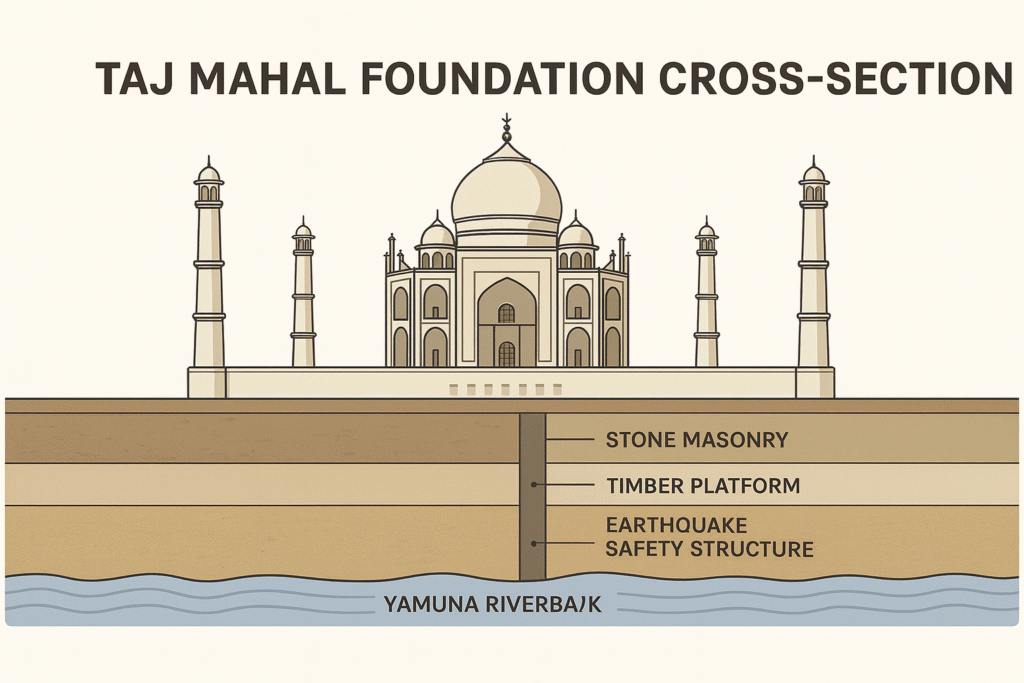
One of the Taj Mahal’s most fascinating secrets lies beneath the ground. The entire structure rests on a wooden foundation made of sissam (teak wood). Normally, wood weakens over time, but sissam becomes stronger when kept moist.
The Yamuna River, flowing nearby, continuously supplies the required moisture, ensuring the foundation remains solid even after 400 years. This unique engineering technique is why the Taj Mahal has survived earthquakes and natural calamities.
Quranic Inscriptions and Calligraphy in the Taj Mahal
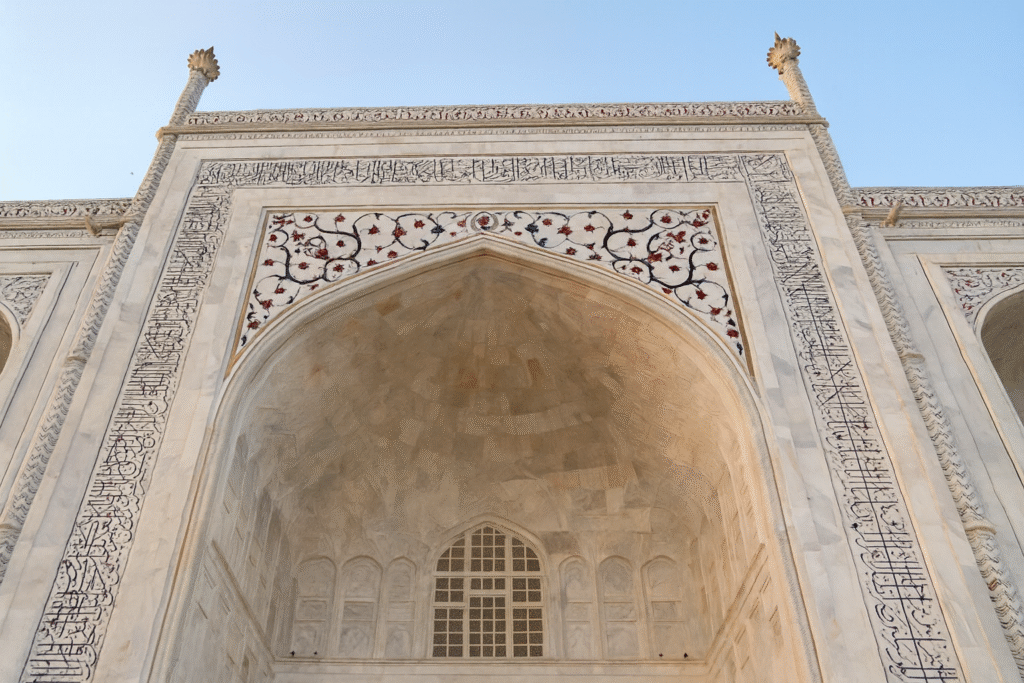
The Taj Mahal is decorated with 114 verses from the holy Quran, the master calligrapher Amanat Khan Shirazi used black marble. The inscriptions carry themes of paradise, eternity, and divine mercy.
An optical illusion makes the calligraphy even more fascinating—letters higher up are larger, so from the ground they appear perfectly uniform. These inscriptions add both spiritual depth and artistic beauty to the monument.
Construction Timeline of the Taj Mahal (1631–1653)
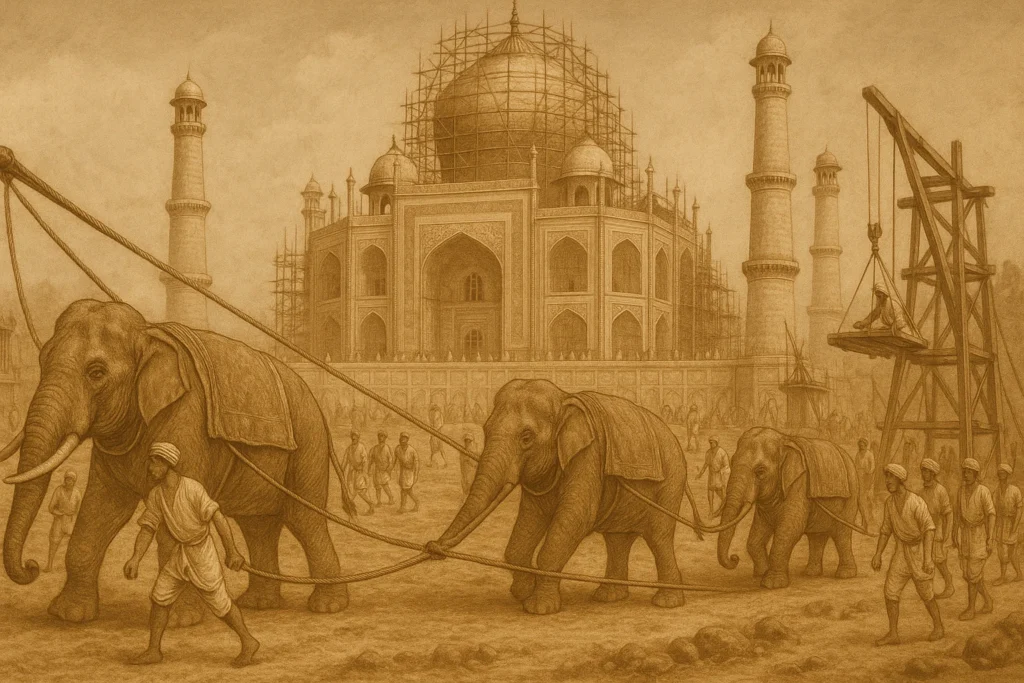
Construction of the Taj Mahal began in 1632 CE and continued for 22 years. They completed The main mausoleum by 1648, but the rest of the complex, as the mosque, guest house, and gardens, could be completed in 1653.
Around 20,000 artisans worked on the project, supported by 1,000 elephants and oxen that transported marble and stones from distant quarries. The sheer effort reflects the wealth, ambition, and engineering expertise of the Mughal Empire.
Binding material for Taj Mahal – Lime Mortar
Despite being built in the 17th century, the Taj Mahal still stands strong without modern cement. Instead, builders used Lime Mortar (Chuna + Surkhi mix), enhanced with natural additives.
This mixture contained lime, powdered bricks, jaggery (gur), bael fruit pulp, herbal extracts, and water from the Yamuna. The unique blend not only bound the stones firmly but also grew stronger with age, making it one of the reasons why the Taj Mahal has remained intact for centuries.
Mysteries and Myths of the Taj Mahal (Hidden Facts)
The Taj Mahal’s minarets have a clever design twist. They are built to tilt slightly outwards so that if an earthquake ever struck, they would topple away from the main dome, keeping the heart of the monument safe.
Legends speak of a Black Taj Mahal, supposedly planned by Shah Jahan across the Yamuna as his own mausoleum, but no evidence supports this claim. The cenotaphs inside the monument are symbolic; the real tombs of Shah Jahan and Mumtaz Mahal lie in the underground chamber.
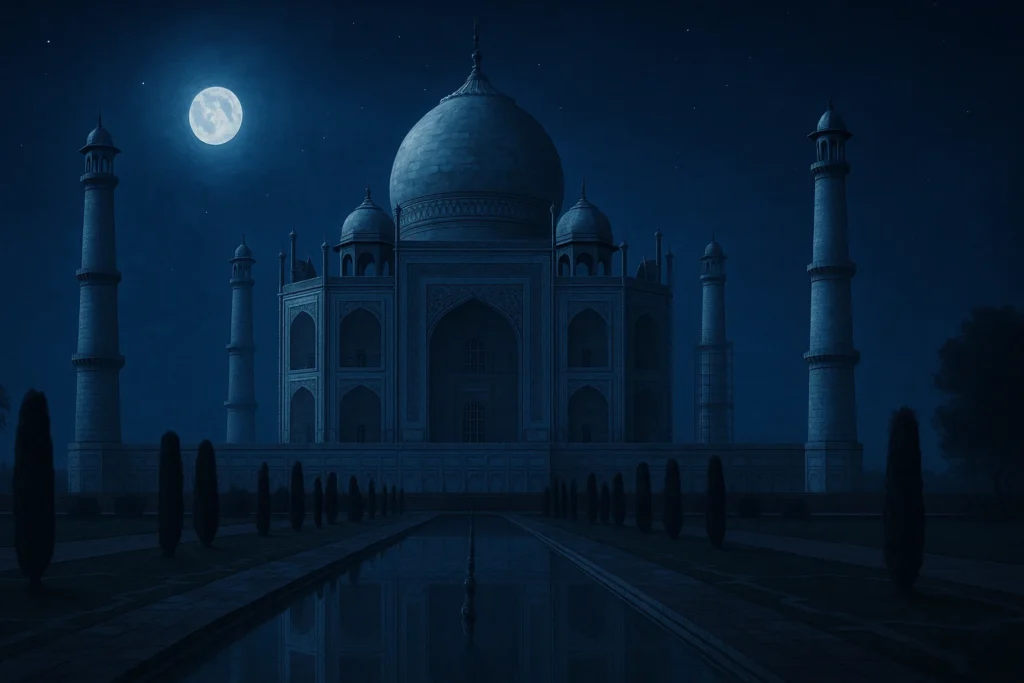
Perhaps most enchanting is the way the marble changes colour—pinkish in the morning, dazzling white during the day, golden at sunset, and silvery under a full moon.
UNESCO World Heritage Status of the Taj Mahal
UNESCO declared the Taj Mahal World Heritage Site in 1983. UNESCO called this a shining example of Mughal art in India and one of the most admired monuments in the world.
Today, the monument is carefully protected by the Archaeological Survey of India (ASI) to ensure its preservation for future generations.
Popular Myths – Were Workers’ Hands Cut Off?
One of the most famous stories claims that Shah Jahan ordered the hands of workers to be cut off so the Taj Mahal could never be recreated.
However, no evidence supports this. Mughal court records, including the Badshahnama, make no mention of such cruelty. Both UNESCO and the ASI confirm the story is a myth. In fact, artisans were rewarded with land, wealth, and titles. Amanat Khan Shirazi even signed his name on the monument, proof of the respect they received.
The truth is far more inspiring—the Taj Mahal was built not by fear but through skill, artistry, and honour.
Taj Mahal Travel Guide 2025 – Tickets, Best Time & Tips
The Taj Mahal welcomes visitors every day except Friday, from 6:00 AM to 6:30 PM. On nights with a full moon, as well as the two nights before and after, special night viewings are arranged for a magical experience of the monument under moonlight.
Regular Daytime Entry
Here’s the updated ticket information in table format:
| Visitor Category | Entry Fee (Taj Mahal Complex) | Extra Fee for Main Mausoleum* | Total (agar mausoleum jaana ho) |
|---|---|---|---|
| Indian / Indian Citizens / OCI Cardholders | ₹ 50 | ₹ 200 | ₹ 250 |
| Foreign Nationals | ₹ 1,100 | ₹ 200 | ₹ 1,300 |
| Citizens of SAARC / BIMSTEC Countries | ₹ 540 | ₹ 200 | ₹ 740 |
The Main Mausoleum refers to the inside of the Taj Mahal, where the cenotaphs of Shah Jahan and Mumtaz Mahal are located. Access to this area requires a separate fee.
Children (below 15 years)
Night Viewing
There’s also a night view option for the Taj Mahal, though it’s restricted to specific nights, such as those around the full moon. The pricing is as follows:
Visitor Category
Night Viewing Fee
Indian Adults – ₹ 510
Foreign Adults – ₹ 750
Children (3-15 yrs, both Indian & Foreign) – ₹ 500
The best time to visit is between October and March, when the weather is pleasant. Early mornings are ideal for photography and avoiding crowds, while the summer months from April to June should be avoided due to extreme heat.
Visitors are advised to book tickets online via the ASI’s official do not carry Large bags, food, and tripods with you. Hiring a professional guide is highly recommended, and the visit is best combined with nearby attractions such as Agra Fort and Fatehpur Sikri.
How to reach Taj Mahal
To reach the Taj Mahal, you can use air, train, or bus. Here’s a breakdown of the best ways for each mode of transport:
By Air
Nearest Domestic Airport: The closest airport to the Taj Mahal is Agra Airport (AGR), also known as Pandit Deen Dayal Upadhyay Airport, located about 7-13 km away. It handles domestic flights from major Indian cities like New Delhi.
Nearest International Airport: The nearest major international airport is the Indira Gandhi International Airport (DEL) in New Delhi, approximately 200-210 km from Agra. From there, you can take a domestic flight to Agra or travel by train or road.
From Agra Airport (AGR): Taxis and auto-rickshaws are readily available outside the terminal. A taxi ride to the Taj Mahal usually takes 15-30 minutes, depending on traffic.
By Train
Nearest Railway Stations: Agra has several railway stations, with two being most convenient for tourists:
Agra Fort Railway Station (AF): This is the closest station to the Taj Mahal, about 2.8-4 km away. It’s ideal for those traveling from Rajasthan.
Agra Cantonment Railway Station (AGC): This is the main railway hub in Agra, connecting to all major cities in India. It is about 6 km from the Taj Mahal.
From Agra Railway Stations: You can easily hire a taxi, auto-rickshaw, or cycle rickshaw from outside either station to reach the Taj Mahal.
By Bus
Agra is well-connected by bus to major cities like Delhi and Jaipur. The main bus terminals are Idgah Bus Stand and the Agra ISBT.
The journey from Delhi to Agra by bus on the Yamuna Expressway takes about 4 hours.
From either the Idgah Bus Stand or the Agra ISBT, you can hire a local taxi or auto-rickshaw to reach the Taj Mahal, as they are both about a 10-15 minute ride away.
Luxury Hotels & Resorts Near the Taj Mahal, Agra
A visit to the Taj Mahal becomes even more memorable with a luxury stay in Agra.
The Oberoi Amarvilas, Agra ↗ is located just 600 metres from the monument. Every room offers a direct view of the Taj, along with private balconies, Mughal-inspired gardens, fine dining, and a luxury spa—perfect for honeymooners and those seeking unmatched luxury.
ITC Mughal, A Luxury Collection Resort & Spa ↗ is spread over 35 acres of lush gardens. With its award-winning Kaya Kalp Spa, opulent suites, and heritage-inspired design, it is ideal for families and travellers who want comfort blended with tradition.
Taj Hotel & Convention Centre, Agra ↗ is located near the East Gate and offers modern facilities, including 239 luxury rooms, a convention centre, and an infinity pool with views of the Taj Mahal. Luxury Tip: Average tariffs range from ₹12,000 – ₹45,000 per night, depending on the season. Always book directly through the official websites of these hotels for the best deals.
To get more from us Visit our Blog Page ↗
FAQs of Taj Mahal
Who designed the Taj Mahal and who were its architects
The Taj Mahal was commissioned by Mughal Emperor Shah Jahan in memory of his wife Mumtaz Mahal, but it wasn’t designed by a single person. Instead, it was the work of a team of master architects and craftsmen.
The chief architect is most often credited as Ustad Ahmad Lahauri, a Persian architect who was part of the Mughal court. Historical records also mention several others who played important roles, including:
Ustad Isa Shirazi and Isa Afandi – said to have contributed to the planning and design.
Mir Abdul Karim and Makramat Khan – served as project managers.
Amanat Khan – calligrapher responsible for the beautiful inscriptions.
Ustad Ahmad Lahauri’s team – included sculptors, stonecutters, inlayers, and craftsmen from across the Mughal empire and Central Asia.
So the Taj Mahal’s architecture was the result of a collaborative effort blending Persian, Indian, and Islamic traditions, with Ustad Ahmad Lahauri generally regarded as the principal designer.
This shows how monumental architecture in that era was never a one-man show but a symphony of skills and cultures.
How is symmetry and geometry reflected in the design of the Taj Mahal?
Symmetry and geometry are the very heart of the Taj Mahal’s design. The whole complex is built on the principle of perfect bilateral symmetry, meaning if you split it down the middle, both halves mirror each other almost exactly.
The central dome is flanked by four smaller domes, and the main white marble mausoleum is perfectly balanced with four tall minarets at each corner of the plinth.
The charbagh garden (four-part garden) is laid out in geometric precision, divided by water channels into equal quadrants, symbolising the Islamic idea of paradise.
Every façade, arch, and decorative element is mathematically aligned; for example, the calligraphy on the entrance gate was designed with precise scaling so that it appears uniform when viewed from below.
The overall layout follows a grid system, ensuring harmony between the mausoleum, mosque, guest house, and reflecting pools.
This meticulous use of symmetry and geometry doesn’t just make the Taj Mahal beautiful—it gives it a sense of balance, harmony, and timeless perfection, almost as if it were designed to represent eternal love in physical form.
What is the symbolic importance of the Charbagh (four-part garden) layout of the Taj Mahal?
The charbagh (four-part garden) of the Taj Mahal symbolises the Islamic concept of paradise as described in the Quran—a garden with four rivers flowing from a central source, representing water, milk, honey, and wine. Its perfect symmetry and geometry reflect order, harmony, and the eternal balance of the universe. The layout also directs the visitor’s eye towards the mausoleum, making the tomb of Mumtaz Mahal appear as the central jewel of paradise on earth.
It’s essentially not just a garden, but a metaphorical gateway to heaven, reinforcing the Taj Mahal’s role as a monument of eternal rest and love.
What is the structural and religious significance of the dome and minarets?
The dome of the Taj Mahal, often called the “onion dome,” has both structural and religious meaning. Structurally, its double-dome design distributes weight evenly and creates a lofty interior space, giving the impression of vastness and grandeur. Religiously, the dome symbolises the vault of heaven, making the tomb feel like a sacred link between earth and paradise.
The four minarets at each corner of the platform serve both engineering and spiritual purposes. Structurally, they were built with a slight outward tilt so they would fall away from the mausoleum in case of collapse. Religiously, minarets are traditional in Islamic architecture, used for the call to prayer, and here they frame the tomb as if guarding it, reinforcing its sanctity.
Together, the dome and minarets turn the Taj Mahal into a cosmic image of paradise—a heavenly palace built in stone.
What were the engineering aspects of the Taj Mahal’s construction, especially its foundation and weight distribution?
The Taj Mahal’s engineering is as brilliant as its beauty. Shah Jahan’s builders had to solve enormous structural problems to make sure the monument could stand for centuries.
Foundation:
The Taj Mahal sits on the banks of the Yamuna River, where the soil is soft and unstable. To prevent sinking, engineers built a deep foundation of stone and rubble, supported by wells filled with stone and iron. These acted like shock absorbers, stabilising the weight of the huge marble structure.
Weight Distribution:
The central dome weighs thousands of tonnes. To handle this, the builders used a double-dome system: an inner dome for structural support and an outer dome for height and grandeur. This reduced pressure inside while keeping the monumental look outside.
The entire complex is raised on a huge marble plinth (platform). This distributes the building’s weight evenly and protects it from flooding. The four minarets around the mausoleum were designed with a slight outward tilt, so in case of an earthquake, they would fall away from the main tomb instead of crashing onto it.
Together, these clever techniques made the Taj Mahal not only a wonder of art but also a marvel of medieval engineering.
After becoming a UNESCO World Heritage Site, what preservation and conservation challenges does the Taj Mahal face
After becoming a UNESCO World Heritage Site (in 1983), the Taj Mahal faces several preservation and conservation challenges:
Air Pollution and Discolouration
Industrial emissions, vehicle exhaust, and smoke from nearby activities release sulphur dioxide and other pollutants. When these mix with moisture, they cause acid rain, which slowly erodes the marble. Dust and microscopic particles also give the white marble a yellowish or brownish tint.
River Yamuna’s Decline
The Taj Mahal’s foundation depends on moisture from the Yamuna River. With the river drying and becoming polluted, the wooden foundation beams risk drying out and weakening, which threatens the monument’s stability.
Tourism Pressure
Millions of visitors each year cause wear and tear. Foot traffic, touching of surfaces, and even carbon dioxide from breathing in enclosed spaces add up over time.
Conservation Work
Restoration efforts use “multani mitti” (Fuller’s earth) clay packs to clean the marble, but constant cleaning itself risks weakening the stone. Balancing restoration with preservation remains a challenge.
Climate Change
Rising temperatures, heavier monsoons, and unpredictable weather patterns increase stress on the structure and gardens, requiring constant maintenance.
So the Taj Mahal today is not just a masterpiece of Mughal architecture, but also a fragile patient under constant medical care by conservation scientists and engineers.
For more details visit Agra Tourism Website ↗
Conclusion
The Taj Mahal is far more than just a tomb—it is a living symbol of love, artistry, and engineering brilliance. From its wooden foundation nourished by the Yamuna, its colour-changing marble, its 114 Quranic verses, to its 28 types of precious stones, every element tells a story of devotion.
For travellers, historians, and romantics alike, the Taj Mahal in 2025 remains a must-visit destination—an eternal reminder that true love leaves a mark no time can erase.

Mussoorie local culture: 3 Fake Myths to Avoid [2026]
Mussoorie local culture: Exploring authentic traditions beyond the common myths Last Updated on 29 March…
Best Food in Mussoorie: Locals’ Hidden Cafes & Secrets 2026
Best Food in Mussoorie: Discovering Hidden Culinary Gems and Iconic Landour Bakes Last Updated on…

Kerala Houseboat Booking Price 2026: Deluxe vs Luxury Guide
Kerala Houseboat Rates, Amenities & Packages 2026: Deluxe, Premium & Luxury Guide Last Updated on…
Mussoorie Trip Plan 2026 (Find Peace via Secret Walks)
Mussoorie Trip Plan 2026: A Guide to Skip Traffic and Walking Secrets Last Updated on…

Lakshadweep Entry Permit Online 2026: 5 Easy Steps to Apply!
How to Secure Your Lakshadweep Entry Permit Online: The Complete 2026 Planner & Travel Requirements…

Lakshadweep Local Life: 9 Reality Checks & Best Souvenirs
Lakshadweep Local Life: 9 Reality Checks, Economy Facts & Shopping Guide Last Updated on 7…